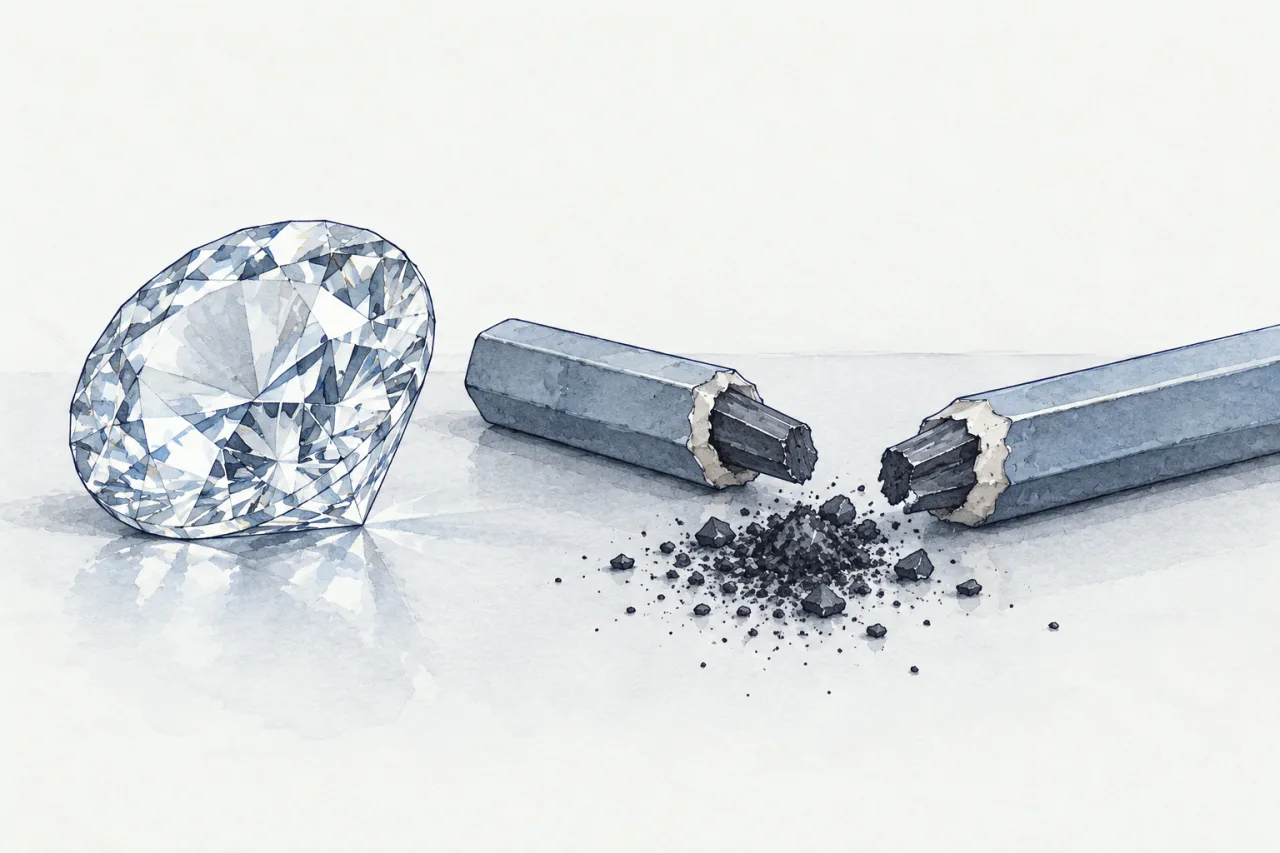
A diamond-tipped saw cuts through granite. The "lead" in a pencil is so soft that it rubs off onto paper as a grey line. Yet both are pure carbon: burn either one in plenty of oxygen and the only product is carbon dioxide. Same atoms, very different solids. In this part you'll test diamond and graphite side by side, find out how their atoms are joined, and see how that explains what each one is used for.
 (enlarge)
Predict, then test
On the bench are four solids: a diamond, a graphite rod, a quartz crystal and a strip of copper. Each one goes through three tests:
- Glass: draw it across a glass slide. A harder solid scratches the glass; a softer one doesn't.
- Bulb: touch it with the two contacts of a circuit. If the solid conducts electricity, the bulb lights.
- Hammer: hit it hard on a steel block and see whether it breaks, crumbles or changes shape.
Diamond and graphite are both carbon. Will they behave the same way? Make your prediction, then test the samples. After each result, look at the solid through the magnifier.
What the tests show
Diamond scratches the glass but leaves the bulb dark. Graphite does the opposite: it leaves a soft grey smear on the glass, and it lights the bulb. Under the hammer, graphite crumbles into flakes. Quartz behaves like diamond at the glass and the bulb, and it shatters under the hammer. Copper leaves no mark on the glass, lights the bulb, and flattens under the hammer without breaking.
The atoms alone can't explain this: diamond and graphite have the same atoms. What differs is how the atoms are joined.
Diamond: a giant network
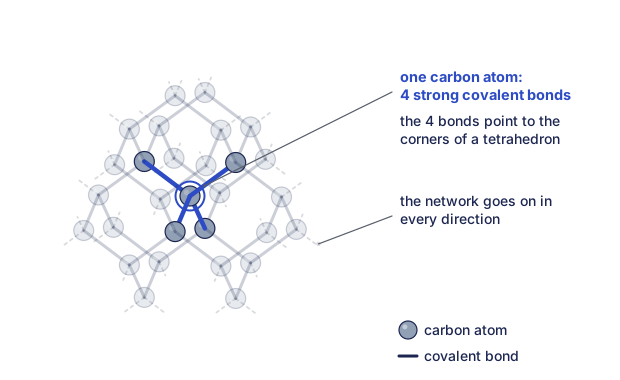
In diamond, every carbon atom forms four covalent bonds, one to each of four other carbon atoms. The four bonds point away from each other, to the corners of a tetrahedron. Each of those neighbours is bonded to four carbon atoms in the same way, and so on, in all three directions, through the whole crystal.
 (enlarge)
There are no separate molecules in diamond. The whole crystal is one network of atoms held by strong covalent bonds: a giant covalent structure. To scratch diamond, or to melt it, you'd have to break a great many of these strong bonds. That's why diamond is the hardest natural substance and has a very high melting point.
Each carbon atom has four outer electrons, and all four are used in its four bonds. So diamond has no electrons free to move, and no ions: it does not conduct electricity.
Trap: "Diamond has a high melting point because of strong intermolecular forces." Diamond has no separate molecules, so there are no intermolecular forces to overcome. Melting diamond means breaking strong covalent bonds, and that needs a lot of energy.
Graphite: layers
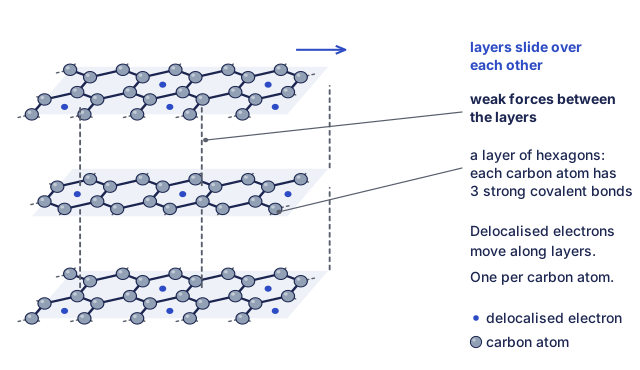
In graphite, every carbon atom forms three covalent bonds, to three other carbon atoms in the same flat layer. The atoms make a pattern of hexagons, like a honeycomb, and each layer is a giant covalent structure of its own. The layers are stacked one above another, held together only by weak forces.
 (enlarge)
Because the forces between the layers are weak, the layers can slide over each other and flake off. That's why graphite feels slippery and leaves a smear on the glass, or a line on paper.
Each carbon atom uses only three of its four outer electrons in bonds. The fourth electron isn't held between two particular atoms: it is delocalised, free to move along the layer. These moving electrons carry an electric current, so graphite conducts electricity.
Trap: "Graphite is soft because its covalent bonds are weak." The covalent bonds inside each layer are strong; that's why graphite also has a very high melting point. What is weak is the force between the layers, so the layers slide apart easily.
Uses that follow from the structure
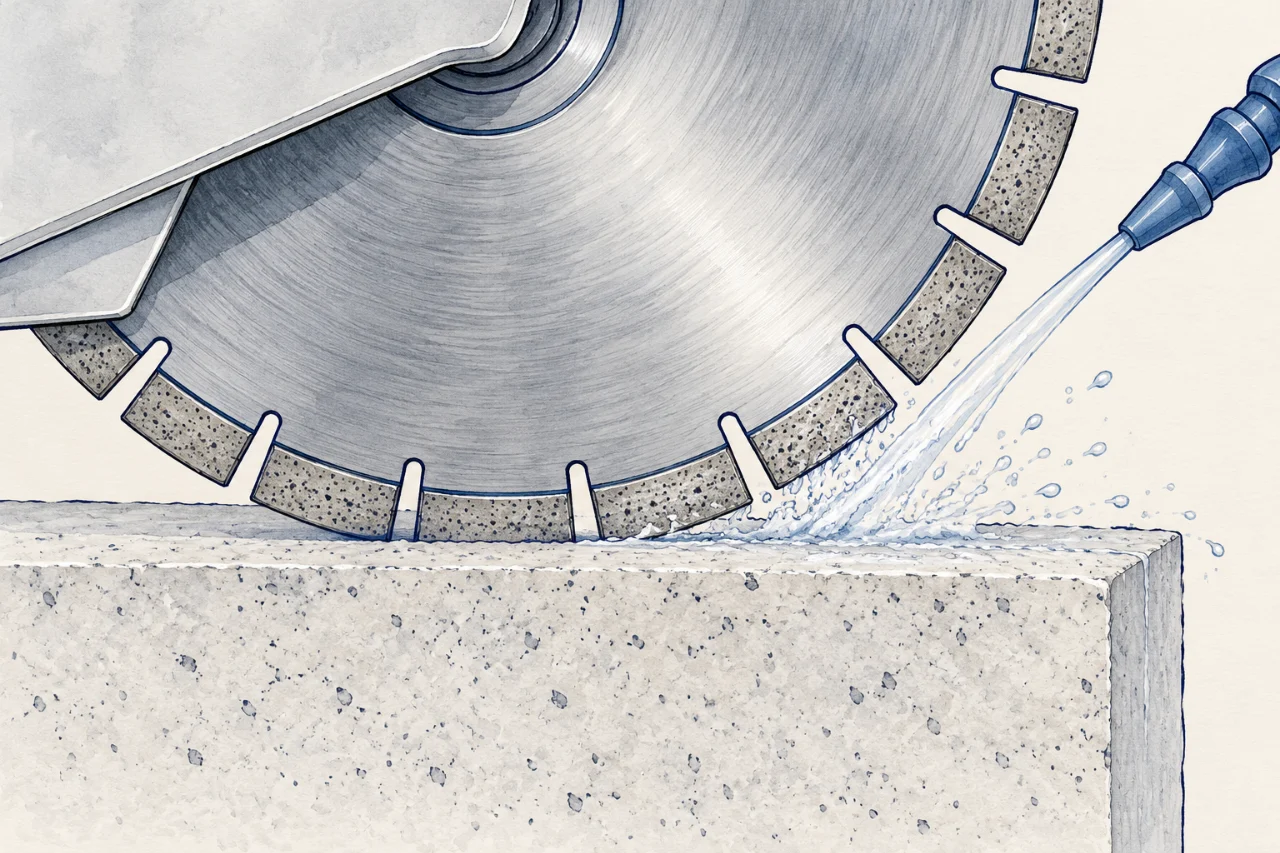
- Diamond in cutting tools. Diamond is harder than any rock or metal it cuts, because scratching it would mean breaking strong covalent bonds in all directions. Saw blades for stone, drill tips and glass cutters are tipped with small diamonds.
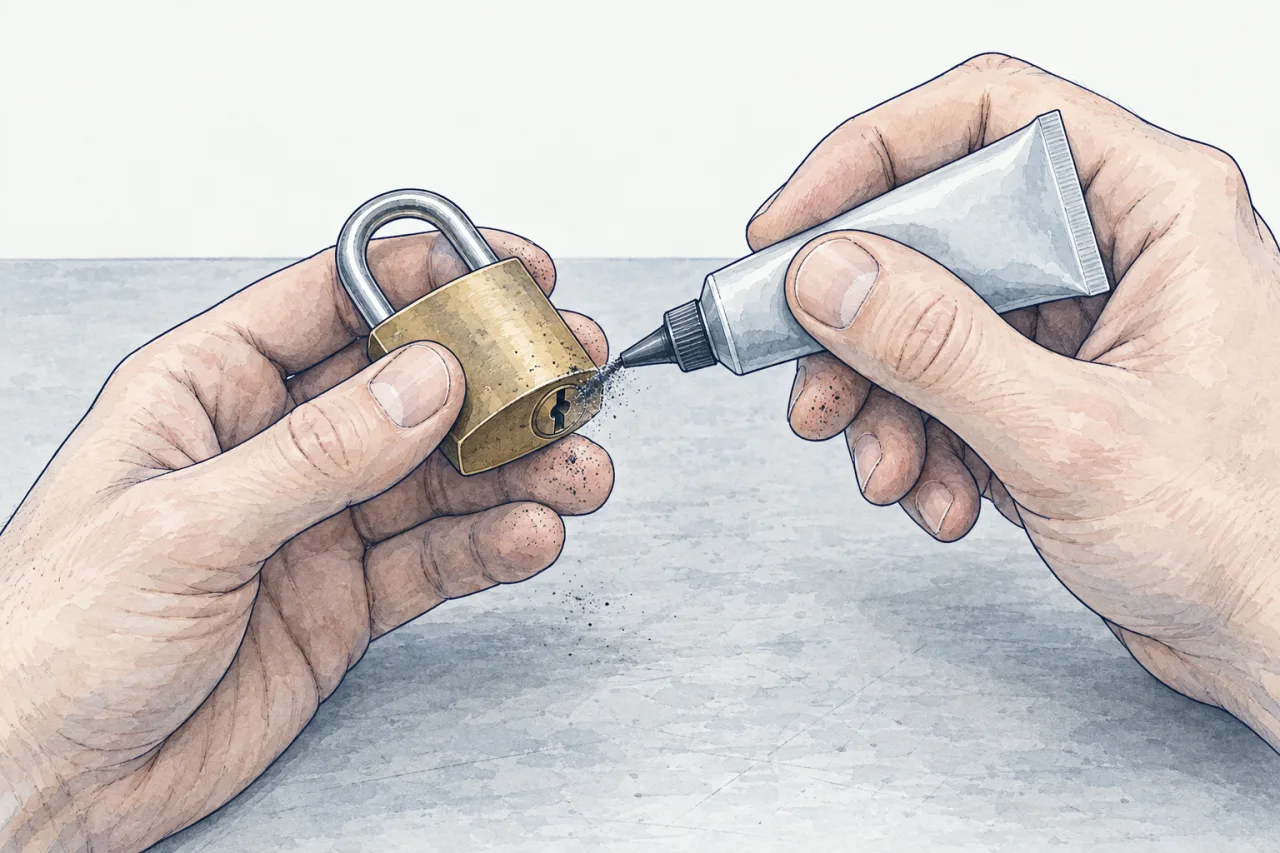
- Graphite as a lubricant. Its layers slide over each other easily, so graphite powder lets moving metal parts, such as the pins in a lock, slide past each other.
- Graphite as an electrode. An electrode is a solid conductor that carries a current into a liquid or out of it. Graphite conducts because of its delocalised electrons, and its strong covalent bonds give it a very high melting point, so it stays solid even in a hot molten compound. You'll use graphite electrodes for electrolysis in topic 4.
 (enlarge)
 (enlarge)
Key idea: Diamond and graphite are both giant covalent structures of carbon atoms. In diamond, each atom forms four strong covalent bonds in a three-dimensional network, so diamond is very hard and is used in cutting tools, and with no electrons free to move it does not conduct. In graphite, each atom forms three bonds in flat layers; the layers are held by weak forces and slide over each other, so graphite is a lubricant, and the fourth outer electron of each atom is delocalised, so graphite conducts and is used as an electrode.
Worked example
Pencil lead and glass cutter
A pencil "lead" is made of graphite mixed with clay. A glass cutter has a tiny diamond at its tip. Use the structures of graphite and diamond to explain why each is suited to its job.
In graphite, each carbon atom has three strong covalent bonds within a flat layer, and the layers are held together by weak forces. When the pencil is drawn across paper, the layers slide over each other and flake off, leaving a grey line. In diamond, each carbon atom has four strong covalent bonds in a three-dimensional network. Scratching diamond would mean breaking many strong bonds, so diamond is harder than glass and scratches it instead of being scratched.
Worked example
Why graphite, not diamond, is an electrode
An electrode must conduct electricity. Explain why graphite can be used as an electrode and diamond cannot.
To conduct, a substance needs charged particles that can move. In graphite, each carbon atom uses three of its four outer electrons in covalent bonds; the fourth is delocalised and free to move along the layers, so graphite conducts. In diamond, each carbon atom uses all four outer electrons in its four covalent bonds, so no electrons are free to move, and diamond does not conduct.
Supplement: silicon(IV) oxide
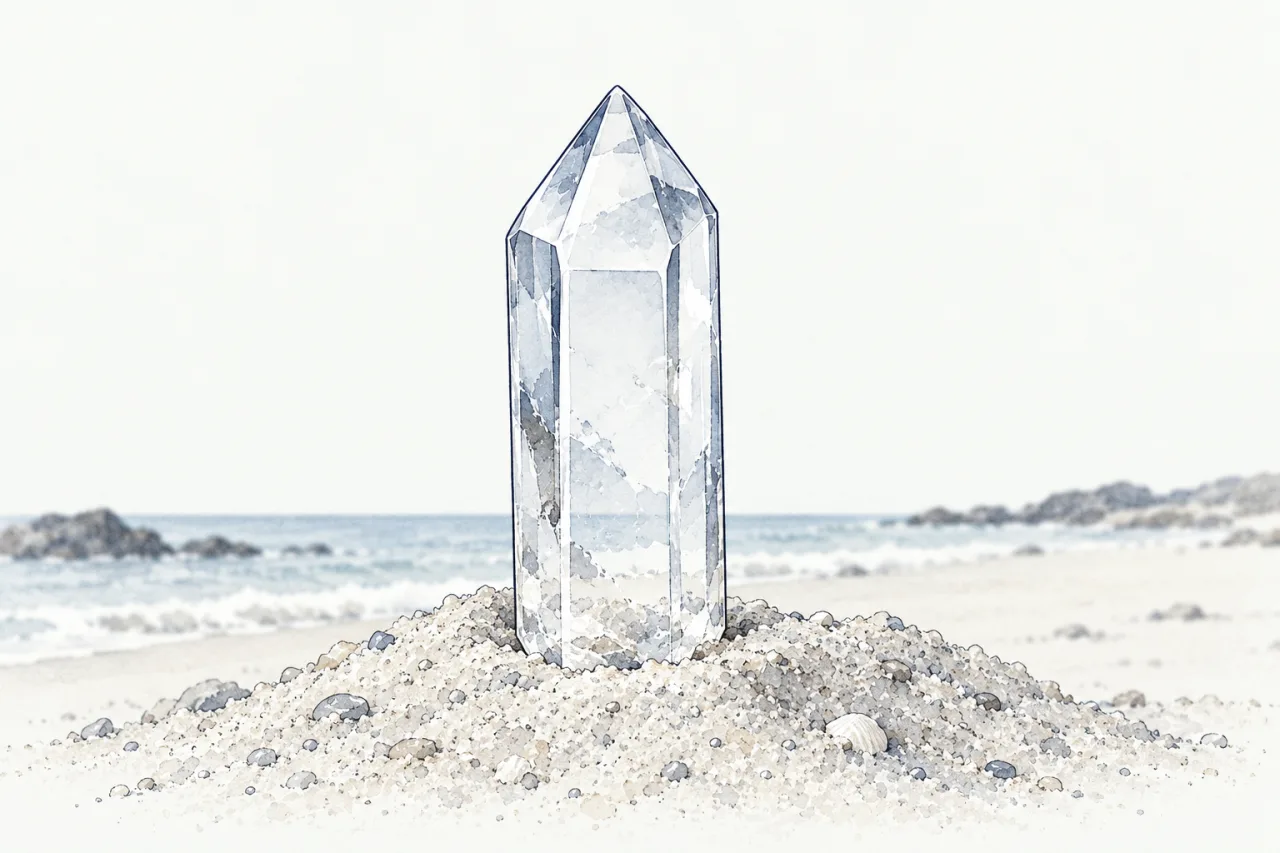
Sand, and the clear quartz crystals found in rocks, are mostly silicon(IV) oxide, SiO2, also called silica. Like diamond, it scratches glass, it doesn't conduct electricity, and it has a very high melting point, about 1700 °C.
 (enlarge)
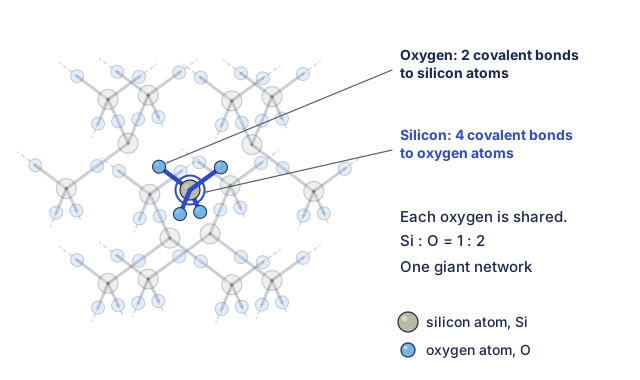
Silicon(IV) oxide is a giant covalent structure too. Each silicon atom forms four covalent bonds, each one to an oxygen atom, and each oxygen atom forms two covalent bonds, each one to a silicon atom. The silicon atoms sit in a network like the carbon atoms in diamond, with an oxygen atom between every pair of silicon atoms. Count them: each silicon atom has four oxygen atoms round it, but each oxygen atom is shared by two silicon atoms, so there are twice as many oxygen atoms as silicon atoms, and the formula is SiO2.
 (enlarge)
Trap: "Silicon(IV) oxide is made of SiO2 molecules, like carbon dioxide is made of CO2 molecules." Carbon dioxide is a gas of small separate molecules. Silicon(IV) oxide has no separate molecules: SiO2 only gives the ratio of atoms in one giant network, 1 silicon to 2 oxygen.
Supplement: diamond and silicon(IV) oxide alike
Diamond and silicon(IV) oxide have similar properties because they have similar structures:
| Property | Diamond | Silicon(IV) oxide | Why |
|---|---|---|---|
| Hardness | very hard | very hard | scratching breaks strong covalent bonds, which run in all directions |
| Melting point | very high | very high, about 1700 °C | melting breaks many strong covalent bonds |
| Electrical conductivity | none | none | no ions and no delocalised electrons: no charged particles free to move |
Both are giant covalent structures in which every atom is held by strong covalent bonds pointing in all three directions. That's why quartz grit has long been used on sandpaper, and why diamond dust is used to grind and polish the hardest materials.
Worked example
Quartz and diamond (Supplement)
Quartz scratches glass and does not conduct electricity, just like diamond. Describe the structure of silicon(IV) oxide, and use it to explain why quartz and diamond have these properties in common.
Silicon(IV) oxide is a giant covalent structure: each silicon atom is covalently bonded to four oxygen atoms, and each oxygen atom to two silicon atoms, in a three-dimensional network. Diamond is a giant covalent structure too, with each carbon atom bonded to four others. In both, scratching the solid means breaking many strong covalent bonds that run in all directions, so both are very hard. In both, the electrons stay in bonds or on their own atoms, and there are no ions, so neither has charged particles that can move: neither conducts.
Case closed
Diamond and graphite are both carbon, but their atoms are joined differently. In diamond, every carbon atom has four strong covalent bonds in a three-dimensional network, so diamond scratches glass, is used to cut stone, and has no electrons free to move, so it doesn't conduct. In graphite, every carbon atom has three strong bonds within a flat layer, and the layers are held by weak forces, so they slide over each other: graphite smears, writes on paper and works as a lubricant. Its fourth outer electrons are delocalised, so graphite conducts and is used for electrodes.
About this model
The glass test compares hardness: a solid scratches anything softer than itself. Glass is harder than copper and graphite, softer than quartz and diamond. Real diamonds are expensive, so in a school laboratory the diamond would be a glass cutter's tip. The bench doesn't hammer the diamond: very hard isn't the same as unbreakable, and a sharp blow can split a diamond crystal. Diamond doesn't melt in air: it burns above about 800 °C. The diagrams show only a few atoms of structures that go on in every direction, and the atoms aren't to scale; their colours are only labels. Graphite's delocalised electrons are drawn as dots, but each is spread over its layer, and graphite conducts much better along its layers than across them. The silicon(IV) oxide diagram puts the silicon atoms exactly where carbon atoms are in diamond; in quartz the network is twisted, but every silicon atom still has four oxygen atoms and every oxygen atom two silicon atoms.
For teachers: Core 2.6.1–2.6.2; Supplement 2.6.3–2.6.4, the sections "Supplement: silicon(IV) oxide" and "Supplement: diamond and silicon(IV) oxide alike" and worked example W03 (Cambridge 0620 syllabus, p14).