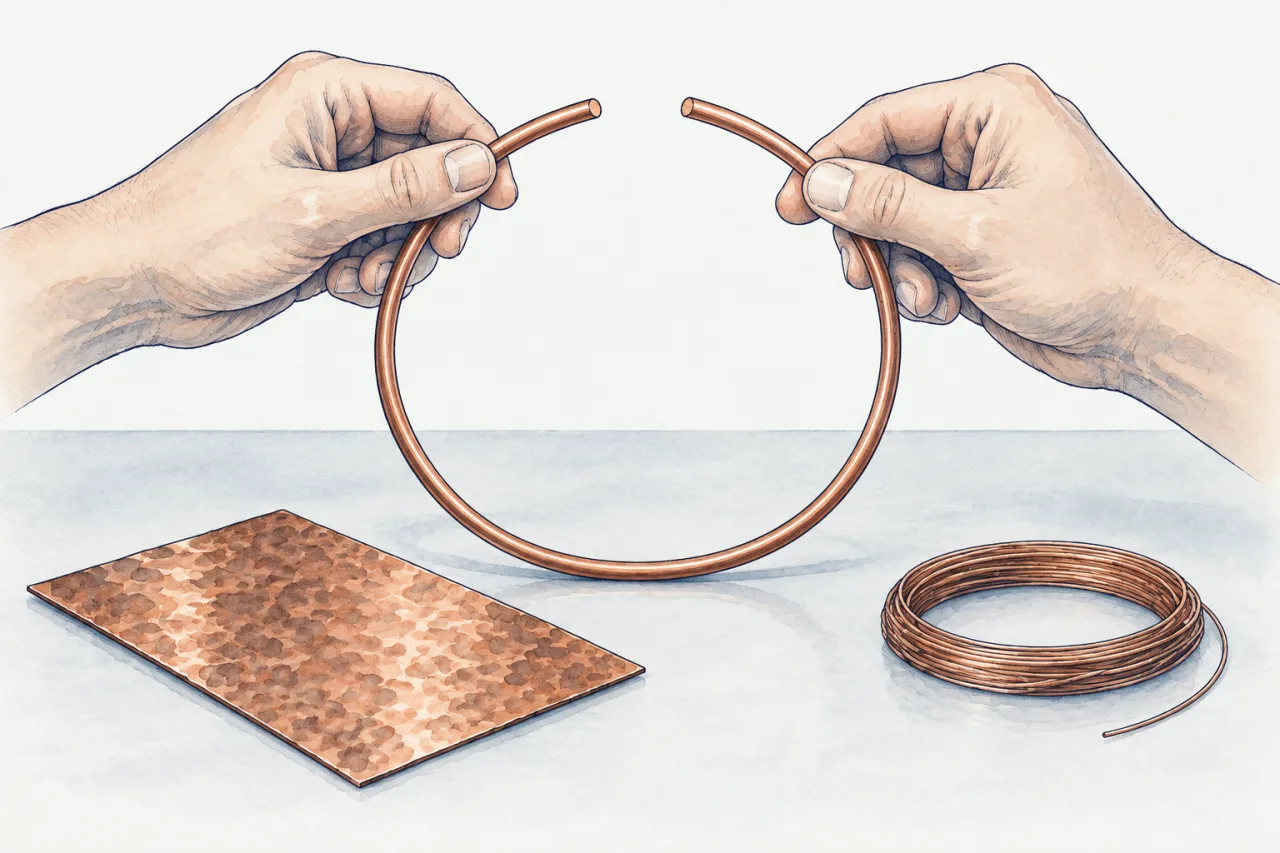
Take a thick copper wire in both hands and you can bend it into a loop. A copper sheet can be hammered into a bowl, and copper can be pulled into wire thinner than a hair. All the while, it carries an electric current. Hit a quartz crystal like that and it shatters. So what holds the particles of a metal together, so firmly that the metal stays in one piece, yet in a way that lets it bend and conduct? In this part you'll look inside the copper strip from the bench. This whole part is Supplement: for pupils taking the Extended papers.
 (enlarge)
What the copper did
On the bench, the copper strip left no mark on the glass, but it lit the bulb, like graphite. Under the hammer it didn't crumble like graphite or shatter like quartz: it flattened, and stayed in one piece. These are the properties of metals: they conduct electricity, and they change shape without breaking.
Metallic bonding
Metal atoms have only a few electrons in their outer shell. In a solid metal, each atom's outer electrons leave it, and the atoms become positive ions. The ions are packed in a regular arrangement of rows and layers that goes on through the whole piece of metal: a giant metallic lattice.
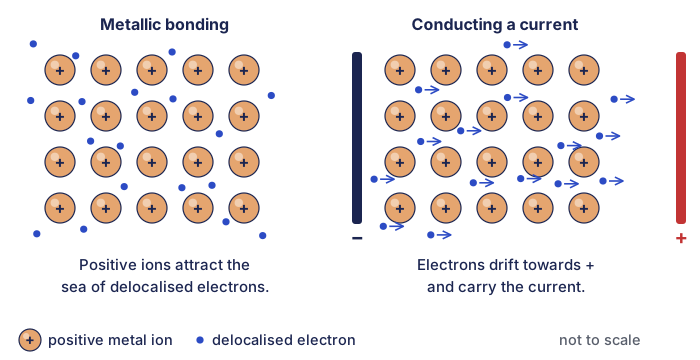
The electrons that left the atoms don't belong to any one ion. They are delocalised: free to move through the whole lattice, like a "sea" of electrons round the ions. Each positive ion attracts the negative electrons around it, and the electrons attract the ions.
Metallic bonding is the electrostatic attraction between the positive ions in a giant metallic lattice and the "sea" of delocalised electrons. It acts in all directions and holds the whole lattice together.
 (enlarge)
Trap: "A metal is held together by the attraction between positive ions and negative ions." A metal has no negative ions. The negative charge is the sea of delocalised electrons, which belong to the whole lattice, not to any one atom.
Why metals conduct electricity
An electric current is a flow of charge, so a conductor needs charged particles that can move. In a metal, the delocalised electrons move freely through the lattice. Connect the metal to a cell, and the electrons drift through it towards the positive terminal: that flow is the current. Metals conduct when solid and when molten, because the sea of electrons is there in both.
Trap: "Metals conduct because their ions move." In a solid metal the positive ions stay in their places in the lattice. The current is carried by the delocalised electrons.
Why metals are malleable and ductile
A metal is malleable: it can be hammered or pressed into a new shape without breaking. It is also ductile: it can be pulled out into a wire.
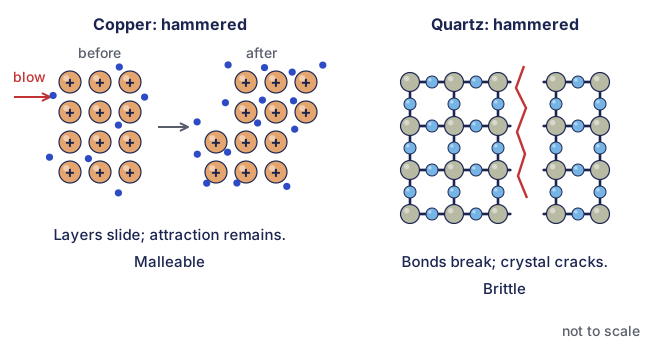
The ions in a metal lie in layers. A hard enough push makes the layers slide over each other. After sliding, every ion is still surrounded by the sea of delocalised electrons, so the attraction still holds the lattice together. The metal changes shape instead of breaking.
 (enlarge)
Quartz is different. Each covalent bond joins two particular atoms in a fixed direction. Atoms can't slide to new places without breaking those bonds, so a hard blow breaks them and the crystal cracks.
Trap: "Metals bend easily because metallic bonding is weak." Metallic bonding is strong: most metals have high melting points. The layers can slide because the attraction to the electron sea doesn't tie any ion to particular neighbours, so it holds the ions together wherever they slide to.
Worked example
Metallic bonding in magnesium
Magnesium is in Group II, so each magnesium atom has two outer electrons. Describe the bonding in solid magnesium.
Each magnesium atom loses its two outer electrons and becomes a magnesium ion, Mg2+. The ions are arranged in layers in a giant metallic lattice. The electrons they lost, two from every atom, are delocalised: they form a "sea" of electrons that move through the whole lattice. Metallic bonding is the electrostatic attraction between the positive Mg2+ ions and the sea of delocalised electrons.
Worked example
Copper wire
Electrical wires are made of copper. To make them, copper is pulled through smaller and smaller holes to draw it out into wire. Explain, in terms of structure and bonding, why copper can be drawn into wire and why the wire conducts electricity.
Copper has a giant metallic lattice of positive copper ions in a sea of delocalised electrons. When the copper is pulled, the layers of ions slide over each other; the ions are still attracted to the delocalised electrons around them, so the copper stretches into a wire instead of breaking: it is ductile. The delocalised electrons are free to move through the lattice, so they can carry a current along the wire.
Key idea: In a metal, positive ions are arranged in a giant metallic lattice, and the electrons they have lost form a sea of delocalised electrons. Metallic bonding is the electrostatic attraction between the positive ions and the delocalised electrons. Metals conduct electricity because the delocalised electrons can move through the lattice. They are malleable and ductile because the layers of ions can slide over each other while the sea of electrons still holds them together.
Case closed
The copper strip lit the bulb because its delocalised electrons are free to move through the lattice and carry the current. It flattened under the hammer because its layers of positive ions slid over each other, while the attraction between the ions and the sea of electrons held them together, so it changed shape without breaking. Quartz shattered because its atoms are held by covalent bonds in fixed directions, which break instead of sliding.
About this model
The ions in the diagrams are drawn as balls and the delocalised electrons as dots, but the electrons are really spread through the whole lattice; there are as many of them as the charges on the ions add up to, far more than the dots show. In a real metal, layers don't slide all at once: the slip moves through the crystal a row of atoms at a time, which is why metals are so much easier to bend than the strength of the bonding suggests. Pure metals are softer than alloys; why mixing in atoms of a different size stops the layers sliding comes with alloys in topic 9.
For teachers: Supplement 2.7.1–2.7.2, the whole part (Cambridge 0620 syllabus, p15).