A teaspoon holds about 5 g of water. That water is made of molecules, each far too small to see, so how many are there in the spoon? Nobody could ever count them one at a time. But in the last module you found that a water molecule has a relative mass of 18, and that number is all you need. In this part you'll count molecules by weighing them, the way a bank counts coins, and by the end you'll be able to turn any mass into a number of particles and back again. This whole part is Supplement: for pupils taking the Extended papers.
Count by weighing
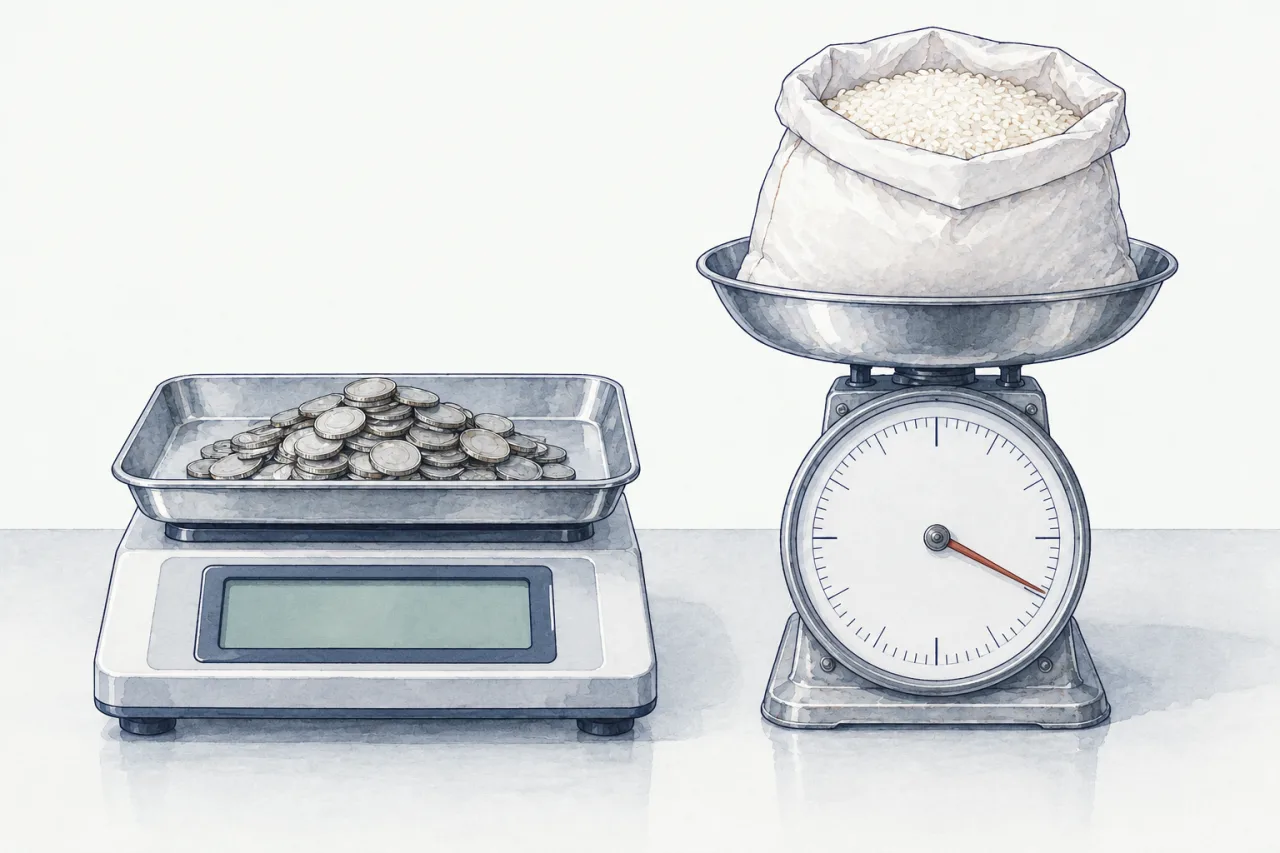
A bank doesn't count a big bag of identical coins one by one: it weighs the bag. Suppose each coin has a mass of 4.00 g and the coins weigh 800 g altogether. Then the bag holds 800 ÷ 4.00 = 200 coins. You found a count from two masses, because you knew the mass of one coin.
 (enlarge)
Chemists need to know how many particles a sample holds, because particles react with each other in fixed numbers: one carbon atom with one oxygen molecule, two hydrogen molecules with one oxygen molecule. Particles are far too small and far too many to count, so chemists count them the bank's way. There's only one difficulty: a single atom is so light that a sensible mass of anything holds an enormous number of them. So chemists count in big bundles.
A mole of anything
A dozen always means twelve things, whether they're eggs or pencils. Chemists use a bundle in the same way, but a vastly bigger one. The mole, symbol mol, is the unit of amount of substance. One mole of any substance contains 6.02 × 10²³ particles. This number is called the Avogadro constant.
6.02 × 10²³ means 602 followed by 21 zeros. If you could count a million particles every second, a mole of them would still take you about 19 billion years, longer than the universe has existed.
Why such an awkward number? It was chosen so that one mole of carbon-12 atoms has a mass of exactly 12 g. Relative masses compare every particle with carbon-12, so the same bundle works for everything. A water molecule, with Mr 18, is 18/12 = 1.5 times as heavy as a carbon-12 atom. So a mole of water molecules is 1.5 times as heavy as a mole of carbon-12 atoms: 1.5 × 12 g = 18 g. The number 18 comes straight back, now in grams.
The mass of one mole of a substance is its molar mass, symbol M, in grams per mole, g/mol. It has the same number as the substance's Ar or Mr:
| Substance | Ar or Mr | Molar mass, M | One mole has a mass of |
|---|---|---|---|
| Carbon, C | 12 | 12 g/mol | 12 g |
| Iron, Fe | 56 | 56 g/mol | 56 g |
| Sodium chloride, NaCl | 23 + 35.5 = 58.5 | 58.5 g/mol | 58.5 g |
| Water, H2O | 2 × 1 + 16 = 18 | 18 g/mol | 18 g |
| Sugar (sucrose), C12H22O11 | 342 | 342 g/mol | 342 g |
 (enlarge)
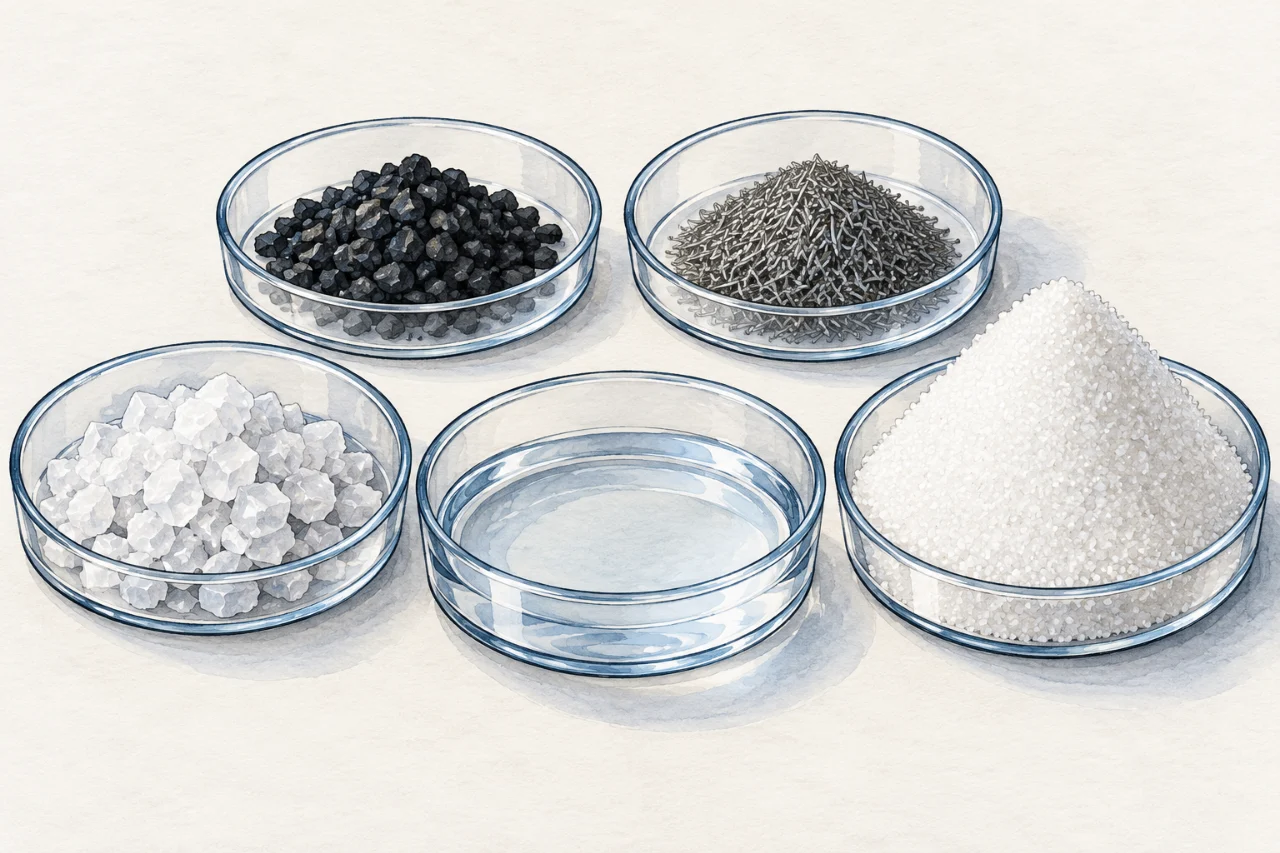
Each dish in the picture holds one mole: the same number of particles, 6.02 × 10²³. The heaps look nothing alike, because the particles have different masses and pack differently.
Trap: “The same number of moles means the same mass.” A hundred small coins and a hundred large coins are the same count, but the large coins are heavier. One mole of sugar has a mass of 342 g and one mole of water only 18 g, yet both hold 6.02 × 10²³ molecules.
Trap: “Molar mass and relative mass are the same thing.” They have the same number, but Mr has no unit: it compares one particle with carbon-12. Molar mass is a real mass, the grams in each mole, so it always has the unit g/mol.
Name the particle
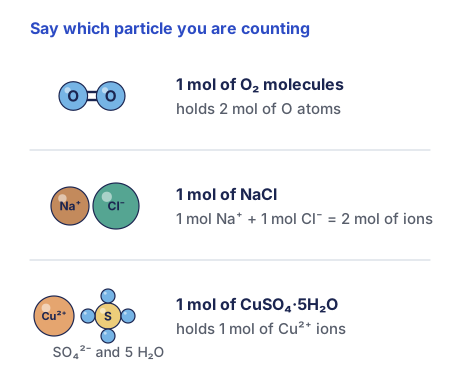
“One mole of oxygen” isn't clear enough, because oxygen could mean atoms or molecules. Always say which particle you're counting.
 (enlarge)
- A mole of oxygen molecules, O2, holds 6.02 × 10²³ molecules but twice as many atoms: 2 mol of oxygen atoms.
- Sodium chloride is ionic, so it has no molecules. A mole of its formula units, NaCl, holds one mole of Na+ ions and one mole of Cl− ions: 2 mol of ions.
- A mole of the blue crystals, CuSO4·5H2O, holds one mole of Cu2+ ions, because each formula unit has one copper ion.
One relationship, three unknowns
The bank divided the total mass by the mass of one coin. A chemist does the same, with the molar mass as the mass of one bundle:
| Quantity | Symbol | Unit |
|---|---|---|
| Mass of the sample | m | g |
| Amount of substance | n | mol |
| Molar mass | M | g/mol |
Watch the letter size: small m is the mass of your sample, and capital M is the mass of one mole.
amount = mass ÷ molar mass, so n = m/M
Check the units, because they show whether you divided the right way round. Dividing by g/mol is the same as multiplying by mol/g, so g ÷ g/mol = g × mol/g. Grams divided by grams is just 1, so the grams drop out: we say they cancel. Only mol is left, and that's the unit an amount should have.
When a different quantity is missing, rearrange the same relationship. Multiply both sides by M and you get mass = amount × molar mass: m = n × M. Divide the mass by the amount and you get molar mass = mass ÷ amount: M = m/n, in g/mol. A molar mass found this way also gives you the Ar or Mr: it's the same number without the unit, and the Periodic Table then tells you which element has that Ar.
From moles to particles
To count the particles, multiply the amount by the size of the bundle:
number of particles = amount in moles × 6.02 × 10²³
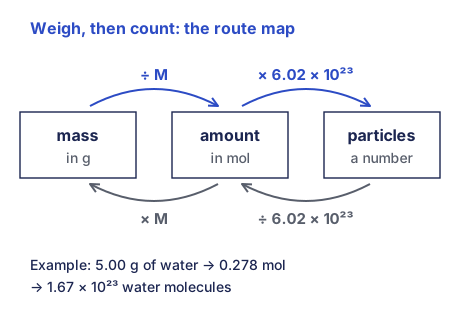
To go back, divide: amount = number of particles ÷ 6.02 × 10²³. With the mass relationship, that gives a route between all three: weigh a sample, turn the mass into moles, turn the moles into particles.
 (enlarge)
Particle numbers are huge, so they're written in standard form: a number between 1 and 10, multiplied by a power of ten. 10²³ means 1 followed by 23 zeros, and 10−6 means 1 divided by a million, 0.000 001. On a calculator, the power of ten goes in with the ×10ˣ or EXP key. Here you can type an answer like 1.67 × 10²³ as 1.67x10²³.
In these questions give final answers to three significant figures. That's our practice rule here, not a Cambridge rule for every question. Significant figures count from the first digit that isn't zero: 0.278 has three, and so has 1.67 × 10²³. Keep every digit on your calculator through the middle steps and round only the final answer.
Worked example
A spoonful of water
A teaspoon holds 5.00 g of water. How many water molecules is that? (Ar: H 1, O 16.)
Before you calculate, predict: is it more than a mole or less? Less, because one mole of water is 18 g. First the molar mass: M = 2 × 1 + 16 = 18 g/mol. Then the amount:
n = m/M = 5.00 g ÷ 18 g/mol = 0.278 mol (the grams cancel, leaving mol)
Then the molecules: 0.2778 × 6.02 × 10²³ = 1.67 × 10²³ water molecules. Each molecule has three atoms, so the spoon holds three times as many atoms: 5.02 × 10²³.
Worked example
Weigh out 0.100 mol of salt
What mass of sodium chloride is 0.100 mol, and how many ions does it hold? (Ar: Na 23, Cl 35.5.)
M = 23 + 35.5 = 58.5 g/mol, so m = n × M = 0.100 mol × 58.5 g/mol = 5.85 g (the moles cancel). Each formula unit NaCl has two ions, Na+ and Cl−, so 0.100 mol of NaCl holds 0.200 mol of ions: 0.200 × 6.02 × 10²³ = 1.20 × 10²³ ions.
Worked example
Which element is it?
0.150 mol of a metal has a mass of 3.60 g. Find its molar mass and name the metal.
M = m/n = 3.60 g ÷ 0.150 mol = 24.0 g/mol. So the metal's Ar is 24, and the Periodic Table says that's magnesium. Grams divided by moles gives g/mol, the right unit for a molar mass. If you'd divided the other way, 0.150 ÷ 3.60, you'd get mol/g: the moles in each gram, not the grams in each mole.
Worked example
The mass of a drop
A drop of water holds 1.67 × 10²¹ molecules. What is its mass?
Go along the route map the other way. Amount: n = 1.67 × 10²¹ ÷ 6.02 × 10²³ = 0.002774 mol. Mass: m = n × M = 0.002774 mol × 18 g/mol = 0.0499 g. Check the size: a mole of water is 18 g, and this drop is about a three-hundred-and-sixtieth of a mole, so a twentieth of a gram is about right.
Case closed
How many molecules are in a spoonful of water? 5.00 g of water is 0.278 mol, and each mole is 6.02 × 10²³ molecules, so the spoon holds 1.67 × 10²³ of them. To count any particles by weighing, name the particle, find the molar mass from the Ar or Mr, use n = m/M to get moles, then multiply by the Avogadro constant. Go the other way to find a mass, and divide mass by amount to find a molar mass.
About this lesson
Since 2019 the mole has been defined by fixing the Avogadro constant itself; 12 g of carbon-12 still holds one mole of atoms to far better than three significant figures. The 3 significant figures rule is a practice convention on this site: an exam question says how to round. The pictures show one mole of each substance as a model of the idea; a real teaspoon of water is closer to 5 g than to 5.00 g.
For teachers: Supplement 3.3.2 and 3.3.3 (a)–(e), the whole part (Cambridge 0620 syllabus, p16). Ar and Mr come from 3.2 (module Relative masses); concentration follows in part 2.