Two mugs hold the same volume of sweet tea, but the second has twice as much sugar dissolved in it. You'd taste the difference at once. In a laboratory you never taste anything, so a bottle of solution carries a label instead, such as “0.100 mol/dm³”. In this part you'll find out what a label like that means, make a solution of your own from a spoonful of blue crystals, and count the copper ions in a single drop of it. The first section is Core; the calculations after it are Supplement.
The sugar is the solute, the substance that dissolves. The water in the tea is the solvent, and together they make a solution.
Concentration: solute per volume of solution
Now imagine a big mug with two spoonfuls of sugar and a small mug with one, where the big mug holds twice as much tea. They taste just as sweet, because each sip holds the same sugar. The big mug holds more sugar, but the concentration is the same: how much solute there is in each volume of solution.
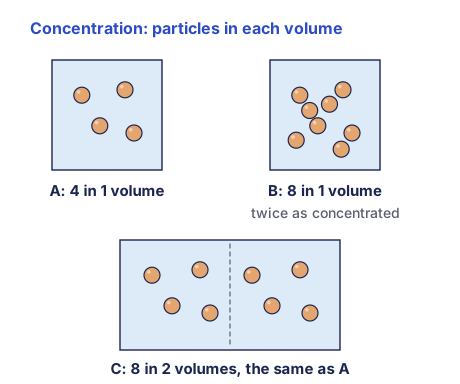 (enlarge)
In chemistry the volume is measured in cubic decimetres, dm³, so concentration can be given in two units:
- g/dm³: the mass of solute in each dm³ of solution;
- mol/dm³: the amount of solute, in moles, in each dm³ of solution.
Both describe the same solution, but their numbers are usually different, because grams and moles measure different things.
Trap: “Use the volume of water poured in.” Concentration divides by the final volume of the whole solution, after the solid has dissolved. The dissolved solid is part of the solution too, so the volume of water you poured in doesn't tell you the final volume.
Convert the volume first
A box 10 cm along each edge holds exactly one litre, as much as a carton of juice. A decimetre is 10 cm, so the box is 1 dm along each edge, and its volume is one cubic decimetre: 1 dm³ = 1 litre. How many 1 cm cubes fit inside? Ten small cubes make a row along one edge, ten rows make a layer, and ten layers fill the box: 10 × 10 × 10 = 1000. So 1 dm³ = 1000 cm³.
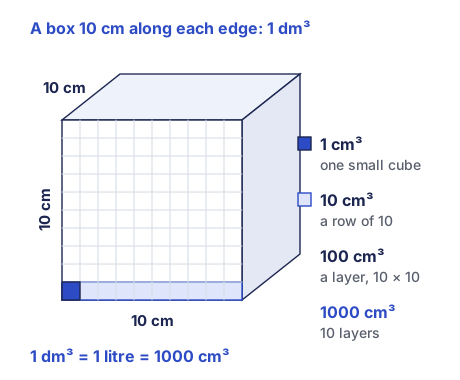 (enlarge)
To turn cm³ into dm³, divide by 1000; to go back, multiply by 1000. A 250.0 cm³ flask holds 250.0 ÷ 1000 = 0.2500 dm³, a quarter of the carton.
Concentration from mass
To find a concentration, divide the quantity of solute by the volume of the solution in dm³:
concentration in g/dm³ = mass of solute (g) ÷ volume of solution (dm³)
concentration in mol/dm³ = amount of solute (mol) ÷ volume of solution (dm³), so c = n/V
From part 1, the amount comes from the mass: n = m/M. Molar mass also links the two units. Each mole has a mass of M grams, so a solution with c moles in each dm³ has c × M grams in each dm³: g/dm³ = mol/dm³ × M.
Trap: “Divide by 250.” 0.100 mol ÷ 250 cm³ = 0.000400 mol in each cm³. A dm³ holds 1000 cm³, so it holds 1000 times as much: 0.400 mol/dm³. Convert the volume to dm³ first.
Trap: “I can swap g/dm³ and mol/dm³ after calculating.” 16.0 g/dm³ and 0.400 mol/dm³ of sodium hydroxide describe the same solution, but “16.0 mol/dm³” would be a different, far stronger one. To change the unit, change the number too, using M.
Make a solution of known concentration
A solution whose concentration you know exactly is made in a volumetric flask: a flask with a long, narrow neck and one line etched round it. Filled to that line, it holds exactly the volume written on it, such as 250.0 cm³. This is the method.
- Weigh the solid.
- Dissolve it in a little distilled water in a beaker.
- Pour the solution into the flask through a funnel.
- Rinse the beaker and the funnel with distilled water, and let the rinsings run into the flask too, so that none of the solute is left behind.
- Add distilled water until the bottom of the curved surface, the meniscus, sits exactly on the line. Add the last few drops one at a time, with your eye level with the line.
- Put the stopper in and turn the flask upside down and back several times, so the solution is the same all through.
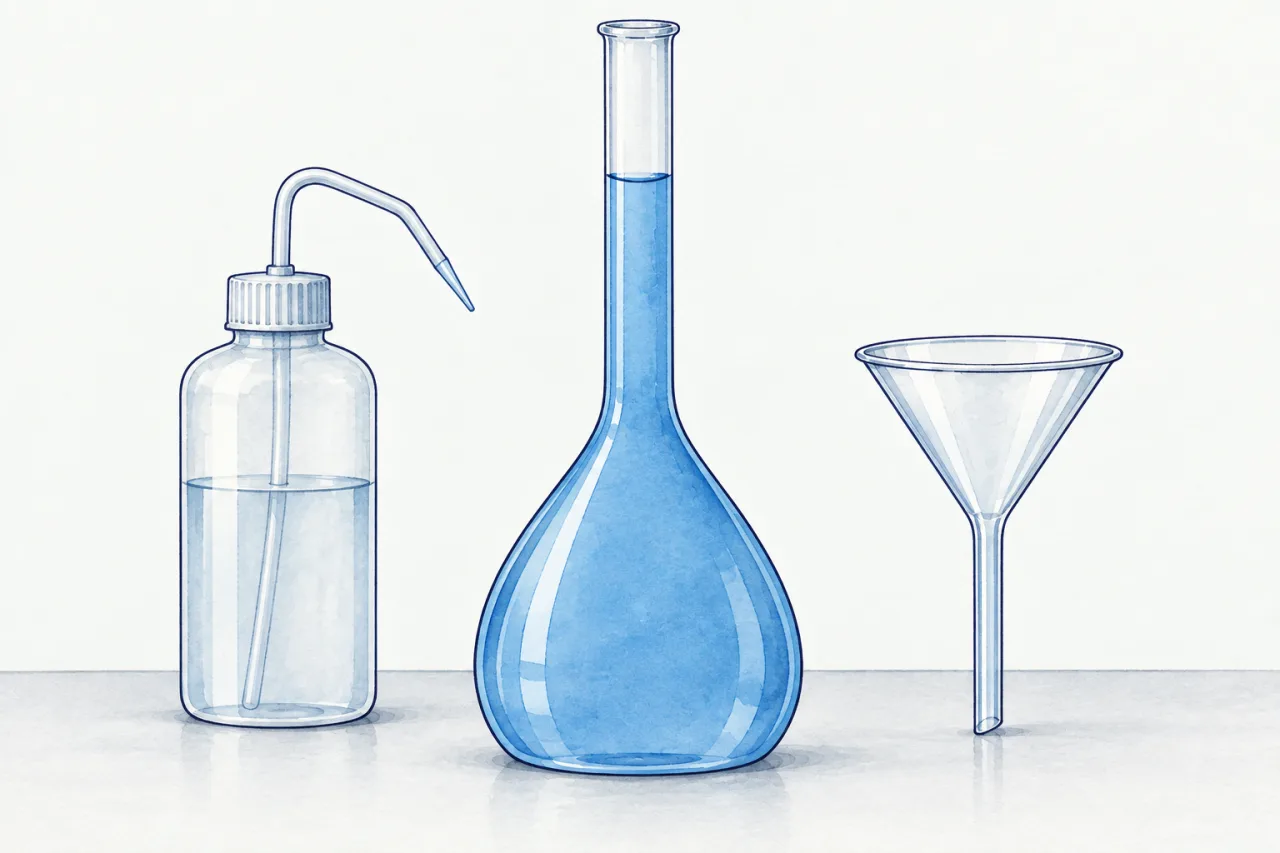 (enlarge)
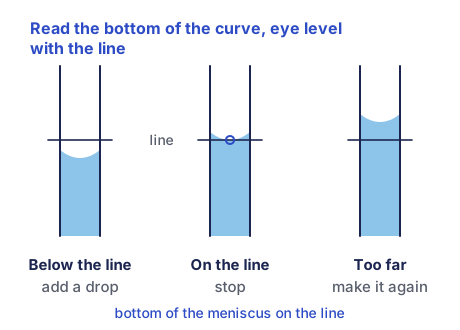 (enlarge)
If you add too much water, the flask holds more than 250.0 cm³. Pouring some out doesn't help, because the solution you pour out takes solute with it. The only fix is to make the solution again.
Now make one. Weigh a spoonful of blue copper(II) sulfate crystals, CuSO4·5H2O, and make it into 250.0 cm³ of solution. Predict first: will the solution in the flask be darker than in the beaker, the same, or paler? Then find its concentration, and how many copper ions are in a single drop.
What the flask shows
The spoonful has a mass of 6.31 g. In the beaker it makes a strong blue solution; made up to 250.0 cm³ and mixed, the solution is paler. The same solute is now spread through a bigger volume, so each drop holds less of it: the concentration is lower.
The crystals have Mr 250 (from Relative masses), so M = 250 g/mol:
- amount: n = 6.31 g ÷ 250 g/mol = 0.0252 mol;
- volume: V = 250.0 cm³ ÷ 1000 = 0.2500 dm³;
- concentration: c = 0.02524 mol ÷ 0.2500 dm³ = 0.101 mol/dm³, or 6.31 g ÷ 0.2500 dm³ = 25.2 g/dm³ of the crystals.
Each formula unit has one Cu2+ ion, so the flask holds 0.02524 × 6.02 × 10²³ = 1.52 × 10²² copper ions. A drop from a dropper is about 0.050 cm³, which is 0.000050 dm³, so it holds 0.101 × 0.000050 = 5.05 × 10⁻⁶ mol of copper ions: 3.04 × 10¹⁸ of them. To make 250.0 cm³ of 0.0400 mol/dm³ instead, you need 0.0400 × 0.2500 = 0.0100 mol, which is 2.50 g of crystals, and the solution is paler again.
Worked example
From mass to concentration
4.00 g of sodium hydroxide, NaOH, is made into 250.0 cm³ of solution. Find its concentration in mol/dm³ and in g/dm³. (Ar: H 1, O 16, Na 23.)
Two things must change first: the mass must become an amount, and the volume must be in dm³. M = 23 + 16 + 1 = 40 g/mol, so n = 4.00 g ÷ 40 g/mol = 0.100 mol. V = 250.0 ÷ 1000 = 0.2500 dm³. Then:
c = n/V = 0.100 mol ÷ 0.2500 dm³ = 0.400 mol/dm³
In g/dm³: 4.00 g ÷ 0.2500 dm³ = 16.0 g/dm³. Check with the link between them: 0.400 mol/dm³ × 40 g/mol = 16.0 g/dm³.
Worked example
Plan backwards from a target
You need 100.0 cm³ of 0.250 mol/dm³ sodium hydroxide solution. What mass of sodium hydroxide do you weigh out?
You can't go straight from cm³ to grams, so find the amount in between. V = 100.0 ÷ 1000 = 0.1000 dm³. Rearrange c = n/V to amount = concentration × volume: n = c × V:
n = 0.250 mol/dm³ × 0.1000 dm³ = 0.0250 mol (the dm³ cancel, leaving mol)
Then m = n × M = 0.0250 mol × 40 g/mol = 1.00 g. The 100.0 cm³ is the final volume of the solution: you dissolve the 1.00 g and make it up to the line of a 100.0 cm³ flask, not add 100.0 cm³ of water. When the volume is the unknown, rearrange once more: volume = amount ÷ concentration: V = n/c. For example, what volume of the same 0.250 mol/dm³ solution holds 0.0500 mol?
V = 0.0500 mol ÷ 0.250 mol/dm³ = 0.200 dm³ (the mol cancel, leaving dm³), which is 0.200 × 1000 = 200 cm³.
Worked example
Ions in a sample
How many ions are in 25.0 cm³ of 0.200 mol/dm³ sodium chloride solution?
V = 25.0 ÷ 1000 = 0.0250 dm³, so n = c × V = 0.200 × 0.0250 = 0.00500 mol of NaCl. Each formula unit gives two ions, Na+ and Cl−, so there are 0.0100 mol of ions: 0.0100 × 6.02 × 10²³ = 6.02 × 10²¹ ions.
Case closed
How many particles are in a spoonful? 6.31 g of blue crystals is 0.0252 mol, 1.52 × 10²² formula units, each with one copper ion. Made into 250.0 cm³ of solution, it's 0.101 mol/dm³, or 25.2 g/dm³ of the crystals, and a single drop still holds 3.04 × 10¹⁸ copper ions. Concentration is solute divided by the volume of the whole solution in dm³, in g/dm³ or mol/dm³. Convert the volume first, turn grams into moles with M, and work backwards with n = c × V when you know the solution you want.
About this model
The readings are simulated: the model calculates them from M = 250 g/mol with a balance that reads to 0.01 g and a flask of exactly 250.0 cm³. A real volumetric flask holds its volume to about ±0.2 cm³. The scene draws the last drops much larger than real ones, so that each one moves the meniscus where you can see it. When the crystals dissolve, their water joins the solvent, so the label “25.2 g/dm³” counts the mass of crystals weighed out, CuSO4·5H2O; the amount, 0.101 mol/dm³, is the same for the copper(II) sulfate in the solution. The magnifier shows the ions and water molecules of a drop as a model, not to scale.
For teachers: Core 3.3.1 (the first section); Supplement 3.3.5, its part on volumes and concentrations of solutions with cm³ and dm³, and 3.3.3 and 3.3.2 used throughout (Cambridge 0620 syllabus, p16). Gas volumes, reacting masses with moles, limiting reactants and yield are in the next module; titration comes in topic 12.