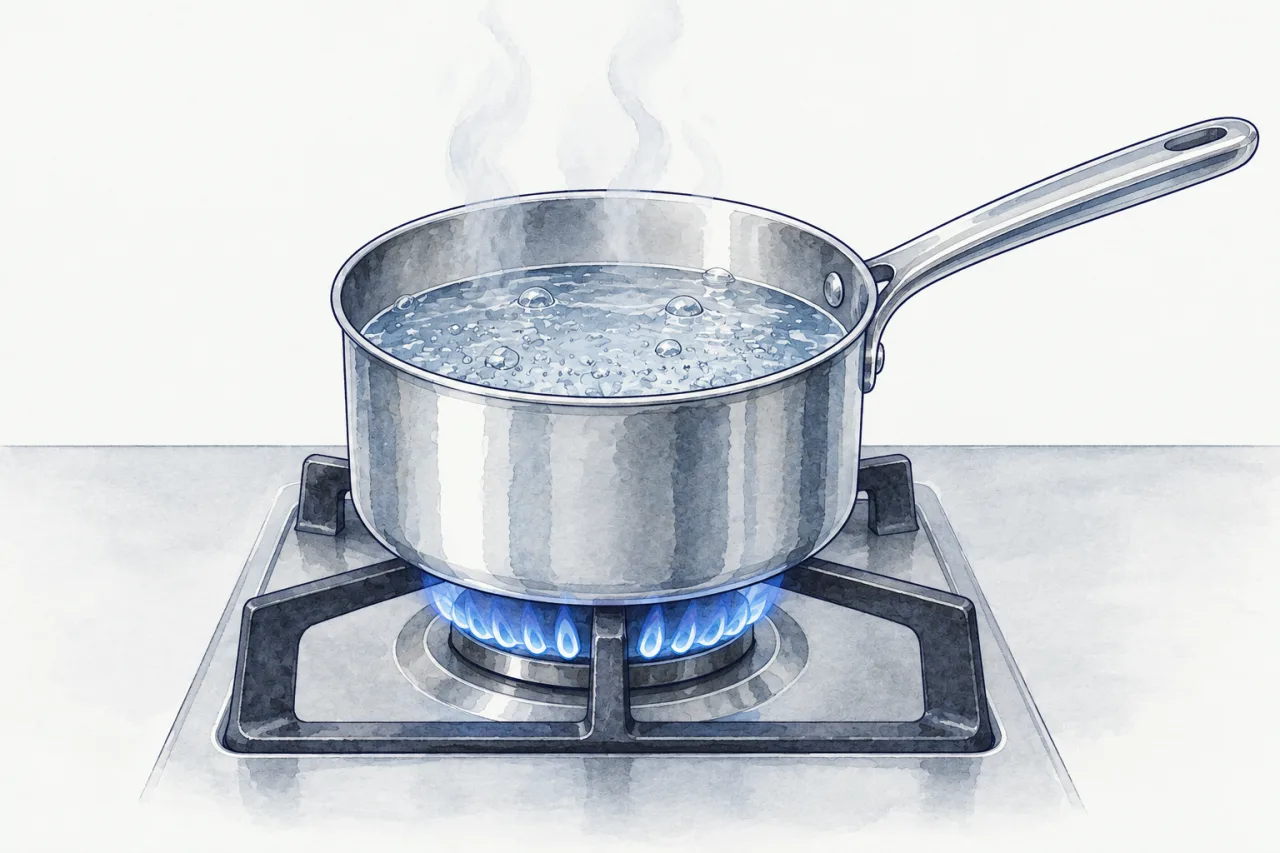
Light a gas hob and the flame boils a pan of water in a few minutes. The gas is mostly methane, CH4, and in the last module you found that burning methane is exothermic: it gives out 890 kJ for every mole that burns. Yet every methane molecule is held together by four strong covalent bonds, and to burn, those bonds have to come apart. Pulling atoms apart takes energy. So how can a reaction that starts by taking energy in end up giving so much out? In this part you'll take molecules apart and build new ones, keep count of the energy at every step, and find out. This whole module is Supplement, for the Extended papers.
 (enlarge)
Your investigation
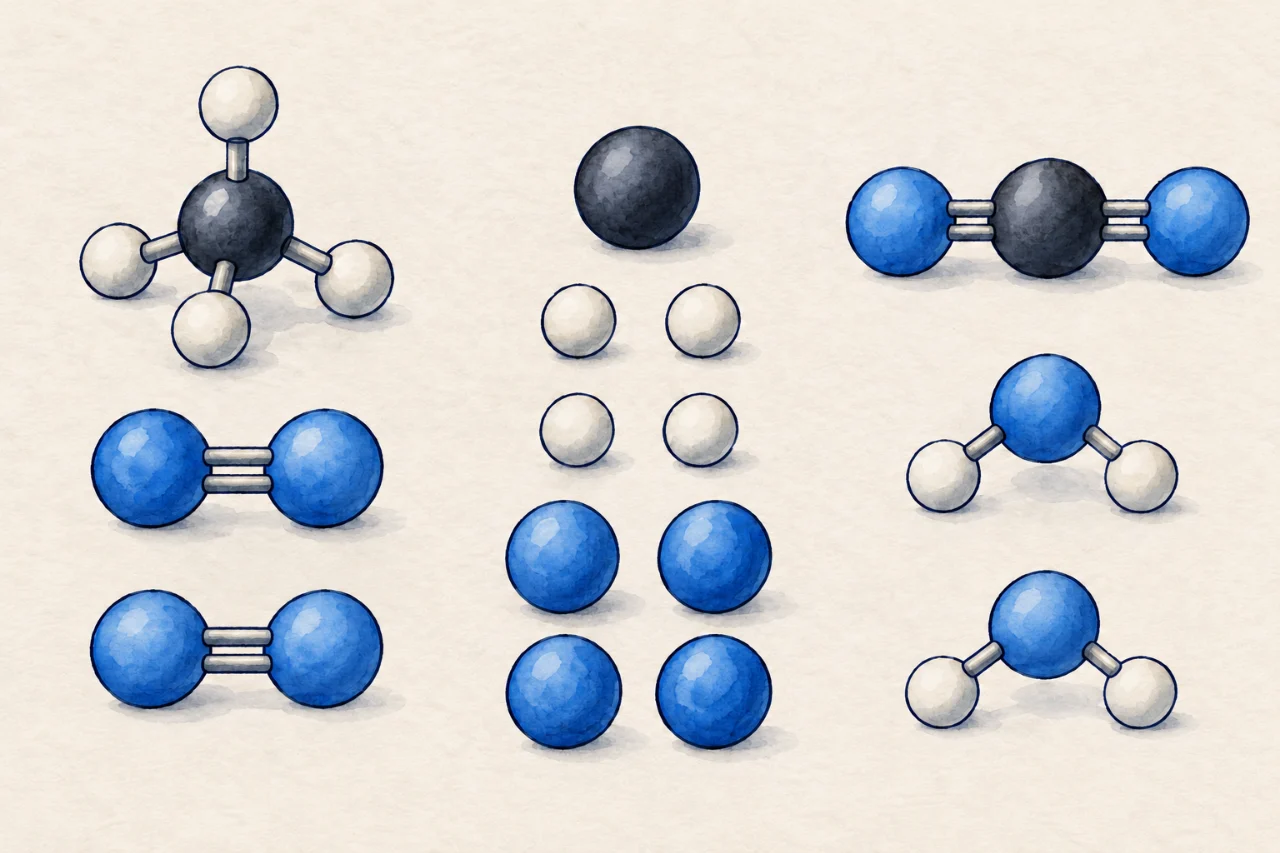
Your bench has a tray of ball-and-stick models and, behind it, an energy board. You'll take the reactant molecules apart bond by bond, then use the same atoms to build the products. At every bond you break or make, the board takes one step up or one step down, by the energy of that bond, so the line it draws is a staircase. You'll do it for three reactions:
- hydrogen and chlorine making hydrogen chloride, H2 + Cl2 → 2HCl;
- methane burning, CH4 + 2O2 → CO2 + 2H2O;
- nitrogen and oxygen making nitrogen monoxide, N2 + O2 → 2NO.
Predict first: will the board go up or down when a bond breaks, and when a bond forms? At the end of each reaction, decide where the board finished compared with where it started.
 (enlarge)
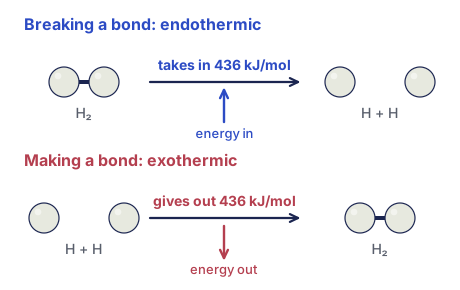
Breaking a bond takes energy in
In a covalent bond, two atoms share a pair of electrons. The shared electrons are attracted to the nuclei of both atoms, and that attraction holds the atoms together. To pull the atoms apart you have to work against the attraction, so energy must be taken in. Breaking a bond is endothermic.
That's why the board stepped up every time you broke a bond. A bond only breaks when something supplies the energy, such as a flame, a spark or light.
Making a bond gives energy out
Now picture it the other way round. When two separate atoms come together and share a pair of electrons, they are pulled into the bond, and energy is given out. Making a bond is exothermic. It gives out exactly the same amount of energy as breaking the same bond takes in.
 (enlarge)
Trap: “Breaking bonds releases energy.” It's the other way round. Breaking a bond always takes energy in; making a bond gives energy out. A fuel gives out energy when it burns because new, stronger bonds form, not because its bonds break.
Bond energy
The bond energy is the energy needed to break one mole of a bond, in kJ/mol. It's also the energy given out when one mole of that bond forms. A stronger bond has a bigger bond energy. Here are the bond energies used in this module:
| Bond | Bond energy / kJ/mol | Bond | Bond energy / kJ/mol |
|---|---|---|---|
| H–H | 436 | C–H | 412 |
| Cl–Cl | 242 | C–C | 348 |
| H–Cl | 431 | C=C | 612 |
| O=O | 498 | C=O | 805 |
| O–H | 463 | N≡N | 945 |
| N–H | 391 | N=O | 630 |
Compare C–C with C=C. A double bond has two shared pairs, so it holds the atoms more strongly than a single bond and takes more energy to break. The triple bond in nitrogen, N≡N, with three shared pairs, is one of the strongest bonds there is.
Energy in, energy out
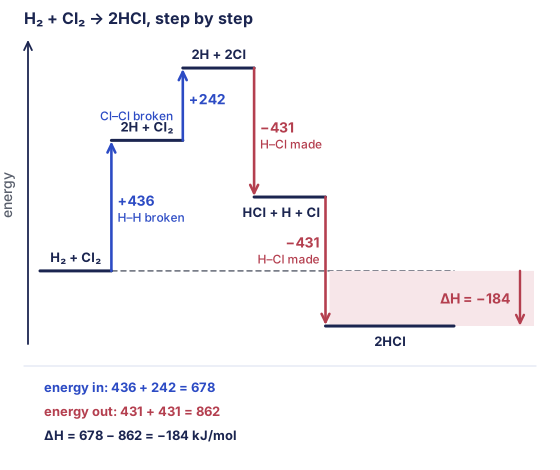
Any reaction breaks some bonds and makes others. Picture it as two stages, as on your energy board: first break every bond in the reactants, which takes energy in, then make every bond in the products, which gives energy out. Compare the two totals:
- if the energy given out making bonds is more than the energy taken in breaking bonds, the extra goes to the surroundings: the reaction is exothermic, and ΔH is negative;
- if the energy taken in breaking bonds is more than the energy given out making bonds, the difference comes from the surroundings: the reaction is endothermic, and ΔH is positive.
So ΔH = energy taken in breaking bonds − energy given out making bonds. The board shows this as where the staircase ends compared with where it started.
 (enlarge)
Worked example
Hydrogen and chlorine
Hydrogen burns in chlorine: H2 + Cl2 → 2HCl. Explain, in terms of bond breaking and bond making, why the reaction is exothermic.
- Bonds broken: one H–H (436 kJ/mol) and one Cl–Cl (242 kJ/mol). Energy taken in = 436 + 242 = 678 kJ/mol.
- Bonds made: two H–Cl, because 2HCl means two molecules, each with one H–Cl bond. Energy given out = 2 × 431 = 862 kJ/mol.
- More energy is given out making the new bonds than is taken in breaking the old ones: 862 is more than 678.
- The extra 862 − 678 = 184 kJ/mol goes to the surroundings, so the reaction is exothermic, ΔH = −184 kJ/mol.
Worked example
Nitrogen and oxygen
In a car engine, or in a flash of lightning, nitrogen and oxygen from the air react: N2 + O2 → 2NO. Explain why this reaction is endothermic.
- Bonds broken: one N≡N (945 kJ/mol) and one O=O (498 kJ/mol). Energy taken in = 945 + 498 = 1443 kJ/mol.
- Bonds made: two N=O. Energy given out = 2 × 630 = 1260 kJ/mol.
- Breaking the very strong triple bond takes in more energy than making the new bonds gives out: 1443 is more than 1260.
- The difference, 1443 − 1260 = 183 kJ/mol, is taken in from the surroundings, so the reaction is endothermic, ΔH = +183 kJ/mol. The N≡N triple bond is so strong that this reaction only starts at a very high temperature, as in a car engine or a flash of lightning: in ordinary air, nitrogen and oxygen don't react.
Key idea: Bond breaking is endothermic and bond making is exothermic. A reaction is exothermic when the energy given out making the bonds in the products is more than the energy taken in breaking the bonds in the reactants, and endothermic when it is less. ΔH = energy in − energy out.
Pause and check
Burning methane gives out energy, yet its bonds have to break first. Which is bigger for burning methane, the energy taken in or the energy given out? Answer in your head, then read on.
The energy given out is bigger. Breaking the bonds in CH4 and 2O2 takes in 2644 kJ/mol, and making the bonds in CO2 and 2H2O gives out 3462 kJ/mol, so the reaction gives out the difference. Part 2 shows you how to get those totals.
From the staircase to a pathway diagram
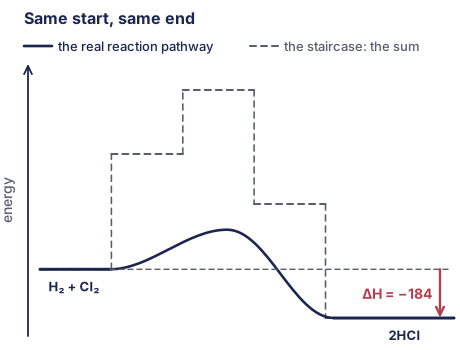
Your staircase and the reaction pathway diagram from the last module start at the same level, the reactants, and end at the same level, the products. So they give the same ΔH.
 (enlarge)
The top of the staircase isn't the top of the hump, though. In a real reaction the bonds don't all break first and then all form: old bonds loosen while new ones start to form, so the real hump, the activation energy, is much lower than the top of the staircase. The staircase is a way of adding up the energy, not a picture of how the particles actually react.
Trap: “The reaction really breaks every bond first, so Ea is the energy in.” The energy taken in breaking all the bonds is just a total for the sum. The activation energy is the height of the hump on the real pathway, and it is much smaller.
Case closed
How can burning methane give out energy when its bonds must break first? Breaking bonds does take energy in, but making the new bonds in carbon dioxide and water gives out more. The difference goes to the surroundings and boils the pan. Every reaction works this way: compare the energy taken in breaking bonds with the energy given out making bonds. If more comes out than goes in, the reaction is exothermic; if less, it is endothermic. In the next part you'll calculate ΔH from bond energies.
About this model
The energy board adds up the energy as if every bond broke first and then every bond formed: a way of keeping count, not the path the particles take. Bond energies such as C–H are average values, taken over many different molecules, so a ΔH worked out from them is close to the measured value but not the same: burning methane comes out at −818 kJ/mol here, while the data-book value, which is for liquid water, is −890 kJ/mol. All the substances are gases. The models aren't to scale.
For teachers: Supplement 5.1.7 (Cambridge 0620 syllabus, p18). Calculating ΔH from bond energies (5.1.8) is in part 2; collisions and activation energy in rates come in topic 6.