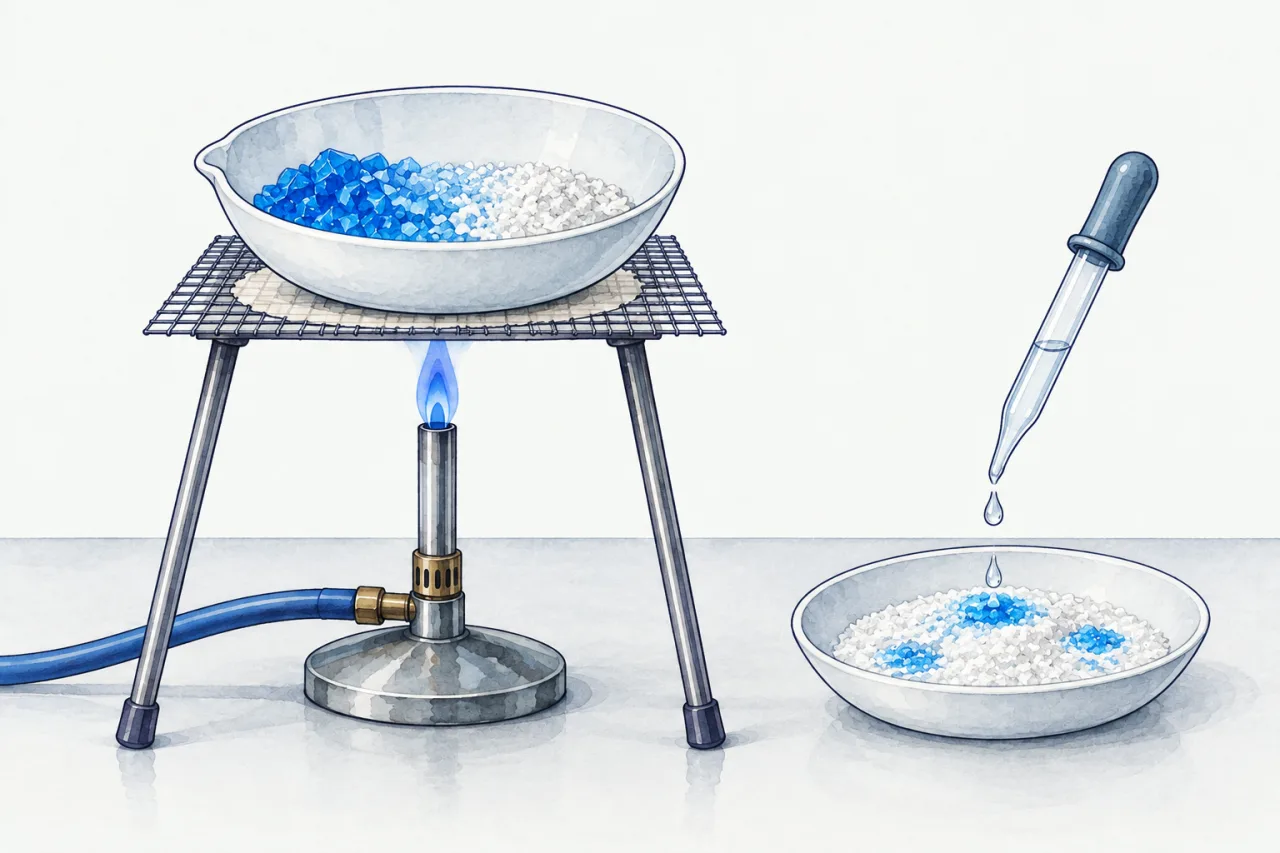
Heat some blue copper(II) sulfate crystals gently in a basin and they crumble into a white powder, while a wisp of steam rises from them. Let the powder cool and add a few drops of water: blue spots appear at once, and the basin gets warm. Heating made a new substance, and water turned it back into the old one. Can a chemical reaction really go backwards? In this part you'll meet reactions that run both ways, and two of them that chemists use to test for water.
 (enlarge)
A reaction that goes back
Most reactions you have met go only one way. Paper that has burned never turns back into paper; magnesium that has burned stays as white magnesium oxide. But some reactions can go both ways: the products can react together to make the reactants again. These are reversible reactions.
You met one in an earlier module: heating blue copper(II) sulfate makes a new substance, so it's a chemical change, even though water can turn it back.
The reversible sign ⇌
An ordinary equation has one arrow, →. A reversible reaction is written with a double arrow, ⇌: one half points right, the other left.
reactants ⇌ products
The reaction from left to right is the forward reaction; the one from right to left is the reverse reaction. Which way the reaction goes depends on the conditions, such as the temperature or whether water is added.
Copper(II) sulfate: hydrated and anhydrous
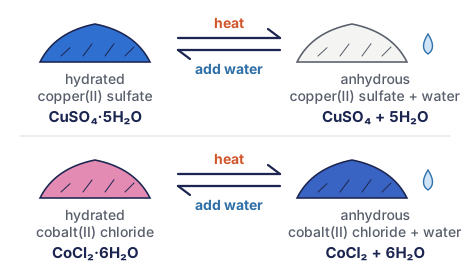
Blue copper(II) sulfate crystals have water built into them as they grow, called water of crystallisation. A compound that has water in its crystals is hydrated. The same compound with that water taken out is anhydrous, which means "without water".
hydrated copper(II) sulfate ⇌ anhydrous copper(II) sulfate + water
CuSO4·5H2O ⇌ CuSO4 + 5H2O
The hydrated crystals are blue; the anhydrous powder is white. Heating drives the water out: that is the forward reaction, and it takes in energy, so it is endothermic. Adding water to the white powder makes the blue hydrated compound again: the reverse reaction. It gives out the same amount of energy, which is why the basin gets warm.
 (enlarge)
Key idea: Some reactions are reversible, shown by ⇌. Heating a hydrated compound drives out its water and leaves the anhydrous compound; adding water to the anhydrous compound makes the hydrated compound again. The conditions choose the direction.
Trap: "It's only drying, so it's a physical change." The white powder is a different substance from the blue crystals, with a different formula and colour, and energy is taken in one way and given out the other. Both directions are chemical changes. What makes them unusual is that they can go back.
Worked example
Which way does it go?
For each change, say which way the copper(II) sulfate reaction goes, and what you would see.
- Blue crystals are heated in a test tube. The water of crystallisation is driven out: the forward reaction. The crystals turn white, and drops of water collect near the cool mouth of the tube.
- Water is dripped onto the white powder. The water joins the anhydrous copper(II) sulfate: the reverse reaction. The powder turns blue and gets warm.
- The tube of white powder is left closed and cool. Nothing changes: there is no water to react with, and no heat to drive the reaction forward.
Cobalt(II) chloride
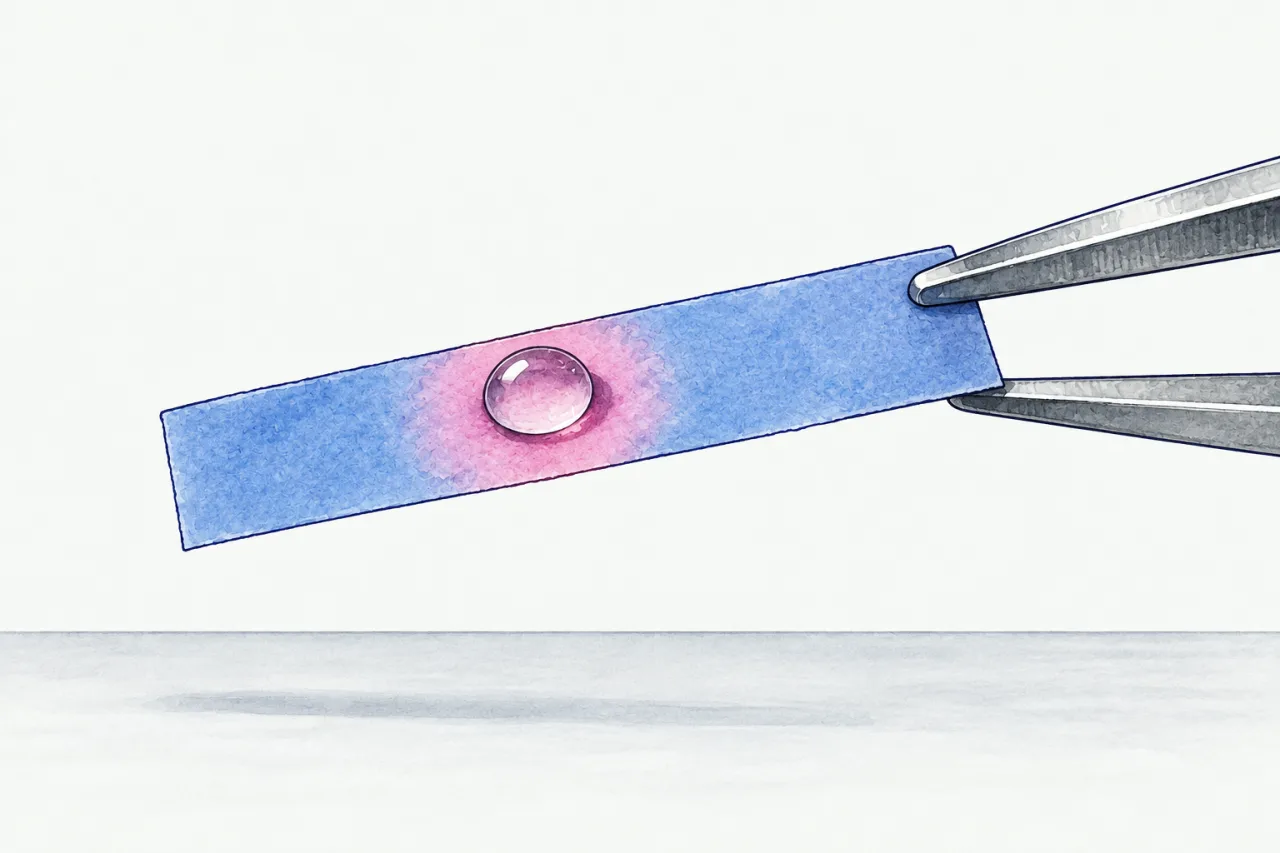
Cobalt(II) chloride behaves in the same way, with different colours. The hydrated compound is pink; heat it and its water is driven out, leaving the anhydrous compound, which is blue. Add water and it turns pink again.
hydrated cobalt(II) chloride ⇌ anhydrous cobalt(II) chloride + water
CoCl2·6H2O ⇌ CoCl2 + 6H2O
Paper soaked in cobalt(II) chloride solution and dried in an oven is called cobalt chloride paper. Dry, it is blue. A drop of water turns it pink where it touches.
 (enlarge)
Two tests for water
Both reactions are used to test whether a liquid contains water:
| Test | Colour without water | Colour if water is present |
|---|---|---|
| anhydrous copper(II) sulfate | white | blue |
| anhydrous cobalt(II) chloride (cobalt chloride paper) | blue | pink |
The test shows that water is there. It does not show that the liquid is pure water: salty water, lemonade and ink all turn the white powder blue, because they all contain water. To show that water is pure, you would check its boiling point (100 °C) or its melting point (0 °C).
Worked example
A test result
A colourless liquid drips from a cooling tube when a fuel burns. A pupil adds a few drops of it to white anhydrous copper(II) sulfate, and the powder turns blue. What can they conclude?
- What the colour change shows: the white powder turned blue, so the liquid contains water.
- What it doesn't show: whether the liquid is pure water. Other substances could be dissolved in it.
- How to check: measure its boiling point. Pure water boils at 100 °C.
Pause and check
A blue strip of cobalt chloride paper is held in the steam above a kettle. What colour does it turn, and which way has the reaction gone? Answer in your head, then read on.
It turns pink. Steam is water, so the anhydrous blue cobalt(II) chloride takes up water and makes the pink hydrated compound: the reverse reaction. Dry the pink paper in a warm oven and it turns blue again.
Case closed
Can a chemical reaction go backwards? Some can, and the equation shows it with ⇌. Heating hydrated copper(II) sulfate drives out its water and leaves white anhydrous copper(II) sulfate; add water and it turns blue and warms up again. Cobalt(II) chloride does the same, from pink to blue and back. Because the anhydrous compounds change colour when water reaches them, they are tests for water, but not for pure water. In the next part you'll find out what happens when a reversible reaction is left to go both ways at once.
About this model
The colours are those of the solid compounds: in solution, copper(II) sulfate is blue and cobalt(II) chloride is pink. Strong heating can break copper(II) sulfate down further, into other substances; the reaction here is the gentle heating that drives out only the water. The numbers 5H2O and 6H2O come from the compounds' formulae: you'll work with water of crystallisation in calculations later in the course. Cobalt(II) chloride is toxic, so cobalt chloride paper is handled with tweezers and gloves.
For teachers: Core 6.3.1 and 6.3.2 (Cambridge 0620 syllabus, p20). The tests for water and for its purity are also 10.1.1 and 10.1.2 (topic 10, previewed here); water of crystallisation in calculations is SALT01.