Every year the world's factories make well over a hundred million tonnes of ammonia, most of it for fertilisers that help crops grow, and even more sulfuric acid, for fertilisers, paints, detergents and car batteries. Both are made by reversible reactions. A reversible reaction never turns all its reactants into products, so the engineers who run these plants face a puzzle: which temperature and pressure give them the most product, fast enough, safely and at a price people will pay? In this part you'll use the rules from part 2 to work out their answers.
 (enlarge)
The Haber process
Ammonia is made from nitrogen and hydrogen in the Haber process:
N2(g) + 3H2(g) ⇌ 2NH3(g)
The forward reaction is exothermic: it gives out heat.
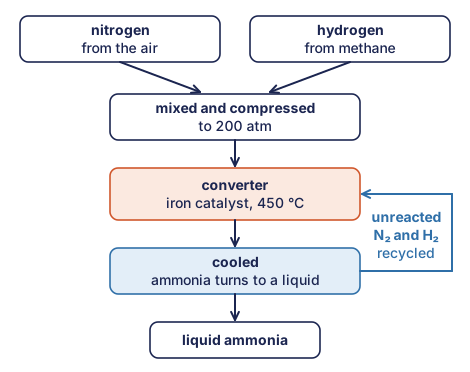
- Nitrogen comes from the air, which is about 78 % nitrogen.
- Hydrogen comes from methane, the main gas in natural gas, which is reacted with steam.
The typical conditions are a temperature of 450 °C, a pressure of 20 000 kPa (200 atm) and an iron catalyst.
 (enlarge)
Only some of the nitrogen and hydrogen react each time the gases pass over the catalyst. The mixture is cooled until the ammonia turns to a liquid and can be run off; the unreacted nitrogen and hydrogen are pumped back round to pass over the catalyst again, so none is wasted.
Why 450 °C and 200 atm?
Pressure. There are 4 gas molecules on the left of the equation and 2 on the right. A higher pressure moves the position of equilibrium to the side with fewer gas molecules, the right: more ammonia. A higher pressure also makes the reaction faster, because the gas molecules are closer together and collide more often. So why not use an even higher pressure? Very high pressures need thick, strong pipes and powerful pumps, which cost a lot to build and use a lot of energy to run, and a leak or a burst at high pressure is dangerous. 200 atm is a compromise: a good yield, at a cost and a risk that are acceptable.
Temperature. The forward reaction is exothermic, so a lower temperature would move the position to the right and give more ammonia. But at a low temperature the reaction is far too slow, even with a catalyst: the plant would make very little ammonia each hour. At 450 °C the yield is lower, but the ammonia is made much faster. 450 °C is a compromise between yield and rate.
The catalyst. Iron makes both reactions faster, so equilibrium is reached sooner. It doesn't change the yield, but without it the reaction would be too slow at 450 °C.
 (enlarge)
Trap: "450 °C is used because it gives the highest yield." A lower temperature gives a higher yield. 450 °C is used because the reaction is fast enough there while the yield is still acceptable.
Worked example
Reading the yield graph
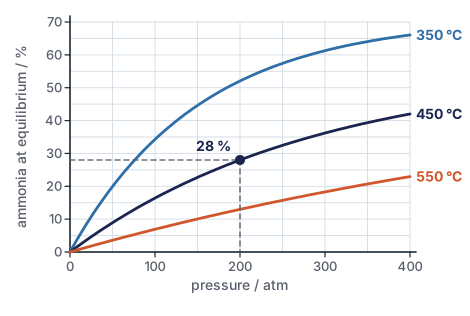
Use the graph of the percentage of ammonia at equilibrium.
- At 450 °C, what happens to the yield when the pressure rises from 100 atm to 300 atm? It rises from about 16 % to about 36 %. A higher pressure moves the position to the side with fewer gas molecules, the ammonia side.
- At 200 atm, how does the yield change from 350 °C to 550 °C? It falls, from about 52 % to about 13 %. The forward reaction is exothermic, so heating moves the position to the left.
- 350 °C gives almost twice the yield of 450 °C. Why isn't it used? At 350 °C the reaction is too slow: the plant would make less ammonia each hour, even though more of the gas would turn into ammonia in the end.
The Contact process
Sulfuric acid is made in several steps. The key step is the Contact process, which turns sulfur dioxide into sulfur trioxide:
2SO2(g) + O2(g) ⇌ 2SO3(g)
The forward reaction is exothermic.
- Sulfur dioxide comes from burning sulfur in air, or from roasting sulfide ores, such as zinc sulfide, in air.
- Oxygen comes from the air.
The typical conditions are a temperature of 450 °C, a pressure of 200 kPa (2 atm) and a vanadium(V) oxide catalyst, V2O5. The sulfur trioxide is then used to make sulfuric acid.
Why only 2 atm?
There are 3 gas molecules on the left of the equation and 2 on the right, so a higher pressure would move the position to the right, as in the Haber process. But even at 2 atm, the position is already far to the right: well over nine-tenths of the sulfur dioxide turns into sulfur trioxide. A higher pressure would add a little more product at a much greater cost and risk, so it isn't worth it.
The temperature is a compromise for the same reason as in the Haber process: the forward reaction is exothermic, so a lower temperature would give a higher yield but too slow a rate. The vanadium(V) oxide catalyst makes the reaction fast enough at 450 °C.
Worked example
Two processes side by side
| Haber process | Contact process | |
|---|---|---|
| makes | ammonia | sulfur trioxide, for sulfuric acid |
| equation | N2 + 3H2 ⇌ 2NH3 | 2SO2 + O2 ⇌ 2SO3 |
| raw materials | nitrogen from air; hydrogen from methane | sulfur dioxide from burning sulfur or roasting sulfide ores; oxygen from air |
| temperature | 450 °C | 450 °C |
| pressure | 20 000 kPa (200 atm) | 200 kPa (2 atm) |
| catalyst | iron | vanadium(V) oxide |
| gas molecules, left → right | 4 → 2 | 3 → 2 |
Why does the Haber process use a hundred times the pressure of the Contact process? Both reactions have fewer gas molecules on the right, so a higher pressure helps both. But at 2 atm the Contact process already turns most of the sulfur dioxide into product, while the Haber process at a low pressure would make very little ammonia. For the Haber process the extra yield pays for the cost of the high pressure; for the Contact process it wouldn't.
Pause and check
A manager suggests running the Haber process at 250 °C instead of 450 °C, "because a lower temperature gives more ammonia". What is right about the idea, and what is wrong with it? Answer in your head, then read on.
It's right that the yield would be higher: the forward reaction is exothermic, so cooling moves the position to the right. But the reaction would be much slower, even with the iron catalyst, so the plant would make less ammonia each hour. 450 °C is a compromise between a good yield and a fast enough rate.
Case closed
How do engineers choose the conditions for a reversible reaction? They use the rules of equilibrium, then weigh them against rate, safety and cost. In the Haber process, N2 + 3H2 ⇌ 2NH3, a high pressure of 200 atm moves the position towards the fewer gas molecules of ammonia, and 450 °C with an iron catalyst makes it fast enough, even though a lower temperature would give a higher yield. In the Contact process, 2SO2 + O2 ⇌ 2SO3, the yield is already high at 2 atm, so a higher pressure isn't worth its cost; 450 °C and vanadium(V) oxide give a good rate. Both recycle or reuse what doesn't react.
About this model
The yield graph shows the share of ammonia when the gases reach equilibrium, rounded from a smooth model; the numbers are approximate. In a real converter the gases pass through too quickly to reach equilibrium, and only about 15 % of them turn into ammonia on each pass, which is why recycling matters so much. Real plants vary their conditions a little around the typical values given here. The steps that turn sulfur trioxide into sulfuric acid, and the other steps that make hydrogen from methane, are not part of this course. The heat that both reactions give out is used to warm the gases coming in.
For teachers: Supplement 6.3.5 to 6.3.11 (Cambridge 0620 syllabus, p20). Fertilisers are 10.2 (FERT01); collision theory and catalysts are RATE01.