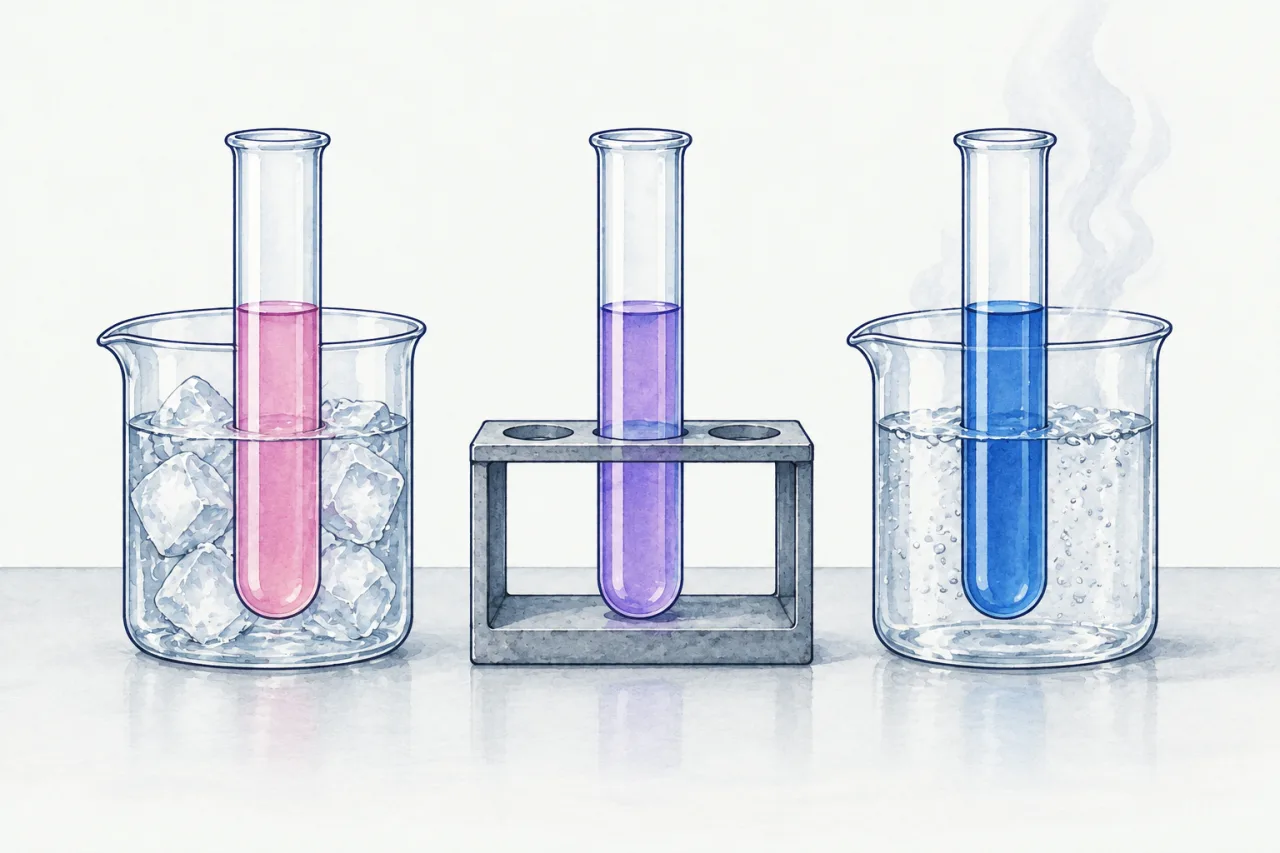
Three tubes of the same solution stand side by side. The one in a beaker of ice is pink, the one in the rack is violet, and the one in hot water is blue. Nothing was added to any of them; only the temperature is different. Move the blue tube into the ice and it turns pink; warm it again and it turns blue. One solution seems to hold both colours at once, and the temperature picks which one wins. In this part you'll find out how a reaction can run both ways at the same time, and how to predict which way it moves when you change the conditions.
 (enlarge)
Your investigation
On your bench is a stoppered flask of cobalt(II) chloride solution with chloride ions added, a rack of three empty test tubes, a beaker of hot water on a hotplate, a beaker of ice and water, a dropping bottle of concentrated hydrochloric acid and a wash bottle of water. The solution contains two forms of cobalt that turn into each other. You are given this information:
pink form + chloride ions ⇌ blue form + water
The forward reaction, to the blue form, takes in energy: it is endothermic. So the reverse reaction, to the pink form, gives out energy.
First you fill the three tubes from the flask. Tube 3 stays in the rack as the reference: you compare the colour of every other tube with it. A magnifier shows you what is happening inside the reference tube. Then you change one condition at a time: you heat tube 1, then cool it, and you add acid to tube 2, then water. Before each change you predict whether the tube will turn bluer, pinker, or stay the same.
Concentrated hydrochloric acid is corrosive and cobalt(II) chloride is toxic, so in school this is done by your teacher, wearing gloves and eye protection.
What the tubes showed
| Tube | Change | Colour | The equilibrium moved |
|---|---|---|---|
| 3 | none: the reference | violet | — |
| 1 | put into hot water | blue | to the right, to the blue form |
| 1 | then put into ice | pink | to the left, to the pink form |
| 2 | a few drops of concentrated hydrochloric acid | blue | to the right |
| 2 | then water added | pink | to the left |
Both ways at once
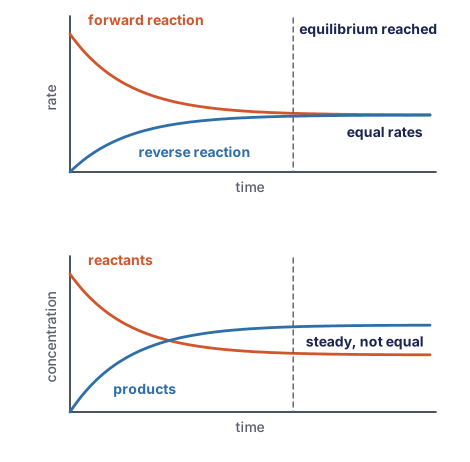
The reference tube stays violet. Nothing seems to happen in it, but the reactions haven't stopped. All the time, pink particles react with chloride ions to make blue ones, and blue particles react with water to make pink ones. Each second, as many pink particles turn blue as blue ones turn pink, so the amounts of each stay the same. The violet colour is the mixture of both.
A reversible reaction in which the forward and reverse reactions go on at the same rate is at equilibrium. Both reactions keep going, so it is called a dynamic equilibrium. It can only happen in a closed system, where no substance can get in or out: in an open container a gas could escape, and the reaction would keep going one way.
A reversible reaction in a closed system is at equilibrium when:
- the rate of the forward reaction is equal to the rate of the reverse reaction;
- the concentrations of the reactants and products are no longer changing.
 (enlarge)
Trap: "At equilibrium the reaction has stopped." Both reactions are still going, at equal rates. The amounts stay the same because each one undoes the other as fast as it happens.
Trap: "At equilibrium there are equal amounts of reactants and products." The concentrations are steady, not equal. The magnifier on the reference tube counted more pink than blue, and the tube was still at equilibrium.
Moving the position
The position of equilibrium tells you how much product there is compared with reactant. If the position moves to the right, more products form: here, the solution turns bluer. If it moves to the left, more reactants form: pinker. The amount of product you get at equilibrium is the yield: when the position moves to the right, the yield goes up.
When you change the conditions of a reaction at equilibrium, the position moves so as to oppose the change: it partly undoes what you did. (This rule is called Le Chatelier's principle.) The changes below show how it works.
Changing the temperature
Heating favours the direction that takes in heat, the endothermic one, because that uses up some of the extra heat. Cooling favours the direction that gives heat out, the exothermic one.
Here the forward reaction is endothermic. So heating moved the position to the right and tube 1 turned blue; cooling moved it to the left and the tube turned pink. If the forward reaction were exothermic, heating would move the position to the left. That's why you must be told which direction takes in heat: you can't tell from the equation alone.
Changing the concentration
Adding more of a reactant moves the position to the right, using up some of what you added: more products form. Adding more of a product moves the position to the left. Taking a product away moves it to the right, to replace it; taking a reactant away moves it to the left, for the same reason.
Concentrated hydrochloric acid is full of chloride ions, a reactant. Adding it to tube 2 moved the position to the right, and the tube turned blue. Then you added water, a product, and the position moved to the left: the tube turned pink.
Changing the pressure
Pressure only matters when there are gases in the reaction. Raising the pressure moves the position to the side with fewer gas molecules, because fewer molecules push less and that lowers the pressure. Lowering the pressure moves it to the side with more gas molecules. Count the gas molecules from the equation, using the numbers in front of each formula:
N2(g) + 3H2(g) ⇌ 2NH3(g): 1 + 3 = 4 gas molecules on the left, 2 on the right, so a higher pressure moves the position to the right.
If both sides have the same number of gas molecules, the pressure makes no difference to the position. Your cobalt solution has no gases at all, so pressure doesn't change its colour.
Using a catalyst
A catalyst speeds up the forward and the reverse reactions by the same amount. The reaction reaches equilibrium sooner, but the position doesn't move: a catalyst makes no more product than you would get without it.
Here are all the changes together:
| Change | The position of equilibrium moves |
|---|---|
| higher temperature | in the endothermic direction |
| lower temperature | in the exothermic direction |
| more of a reactant, or a product taken away | to the right: more products |
| more of a product, or a reactant taken away | to the left: more reactants |
| higher pressure (gases only) | to the side with fewer gas molecules |
| a catalyst | it doesn't move; equilibrium is reached sooner |
Key idea: At equilibrium, the forward and reverse reactions go on at the same rate, and the concentrations stay the same. Change the conditions and the position moves to oppose the change.
Worked example
The brown gas
Nitrogen dioxide, NO2, is a brown gas. Two of its molecules can join to make one molecule of dinitrogen tetroxide, N2O4, a colourless gas. You are told:
2NO2(g) ⇌ N2O4(g), and the forward reaction is exothermic.
A sealed syringe holds the brown mixture at equilibrium. Predict what happens when (a) the syringe is put into ice, (b) the plunger is pushed in, so the pressure rises.
- (a) Cooling favours the exothermic direction, which here is the forward reaction. The position moves to the right: more colourless N2O4, less brown NO2. The gas gets paler.
- (b) Count the gas molecules: 2 on the left, 1 on the right. A higher pressure moves the position to the side with fewer gas molecules, the right. Again, more N2O4 forms, and the brown colour fades.
Worked example
Four changes, one table
Hydrogen and iodine react in a closed flask:
H2(g) + I2(g) ⇌ 2HI(g), and the forward reaction is exothermic.
| Change | Where the position moves | Why |
|---|---|---|
| raise the temperature | to the left: less HI | heating favours the endothermic direction, which here is the reverse reaction |
| raise the pressure | it doesn't move | 2 gas molecules on each side |
| add more hydrogen | to the right: more HI | it uses up some of the added reactant |
| add a catalyst | it doesn't move | both reactions speed up equally; equilibrium is reached sooner |
Heating doesn't always move a position to the right: here it moves it to the left, because the forward reaction gives out heat.
Pause and check
In your investigation, why did the heated tube turn blue? Answer in your head, then read on.
The forward reaction, to the blue form, takes in heat. Heating favours the endothermic direction, so the position moved to the right, making more of the blue form. Cooling did the opposite: it favoured the exothermic reverse reaction, which made more of the pink form.
Case closed
How can one solution be pink and blue at once? Both forms are there all the time, turning into each other at equal rates: a dynamic equilibrium in a closed system, with steady, not equal, amounts. Change the conditions and the position moves to oppose the change. Heating favoured the endothermic forward reaction and the tube turned blue; extra chloride ions pushed the position to the right; extra water pushed it back to the left. Pressure only matters when gases react, and a catalyst gets a reaction to equilibrium sooner without moving its position. In the next part you'll see how chemists use these rules to make ammonia and sulfuric acid.
About this model
The pink form and the blue form are two ions that contain cobalt: in the pink one the cobalt is surrounded by water molecules, in the blue one by chloride ions. You don't need their formulae; questions give you the information you need. The colours in the experiment are worked out from the share of the blue form, so they are a simple model: in real tubes the exact shade depends on how much acid is in the solution. No gas takes part in this reaction, so an open test tube acts as a closed system here: nothing that reacts can escape. The magnifier shows a few particles, drawn much larger and moving much more slowly than real ones. In the syringe of brown gas, pushing the plunger in first makes the gas look darker, because the same gas is squeezed into less space; then it fades as the position moves. Le Chatelier's principle is named here so you know it when you see it; the rules in the table are what you use.
For teachers: Supplement 6.3.3 and 6.3.4 (Cambridge 0620 syllabus, p20). Endothermic and exothermic reactions are ENER01; the Haber and Contact processes are part 3.