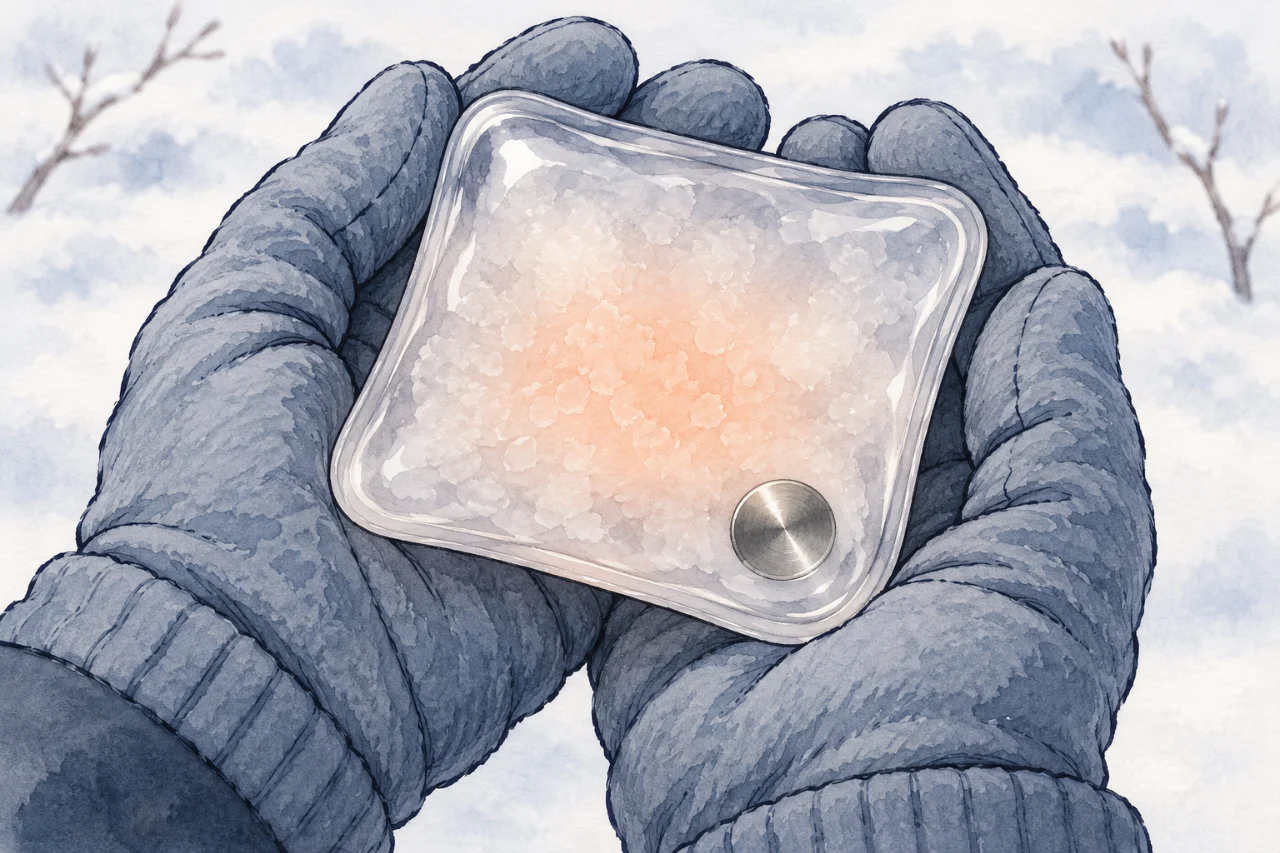
On a snowy day a hand warmer keeps your fingers warm for an hour, and nobody plugged it in. Squeeze an instant cold pack and it soon feels cold enough to put on a sprained ankle, yet nobody put it in a fridge. In both, the energy comes from a change inside the pack. In the reusable warmer in the picture, a liquid turns into crystals; in the cold pack, a solid dissolves in water. Chemical reactions do the same, and a thermometer can tell you which way the energy is going. In this part you'll find out where the heat comes from when a reaction warms things up, and where it goes when a reaction makes them colder.
 (enlarge)
Your investigation
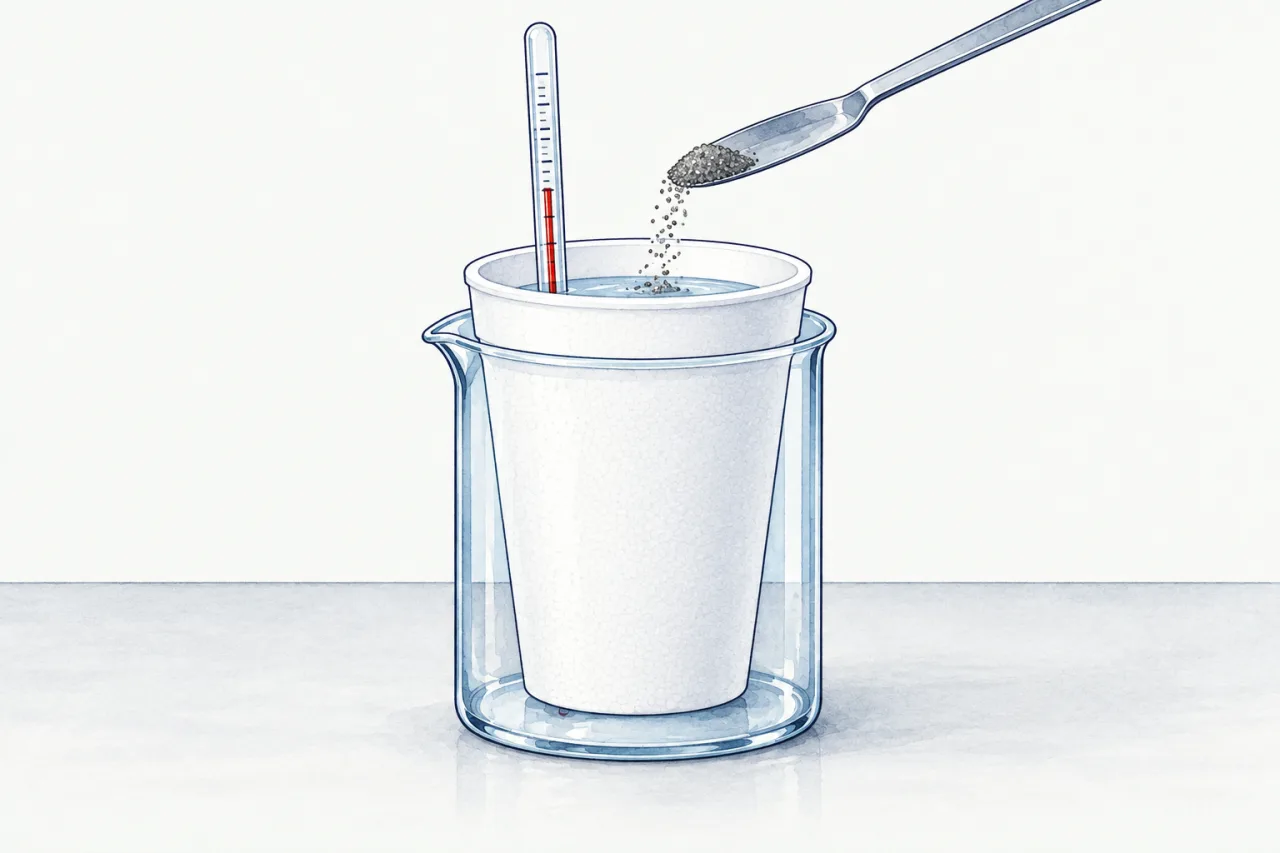
Your bench has a polystyrene cup standing in a glass beaker, so that it can't tip over, and a thermometer held in a clamp so that its bulb dips into the liquid. You'll run three reactions in the cup, one after another, each in a fresh cup, and each starting at room temperature:
- 25.0 cm³ of hydrochloric acid with 0.10 g of magnesium powder;
- 25.0 cm³ of hydrochloric acid with 25.0 cm³ of sodium hydroxide solution;
- 25.0 cm³ of citric acid solution with 3.0 g of sodium hydrogencarbonate powder.
Magnesium fizzes in acid: hydrogen comes off. Predict first: will the thermometer rise, fall or stay where it is? Then read the thermometer before you add anything, add the second reactant, stir, and watch the readings every 15 seconds on the graph.
 (enlarge)
What the thermometer shows
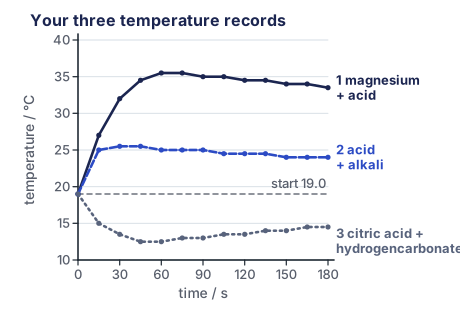
All three runs start at 19.0 °C. Two of them warm the cup up and one cools it down:
| Run | In the cup | Start / °C | Highest or lowest / °C | Change / °C |
|---|---|---|---|---|
| 1 | hydrochloric acid + magnesium | 19.0 | 35.5, highest | +16.5 |
| 2 | hydrochloric acid + sodium hydroxide | 19.0 | 25.5, highest | +6.5 |
| 3 | citric acid + sodium hydrogencarbonate | 19.0 | 12.5, lowest | −6.5 |
 (enlarge)
Look at what happens after the highest point of run 1. The reaction has finished, because the magnesium is used up, so the cup slowly loses thermal energy to the room and the reading slowly falls. Run 3 does the opposite: once the reaction stops, the cold cup slowly takes in thermal energy from the room and warms up again. That's why you record the highest or the lowest temperature, not the last one.
Exothermic: thermal energy goes out
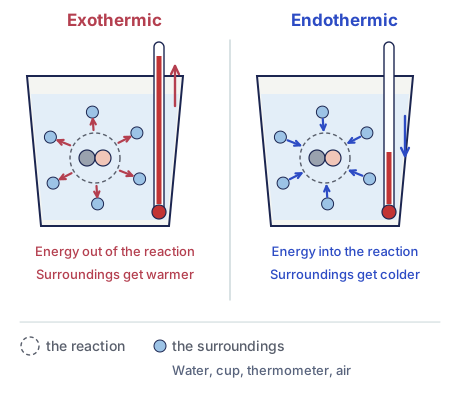
When you talk about the energy of a reaction, split the cup into two parts. The reaction is the reacting particles themselves: the magnesium atoms and the acid. The surroundings are everything else: the water the acid is dissolved in, the cup, the thermometer and the air around it.
In run 1 the reacting chemicals pass thermal energy to the water around them. The water molecules move faster, the water gets warmer and the thermometer rises. A reaction that transfers thermal energy to the surroundings, so that the temperature of the surroundings goes up, is exothermic (exo means "out"). Runs 1 and 2 are both exothermic.
 (enlarge)
Most of the reactions you meet are exothermic:
- combustion: methane burning in a gas cooker, wood burning in a fire;
- neutralisation: an acid reacting with an alkali, like run 2;
- a metal reacting with an acid, like run 1;
- respiration: glucose reacting with oxygen in your cells, which is what keeps your body warm.
Endothermic: thermal energy comes in
Run 3 fizzes just like run 1, yet the thermometer falls. This time the reacting chemicals take in thermal energy from the water around them. The water molecules slow down, the water gets colder and so does the thermometer. A reaction that takes in thermal energy from the surroundings, so that the temperature of the surroundings goes down, is endothermic (endo means "in").
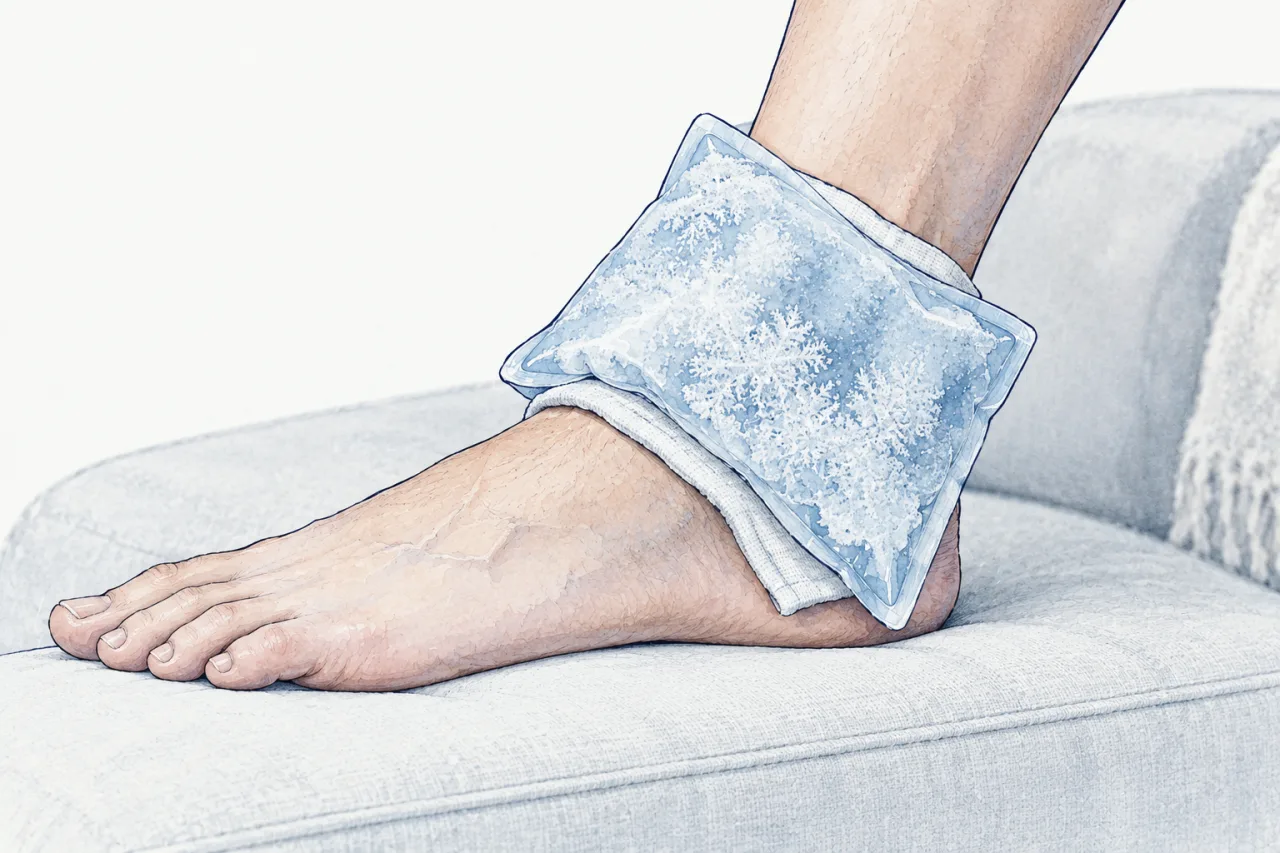
Sherbet sweets contain the same two chemicals as run 3, citric acid and sodium hydrogencarbonate. When they dissolve in your mouth they react and fizz, and they take in thermal energy from your tongue, which is why sherbet feels cool. An instant cold pack works the same way: the solid dissolving in its water takes in thermal energy from the water and the pack, and from your ankle when you hold it there.
 (enlarge)
Endothermic reactions are less common. Two you'll meet again:
- thermal decomposition, such as calcium carbonate breaking down into calcium oxide and carbon dioxide: it only goes on while you keep heating, because it takes in thermal energy all the time;
- photosynthesis: plants take in energy, as light, to make glucose from carbon dioxide and water.
Trap: “An endothermic reaction gives out cold.” Cold isn't something that flows. Thermal energy flows from the surroundings into the reacting chemicals, so the surroundings are left with less energy and get colder. Your tongue feels cool because it has lost energy to the sherbet.
Key idea: An exothermic reaction transfers thermal energy to the surroundings, so the temperature of the surroundings goes up. An endothermic reaction takes in thermal energy from the surroundings, so the temperature of the surroundings goes down. The thermometer measures the surroundings.
Bubbles are not the clue
Runs 1 and 3 both fizz, but one warms the cup and the other cools it. Bubbles tell you that a gas is made; a colour change tells you that a new substance is there. Neither tells you which way the energy goes. Only the change in temperature does, so compare the highest or lowest temperature with the start.
Worked example
Zinc in copper(II) sulfate solution
A pupil puts 25.0 cm³ of copper(II) sulfate solution in a polystyrene cup and reads the thermometer: 21.0 °C. They add zinc powder and stir. The blue colour fades, a brown solid forms and the highest temperature is 43.0 °C. Is the reaction exothermic or endothermic?
- The change is 43.0 − 21.0 = +22.0 °C: the temperature of the solution goes up.
- The solution is the surroundings, so the reaction has transferred thermal energy to the surroundings.
- The reaction is exothermic. The colour change shows that a reaction happened; the rise in temperature shows that it is exothermic.
Worked example
Vinegar and baking soda
Vinegar at 20.0 °C is poured onto baking soda, sodium hydrogencarbonate, in a polystyrene cup. It fizzes hard, and the lowest temperature is 16.0 °C. Is the reaction exothermic or endothermic?
- The change is 16.0 − 20.0 = −4.0 °C: the temperature goes down.
- The reaction has taken in thermal energy from the surroundings.
- The reaction is endothermic, even though it fizzes as hard as magnesium does in acid.
Measuring it well
A few things make your readings show the energy of the reaction and not the room:
- A polystyrene cup. Polystyrene is a good thermal insulator, so very little energy passes through the cup to or from the room while the reaction goes on. A glass beaker on its own lets much more through.
- Stir. Stirring mixes the reactants and keeps the whole liquid at one temperature, so the thermometer reads the whole cup, not one warm corner.
- Read the start, then the highest or lowest. The change is the highest (or lowest) temperature minus the start temperature. The last reading is too low for an exothermic reaction, and too high for an endothermic one, because the cup has started to come back towards room temperature.
- Keep the amounts the same. To compare two reactions fairly, use the same volume of solution each time, because the same energy warms a small volume more than a big one. Run 2 holds 50 cm³, acid and alkali together, so the size of its change can't be compared fairly with runs 1 and 3: it only tells you the type.
Case closed
Where does the heat come from? From the reacting chemicals themselves. In an exothermic reaction, such as magnesium with acid or an acid with an alkali, the reaction transfers thermal energy to the surroundings, and the thermometer in the surroundings rises. In an endothermic reaction, such as citric acid with sodium hydrogencarbonate, the reaction takes in thermal energy from the surroundings, and the thermometer falls. Fizzing doesn't tell you which: the temperature change does.
About this model
The readings are simulated: a model gives typical classroom results for these amounts, read to the nearest 0.5 °C, with a cup that loses or gains a little energy to the room as real polystyrene does. Real results vary with the size of the magnesium grains, the stirring and the room. The magnifier shows the reacting particles inside a dashed ring and arrows for the energy passing to or from the water: a model, not to scale, and the particles move much faster than shown.
For teachers: Core 5.1.1 and 5.1.2 (Cambridge 0620 syllabus, p18). Reaction pathway diagrams, ΔH and activation energy come in part 2; bond energies in the next module.