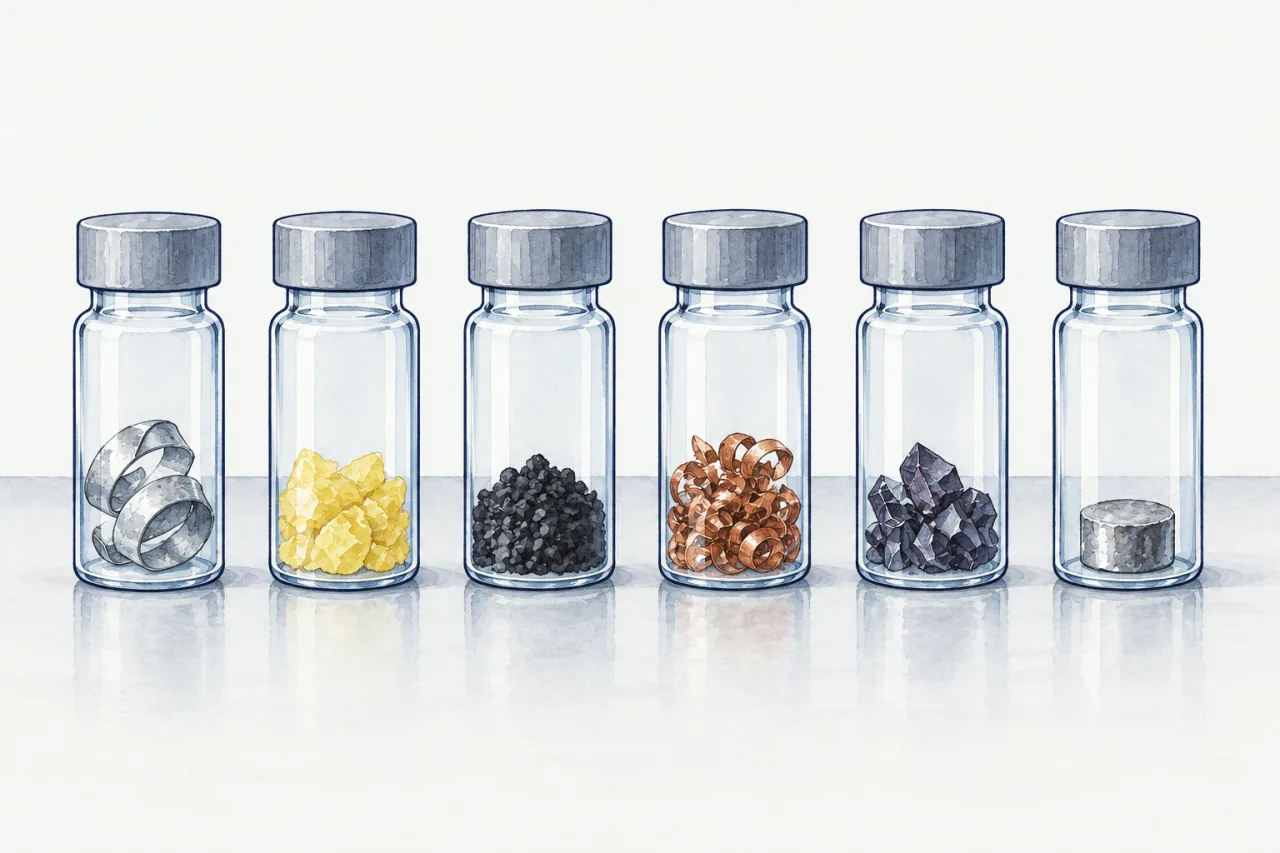
Each of these jars holds one element: magnesium ribbon, yellow sulfur, black carbon, copper turnings, iodine crystals and a pellet of tin. Each element is made of only one kind of atom. So a magnesium atom must differ from a sulfur atom in some way, even though both are far too small to see. In the lab there's also a jar of sodium, a soft metal kept under oil because it reacts with air and water. What exactly makes a sodium atom a sodium atom? In this part you'll take one sodium atom apart, change one particle at a time, and see which change turns it into a different element.
 (enlarge)
Inside an atom
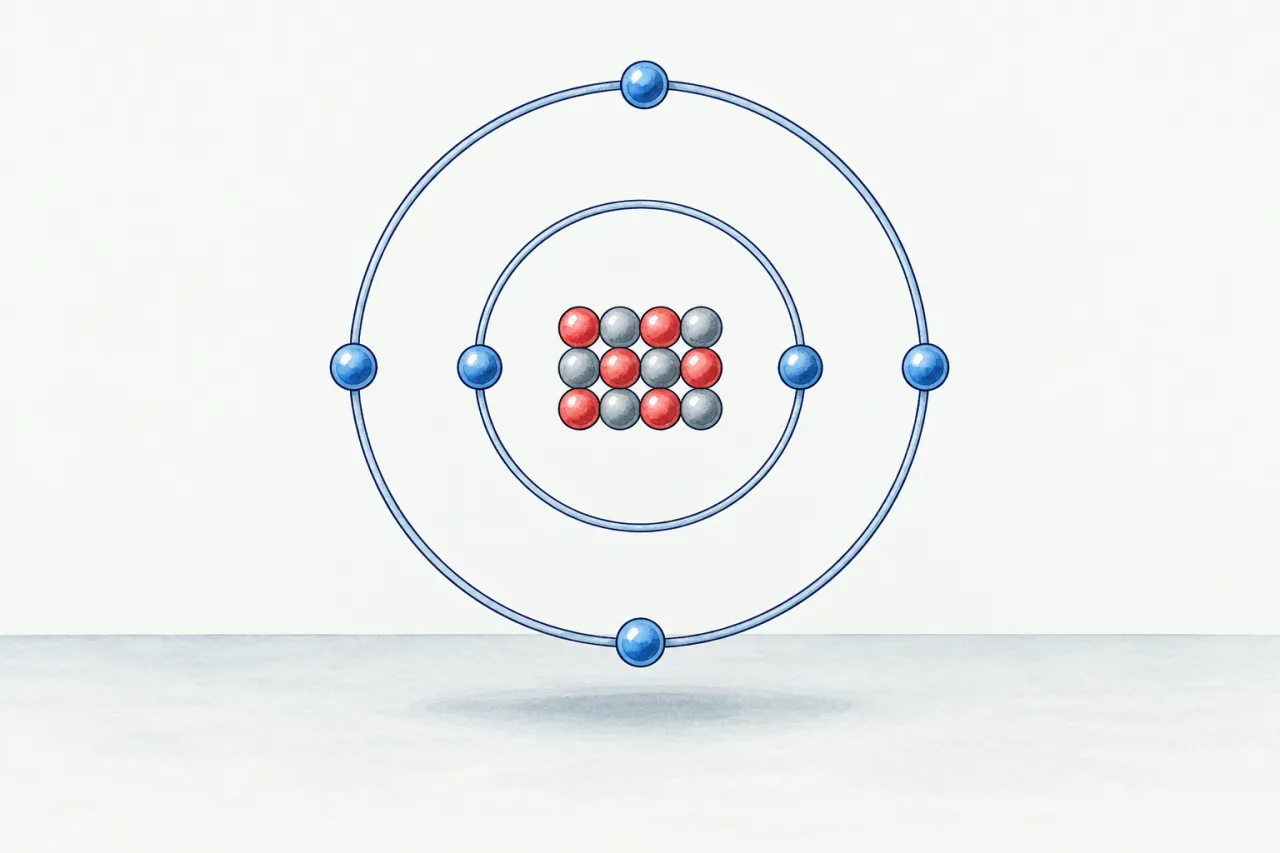
An atom has a tiny nucleus at its centre. The nucleus is made of two kinds of particle: protons and neutrons. Around the nucleus are electrons, arranged in shells: the first shell is closest to the nucleus, the next one further out, and so on. Every atom of every element is built from these three particles. The difference between elements is in how many of each there are.
 (enlarge)
The model in the picture is an atom of carbon: 6 protons (red), 6 neutrons (grey) and 6 electrons (blue). Real particles have no colour, and a real atom is mostly empty space. If the nucleus were the size of a pea in the middle of a football pitch, the electrons would be out near the edge of the stadium.
Three particles
| Particle | Where it is | Relative charge | Relative mass |
|---|---|---|---|
| proton | in the nucleus | +1 | 1 |
| neutron | in the nucleus | 0 | 1 |
| electron | in shells around the nucleus | −1 | 1/1840 |
These are relative values: each charge and mass is compared with that of a proton. A neutron has the same mass as a proton but no charge. An electron has the same size of charge as a proton, but the opposite sign, and only 1/1840 of its mass. So it would take 1840 electrons to balance one proton on a scale. That's why almost all the mass of an atom is in its nucleus.
An atom has the same number of electrons as protons. Each proton's +1 cancels one electron's −1, so the atom has no overall charge: it's neutral.
Proton number and mass number
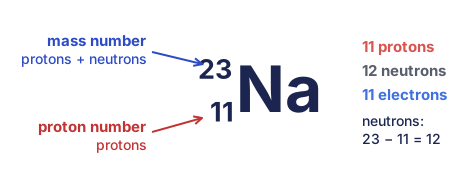
Two numbers describe the nucleus of an atom. The proton number, also called the atomic number, is the number of protons in the nucleus. The mass number, also called the nucleon number, is the total number of protons and neutrons in the nucleus. (Protons and neutrons together are called nucleons.) Electrons aren't counted in the mass number, because their mass is so small.
The two numbers are written beside the element's symbol: the mass number at the top left, the proton number at the bottom left. The most common sodium atom has proton number 11 and mass number 23, so we call it sodium-23.
 (enlarge)
So a sodium atom has 11 protons. The number of neutrons is the mass number minus the proton number: 23 − 11 = 12. And because the atom is neutral, it has 11 electrons, in shells of 2, 8 and 1.
Predict, then change one particle
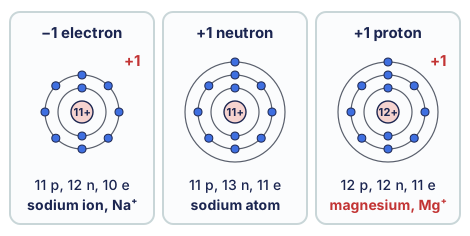
Here's the question for the experiment. A model of one sodium atom has 11 protons, 12 neutrons and 11 electrons, and beside it are three dishes of spare particles. You can make one change at a time: take away an electron, add a neutron or add a proton. Before each change, decide: will the atom still be sodium, or will it become a different element? Watch the atom card after each change: which numbers change, and which stay the same?
Only the protons decide
 (enlarge)
Take away an electron. The nucleus doesn't change: still 11 protons and 12 neutrons, so the proton number is still 11 and the mass number still 23. It's still sodium. But now there are 11 protons and only 10 electrons, so one +1 isn't cancelled and the particle has a charge of +1. A charged particle made from an atom is an ion: this one is a sodium ion, Na+. Its charge is the number of protons minus the number of electrons: 11 − 10 = +1.
Add a neutron. Now the nucleus has 11 protons and 13 neutrons. The mass number goes up from 23 to 24, but the proton number is still 11. So it's still sodium, just a heavier sodium atom: sodium-24. Neutrons have no charge, so it's still neutral. Atoms of one element can have different numbers of neutrons; you'll meet them again later in the course.
Add a proton. Now there are 12 protons, so the proton number is 12. Every element has its own proton number, and 12 belongs to magnesium. The atom has become magnesium. It still has only 11 electrons, so for now it has a charge of 12 − 11 = +1. This is only a step in the model: a real magnesium atom has 12 electrons, and the ion magnesium forms in reactions is Mg2+, which you'll meet in part 2. Adding one more electron makes a neutral magnesium atom, and in part 2 you'll find where that 12th electron goes.
So only a change in the number of protons changes the element. The proton number is the element's identity card: every sodium atom has 11 protons, every magnesium atom has 12, and the Periodic Table lists the elements in order of proton number.
Trap: “Taking away an electron turns sodium into a different element.” The element is decided by the nucleus, and the nucleus hasn't changed: 11 protons is still sodium. Losing an electron makes a sodium ion, with a charge of +1.
Trap: “The mass number tells you which element it is.” Sodium-23 and sodium-24 are both sodium, but their mass numbers differ. Only the proton number tells you the element.
Trap: “Electrons make up most of the mass, because they're spread all round the atom.” They take up most of the space, but each has only 1/1840 of the mass of a proton. Almost all the mass is in the nucleus.
Key idea: An atom has a nucleus of protons (charge +1, mass 1) and neutrons (charge 0, mass 1), with electrons (charge −1, mass 1/1840) in shells around it. The proton number is the number of protons and decides the element. The mass number is the number of protons plus neutrons. In an atom, electrons = protons; in an ion they differ, and charge = protons − electrons.
Worked example
Reading the symbol for aluminium
An aluminium atom is written with mass number 27 at the top left and proton number 13 at the bottom left. How many protons, neutrons and electrons does it have?
The bottom number is the proton number, so there are 13 protons. The top number counts protons and neutrons together, so the neutrons are 27 − 13 = 14. An atom is neutral, so the number of electrons equals the number of protons: 13 electrons.
Check: 13 protons + 14 neutrons = 27, the mass number. The electrons don't count towards it.
Worked example
Naming a particle from its numbers
A particle has 17 protons, 18 neutrons and 18 electrons. Which element is it, what is its mass number, and what is its charge?
The element comes from the protons only. The element with proton number 17 is chlorine. The mass number is protons + neutrons = 17 + 18 = 35. The charge is protons − electrons = 17 − 18 = −1. It has one more electron than protons, so it's an ion of chlorine with a charge of −1, called a chloride ion, Cl−.
The 18 electrons don't make it a different element, and nor do the 18 neutrons. Argon atoms also have 18 electrons, but this particle has 17 protons, so it's chlorine.
Case closed
Sodium is sodium because every sodium atom has 11 protons in its nucleus. Taking away an electron gave a sodium ion; adding a neutron gave a heavier sodium atom; only adding a proton made a new element, magnesium. To work out any atom, read the proton number for the protons, take it from the mass number for the neutrons, and match the electrons to the protons, or use the charge for an ion.
About this model
No real process adds protons to an atom one at a time in a lab: changing a nucleus needs a nuclear reaction, far beyond a chemical one. Chemical reactions change only the electrons. The model isn't to scale either: a real nucleus is about 100 000 times smaller across than its atom, so the whole atom couldn't fit on the screen if the nucleus were visible. Sodium-24 does exist, but it is radioactive and changes into magnesium within a few days, so all the sodium in the jar is sodium-23. The shells are drawn as rings; in a real atom electrons don't travel round fixed circles, but the shell model correctly shows which electrons are closest to the nucleus.