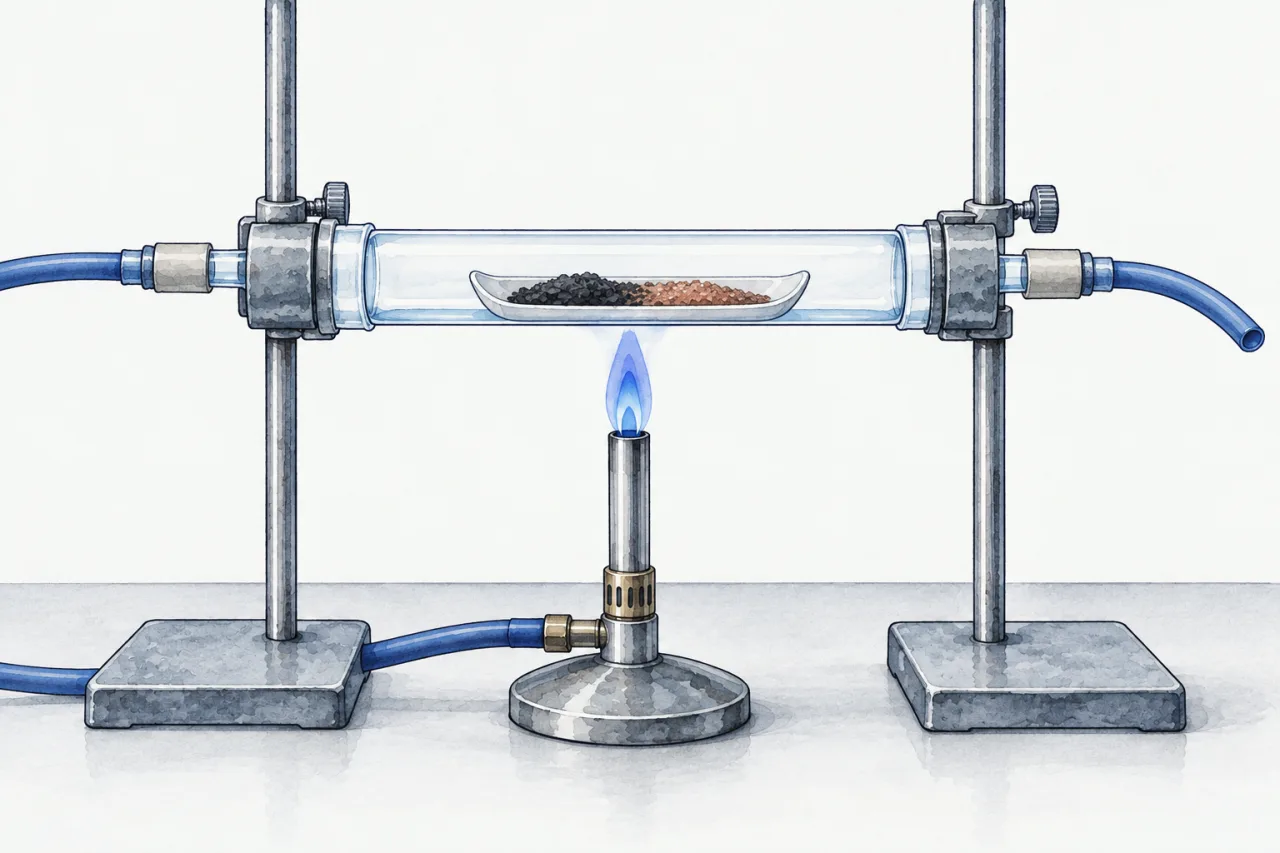
A glass tube lies across two clamp stands, with a Bunsen flame under its middle. Inside the tube, a china boat holds black copper(II) oxide powder, and a slow stream of hydrogen gas flows through from one end to the other.
As the powder gets hot, it turns pink-brown, starting from one end, and drops of a colourless liquid collect where the tube is cooler: water. A black powder has become a metal.
Where did the black go, and what happened to the hydrogen? In this part you'll follow the oxygen: which substance gains it, which loses it, and why the two always happen together.
 (enlarge)
Copper gains oxygen
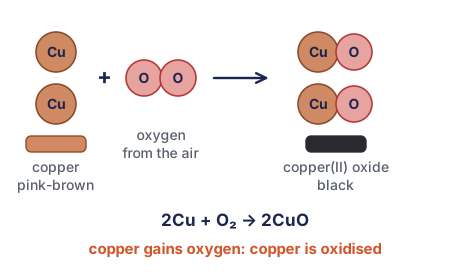
Start with something simpler. Hold a strip of shiny pink-brown copper foil in a Bunsen flame, and after a minute it is covered in a black coat. Nothing was added except heat, so where did the black come from? The copper has reacted with oxygen from the air and made black copper(II) oxide:
copper + oxygen → copper(II) oxide
2Cu + O2 → 2CuO
Copper has gained oxygen. A substance that gains oxygen is oxidised, and the gain of oxygen is called oxidation. Burning is oxidation too: when charcoal burns, carbon gains oxygen and becomes carbon dioxide, C + O2 → CO2.
 (enlarge)
The oxygen changes too: it starts as a gas of O2 molecules and ends up inside an oxide. What that change is called comes in part 2, for the Supplement.
Copper(II) oxide loses oxygen
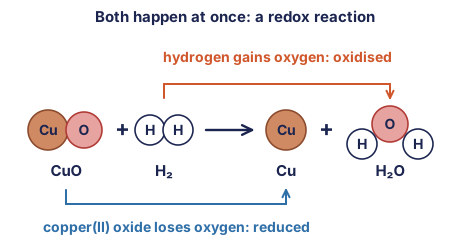
Back to the tube. Hot copper(II) oxide meets hydrogen, and the opposite of the copper foil happens: the oxide loses its oxygen and pink-brown copper is left. The oxygen doesn't vanish. It joins the hydrogen and makes the water that collects in the tube.
copper(II) oxide + hydrogen → copper + water
CuO + H2 → Cu + H2O
A substance that loses oxygen is reduced, and the loss of oxygen is called reduction. Copper(II) oxide is reduced to copper. Now look at the hydrogen: it gained the oxygen that the copper(II) oxide lost, so hydrogen is oxidised. An oxide can only lose its oxygen if something else takes it, so reduction and oxidation happen at the same time, in the same reaction. A reaction in which oxidation and reduction happen together is a redox reaction: the name joins reduction and oxidation.
 (enlarge)
Trap: "Heating copper(II) oxide in hydrogen is a reduction, not a redox reaction." Copper(II) oxide is reduced, yes, but the oxygen it lost was gained by the hydrogen, which is oxidised at the same moment. A reduction never happens on its own, so the reaction as a whole is redox.
Who gains, who loses?
You can find oxidation and reduction in any equation by following the oxygen atoms from the left side to the right.
- Find a substance that gains oxygen: an element that becomes an oxide, or an oxide that takes on more oxygen. That substance is oxidised.
- Find a substance that loses oxygen: an oxide that turns into its element, or into an oxide with less oxygen. That substance is reduced.
- If you find both, the reaction is redox.
Not every reaction with oxygen atoms in it is redox. Mix silver nitrate solution with sodium chloride solution and white silver chloride forms:
AgNO3 + NaCl → AgCl + NaNO3
The oxygen atoms stay inside the nitrate group, NO3, which only moves from the silver to the sodium. No element gains oxygen, and no oxide loses it, so this reaction is not redox.
Key idea: Oxidation is gain of oxygen; reduction is loss of oxygen. They always happen together, in a redox reaction: whatever loses oxygen gives it to something that gains it.
Worked example
Iron from its ore
In a blast furnace, iron is made from iron(III) oxide and carbon monoxide:
Fe2O3 + 3CO → 2Fe + 3CO2
Which substance is oxidised and which is reduced? Is the reaction redox?
- Follow the oxygen from iron(III) oxide. Fe2O3 has three oxygen atoms; the iron on the right has none. Iron(III) oxide loses oxygen: it is reduced.
- Follow the oxygen to carbon monoxide. CO has one oxygen atom; CO2 has two. Carbon monoxide gains oxygen: it is oxidised.
- Both happen at once, so the reaction is redox.
Worked example
Magnesium and copper(II) oxide
A mixture of magnesium powder and black copper(II) oxide is heated. It flashes brightly, and pink-brown copper and white magnesium oxide are left:
Mg + CuO → MgO + Cu
- Magnesium becomes magnesium oxide: it gains oxygen, so it is oxidised.
- Copper(II) oxide becomes copper: it loses oxygen, so it is reduced.
- Here a metal took the oxygen, where in the tube it was hydrogen. Whatever takes the oxygen, the oxide that loses it is reduced, and the reaction is redox.
What the (II) means
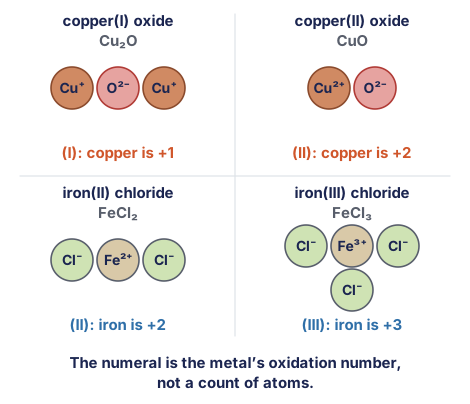
Copper makes two oxides. The black one you have met is copper(II) oxide, CuO. There is also a red-brown one, copper(I) oxide, Cu2O. Why do the names carry numbers in brackets, and why are the formulae different?
Both are ionic compounds. In CuO, each copper ion is Cu2+: its two positive charges balance the two negative charges of one oxide ion, O2−. In Cu2O, each copper ion is Cu+, so two of them are needed to balance one O2−. The Roman numeral in the name shows the oxidation number of the copper in the compound: for the ion of a metal, the oxidation number is the same as its charge. Copper(I) means copper +1; copper(II) means copper +2.
A metal that forms more than one kind of ion needs the numeral. Iron(II) chloride, FeCl2, contains Fe2+ ions; iron(III) chloride, FeCl3, contains Fe3+ ions. To name a compound from its formula, work out the charge on the metal ion: in FeCl3, three Cl− ions balance one iron ion, so the iron is Fe3+ and the compound is iron(III) chloride. A metal that only ever forms one kind of ion, such as sodium (always Na+) or magnesium (always Mg2+), gets no numeral: sodium chloride, magnesium oxide.
 (enlarge)
Trap: "Copper(II) oxide has two copper atoms." The numeral is the oxidation number, not a count of atoms. CuO has one copper for each oxygen; it is copper(I) oxide, Cu2O, that has two. Read copper(II) as "copper is +2".
Case closed
Where did the black go? Black copper(II) oxide lost its oxygen to the hydrogen: it was reduced to pink-brown copper, and the hydrogen, which gained the oxygen, was oxidised to water. Oxidation is gain of oxygen, reduction is loss of oxygen, and one never happens without the other: together they make a redox reaction. To find them in an equation, follow the oxygen from the left side to the right. The Roman numeral in a name such as copper(II) oxide gives the oxidation number of the metal, here +2, not a number of atoms. In the next part, for the Supplement, you'll meet a redox reaction in which no oxygen moves at all.
About this model
The particle drawings show each formula as a few balls side by side. Real copper(II) oxide is a giant lattice of ions, and real copper a giant lattice of atoms; the drawings only count which atoms are joined to which. The "follow the oxygen" rule works when oxygen moves between an element and an oxide. It can mislead elsewhere: copper(II) oxide also reacts with dilute sulfuric acid, CuO + H2SO4 → CuSO4 + H2O, and it looks as if the oxide loses its oxygen. But the copper is copper(II) on both sides, in the oxide and in the sulfate: this is neutralisation, not redox. Part 2, for the Supplement, gives the sharper test that chemists use: a change in oxidation number.