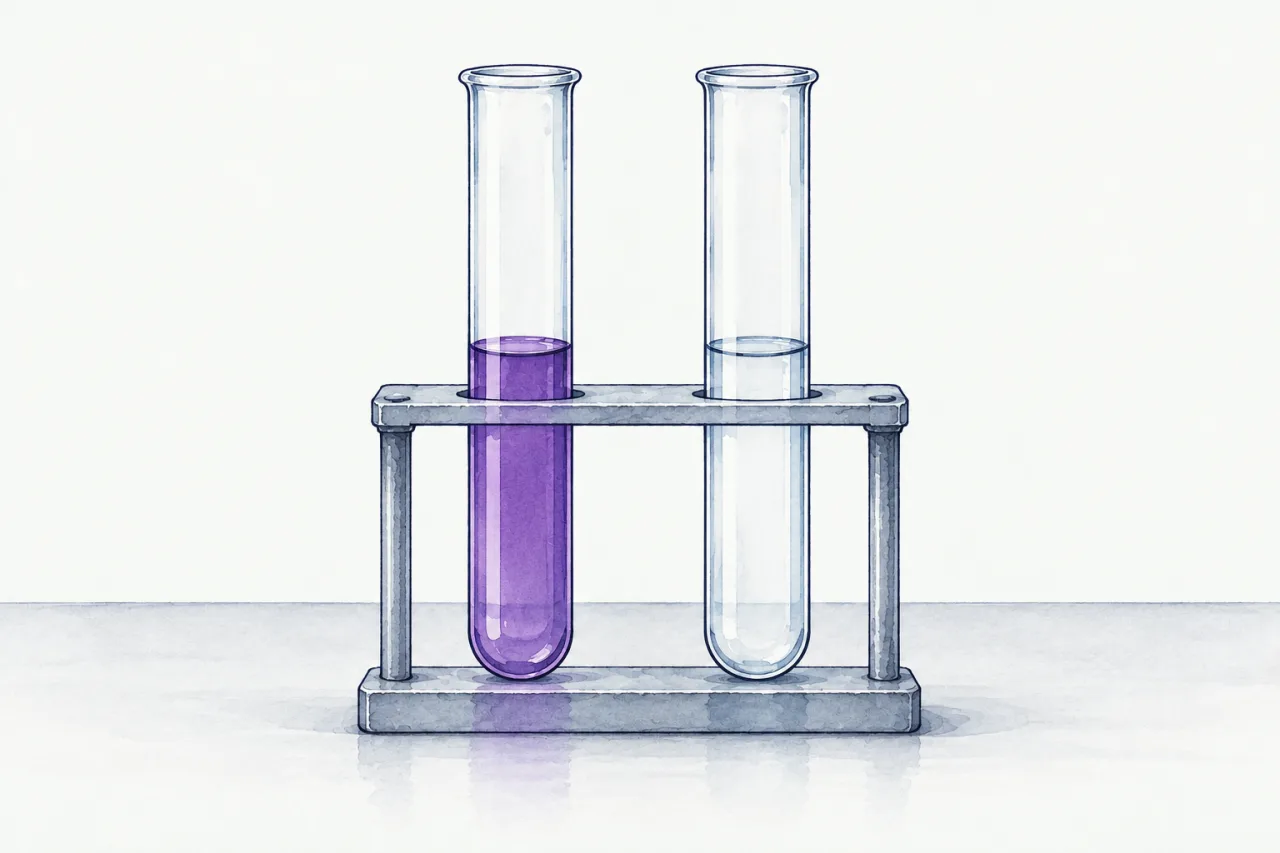
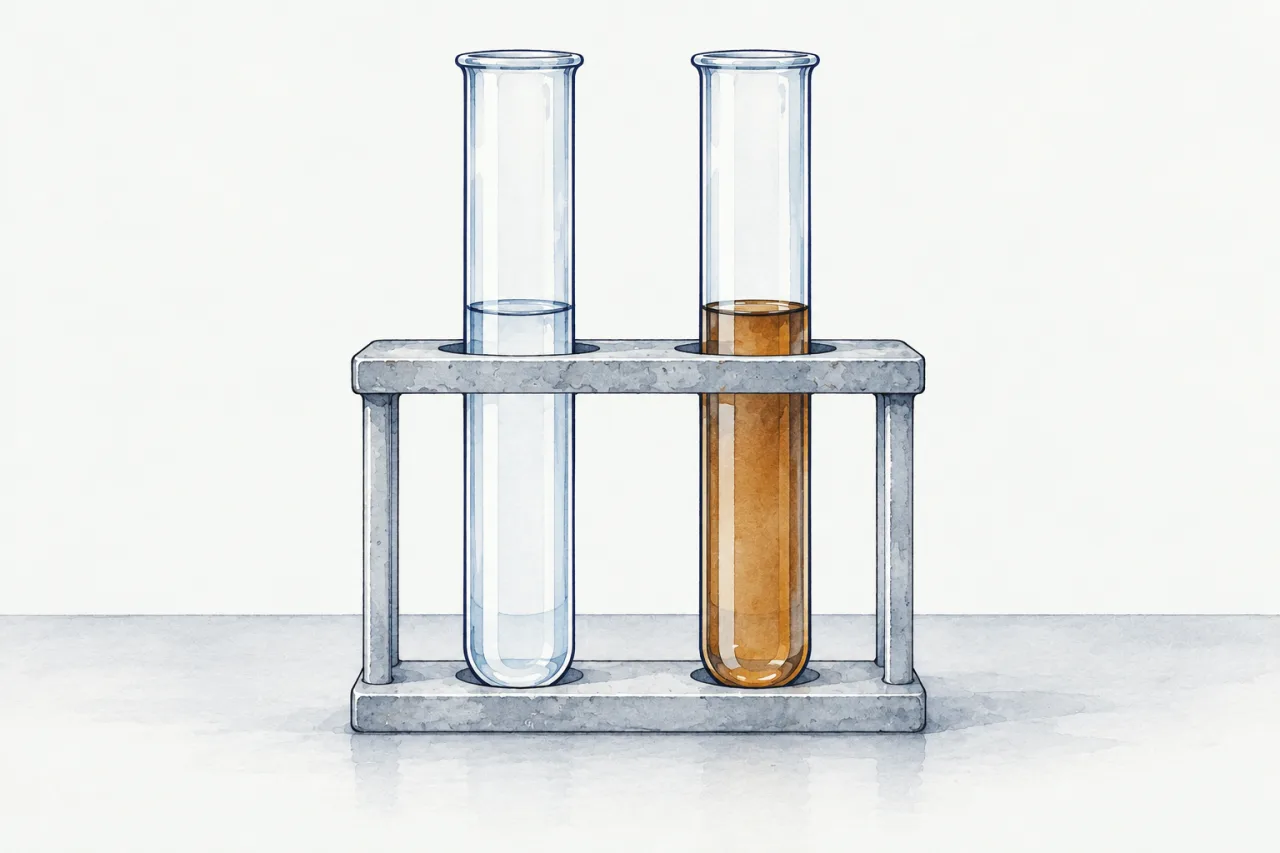
A test tube of bright purple solution stands in a rack. A few drops of a colourless solution go in, and the purple fades until the tube looks as clear as water. In another rack, a colourless solution turns brown as soon as a few drops of a different colourless solution are added. Nothing was heated and no solid appeared, yet both tubes have changed colour. What do these colours tell you about the substance that was added? In this part you'll use the two colour changes as tests for oxidising agents and reducing agents. This whole part is Supplement, for the Extended papers.
 (enlarge)
A purple that vanishes
Potassium manganate(VII), KMnO4, dissolves to give a deep purple solution. The colour comes from the manganate(VII) ion, MnO4−, in which manganese has the oxidation number +7: you worked it out in part 2. For the test, the solution is acidified: a little dilute sulfuric acid is added to it. Why should the purple ever disappear?
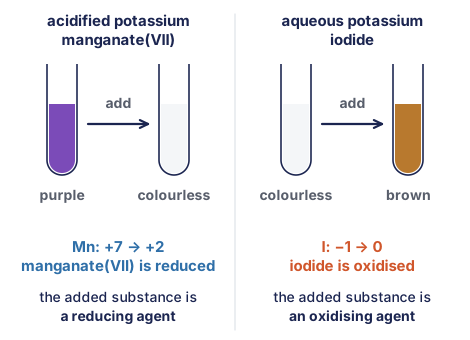
A substance that gives electrons to the manganate(VII) ion reduces the manganese from +7 to +2, in the Mn2+ ion, which is almost colourless. So the purple fades away. Manganese goes down from +7 to +2: it is reduced, which makes acidified potassium manganate(VII) an oxidising agent. The substance added gave the electrons, so it was oxidised: it is a reducing agent.
The test: if acidified potassium manganate(VII) turns from purple to colourless, the substance added is a reducing agent.
For example, iron(II) sulfate solution turns acidified potassium manganate(VII) colourless. Each Fe2+ ion gives up one electron and becomes Fe3+: iron goes up from +2 to +3, so iron(II) sulfate is oxidised. It is the reducing agent.
Trap: "The purple got paler, so the substance is a reducing agent." A paler purple alone proves nothing. Any colourless liquid, even water, makes the purple paler by spreading it through more liquid, and a reducing agent that is too little to use up all the manganate(VII) leaves some purple too. The test needs the purple to go completely: colourless. While some purple stays, however pale, the test has not shown a reducing agent.
A brown that appears
Potassium iodide, KI, dissolves to give a colourless solution of iodide ions, I−, with the oxidation number −1. How can a colourless solution make a colour that neither solution had?
An oxidising agent takes electrons from the iodide ions and turns them into iodine, I2, with the oxidation number 0. Iodine in solution is brown: yellow-brown when only a little forms, a deeper brown with more. Iodide goes up from −1 to 0: it is oxidised. The substance added took the electrons, so it was reduced: it is an oxidising agent.
The test: if aqueous potassium iodide turns from colourless to brown, the substance added is an oxidising agent.
For example, chlorine water turns potassium iodide solution brown:
Cl2 + 2I− → 2Cl− + I2
Chlorine goes down from 0 to −1, so chlorine is reduced: it is the oxidising agent. The potassium ions are spectators.
 (enlarge)
Trap: "The brown is the colour of the substance that was added." The substance added was colourless, and so was the potassium iodide. The brown is iodine, made in the tube from the iodide ions.
 (enlarge)
Worked example
One unknown, two tests
A colourless solution, Q, is tested both ways. With acidified potassium manganate(VII), the purple turns colourless. With aqueous potassium iodide, the solution stays colourless. What does Q do?
- The manganate(VII) test changed. Manganese went from +7 to +2: it was reduced, so Q gave it electrons. Q is a reducing agent, and Q itself was oxidised.
- The iodide test did not change. No iodine formed, so Q took no electrons from the iodide ions. Q is not acting as an oxidising agent here.
- Conclusion: Q is a reducing agent.
What no change tells you
Magnesium sulfate solution is tested both ways. The purple stays purple, and the iodide stays colourless. Is magnesium sulfate therefore unreactive?
No. Add a few drops of sodium hydroxide solution to magnesium sulfate solution and a white precipitate forms at once. Magnesium sulfate reacts, just not by giving or taking electrons with these two tests. A test that shows no change only tells you that, in this test, the substance did not act as that kind of agent: no change with manganate(VII) means it did not reduce the manganate(VII), and no change with iodide means it did not oxidise the iodide. It can still take part in other reactions, such as precipitation or neutralisation.
Trap: "No colour change with manganate(VII) means the substance is unreactive." It only means the substance did not reduce the manganate(VII) in the test. It may be an oxidising agent instead, which the iodide test would show, or it may react in a way that doesn't involve electrons moving at all.
Case closed
What do the colours tell you? When purple acidified potassium manganate(VII) turns colourless, manganese has gone from +7 to +2: it was reduced, so the substance added was a reducing agent. When colourless potassium iodide turns brown, iodide ions have been oxidised to iodine, from −1 to 0, so the substance added was an oxidising agent. Each test has one positive result. No change means only that this test has not shown that kind of agent; it doesn't mean the substance is unreactive.
About this model
The Mn2+ ion is very pale pink, so a dilute solution of it looks colourless. You don't need the full equation for the manganate(VII) reaction: the change of manganese from +7 to +2 is enough. The test solution is acidified because, without acid, the manganate(VII) ion is reduced in a different way and gives a brown solid instead of a colourless solution. The shade of the iodine colour depends on how much iodine forms, from pale yellow-brown to dark brown. The pictures show the solution before and after in two tubes side by side; in the lab, the change happens in one tube.