A grey strip of zinc is about to go into a beaker of blue copper(II) sulfate solution. The blue comes from copper(II) ions, Cu2+. The sulfate ions, SO42−, keep their four oxygen atoms whatever happens, and there is no other oxygen to gain or lose. So by the rule of part 1, nothing here can be oxidised or reduced. Will anything happen at all? And if something does, could it still be a redox reaction? In this part you'll find a way to spot oxidation and reduction that doesn't need oxygen. The investigation is for everyone; from the section on electrons onwards, this part is Supplement, for the Extended papers.
Your investigation
On your bench are two 100 cm³ beakers. The one on the left holds 50 cm³ of blue copper(II) sulfate solution; the one on the right holds 50 cm³ of colourless zinc sulfate solution. In front of them, a clean grey strip of zinc and a clean pink-brown strip of copper lie on a white tile, and a stop-clock stands beside them.
The test runs both ways: zinc metal meets copper(II) ions, and copper metal meets zinc ions. You stand the zinc strip in the copper(II) sulfate solution and the copper strip in the zinc sulfate solution, start the stop-clock, and watch 10 minutes pass in a time-lapse. Afterwards you decide what any new solid is and where it came from. For the Supplement, a magnifier then shows the surface of the zinc as a model of its particles, and you decide which particle lost electrons and which took them.
First, predict: which strip will change in 10 minutes? The zinc in the copper(II) sulfate, the copper in the zinc sulfate, both, or neither?
What the strips showed
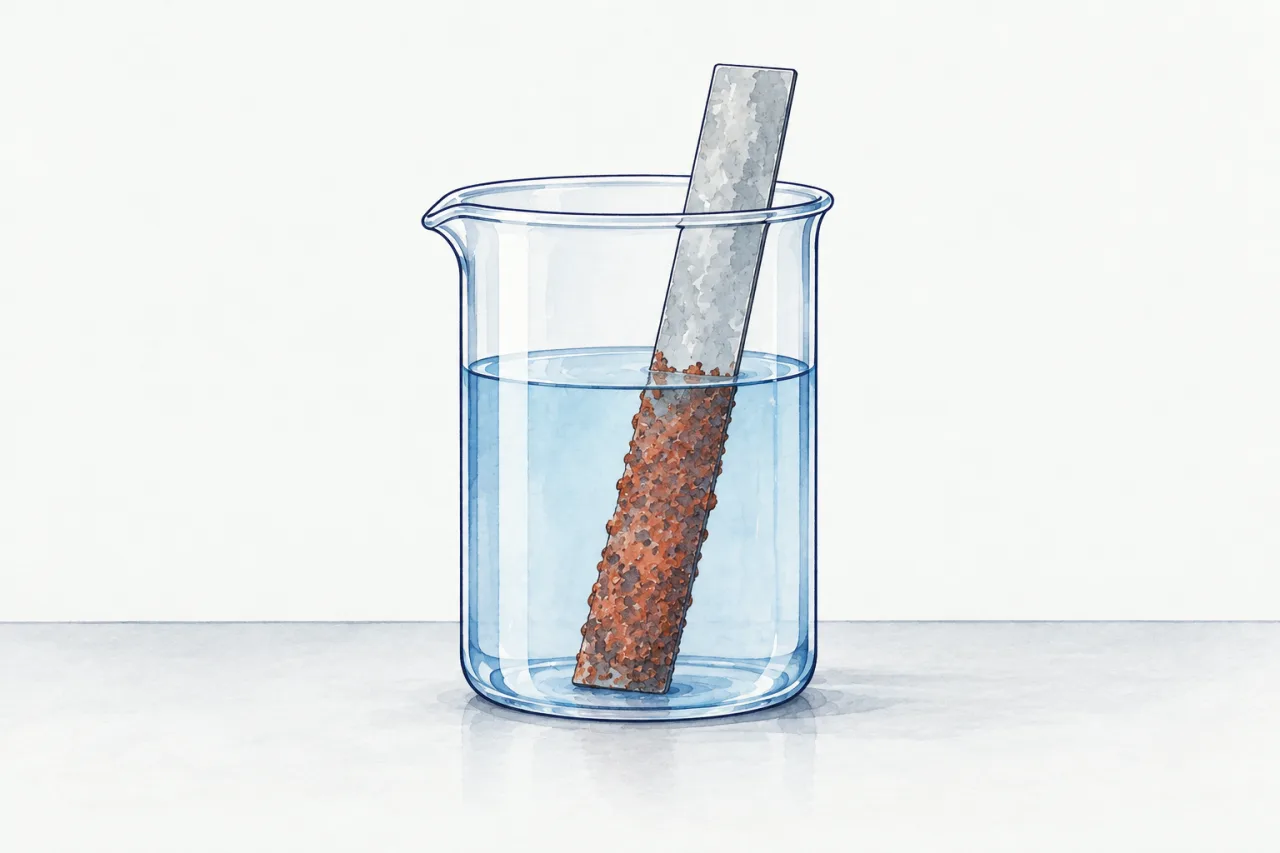
After 10 minutes, the zinc strip has changed and the copper strip hasn't. A crumbly brown-pink solid coats the zinc, but only the part that stood in the solution; the part in the air is still grey. The blue solution is paler, though not colourless. In the other beaker, the copper strip looks as it did at the start, and the zinc sulfate solution is still colourless.
 (enlarge)
| Strip | Solution | What you saw after 10 minutes |
|---|---|---|
| zinc | copper(II) sulfate, blue | a brown-pink solid on the part in the solution; the blue paler |
| copper | zinc sulfate, colourless | no change |
The brown-pink solid is copper. It can only have come from the copper(II) ions in the solution: as they turned into copper metal, fewer were left in the solution, and the blue faded. The blue is paler but not gone, because in 10 minutes the strip used up only part of the copper(II) ions. Zinc took the place of copper in the solution:
zinc + copper(II) sulfate → zinc sulfate + copper
Zn(s) + CuSO4(aq) → ZnSO4(aq) + Cu(s)
Zinc sulfate solution is colourless, so the zinc that went into the solution can't be seen. The reverse doesn't happen: copper doesn't push zinc out of zinc sulfate. Why some metals can do this to others is the subject of a later module, on the reactivity series.
Supplement: no oxygen moved, so what did?
Look at the equation again. No substance gained oxygen and none lost it, yet a new metal appeared. The sulfate ions were in the solution at the start and are still there at the end, unchanged. Ions that are present but take no part in a reaction are spectator ions. An ionic equation leaves them out and shows only the particles that change:
Zn(s) + Cu2+(aq) → Zn2+(aq) + Cu(s)
The state symbols say where each particle is: (s) is a solid, here the metal strip or the copper crust, and (aq) is dissolved in water, here the ions in the solution.
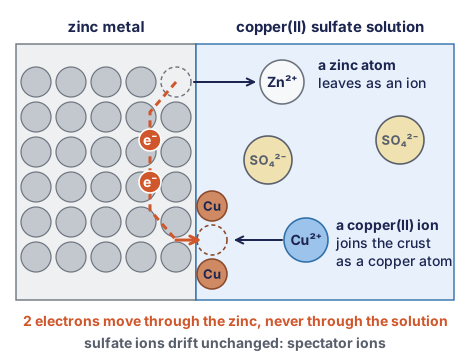
Each electron carries one negative charge. A zinc atom has no charge, because its positive and negative charges balance. When it loses two electrons, two positive charges are left over, so it becomes a zinc ion, Zn2+. A copper(II) ion, Cu2+, is two electrons short of a copper atom: when it gains two electrons, their two negative charges cancel its 2+, and it becomes a copper atom. So the electrons went from zinc to copper. The magnifier showed how: a zinc atom at the surface leaves as a Zn2+ ion, and its two electrons move through the metal to a Cu2+ ion touching the surface, which becomes a copper atom in the crust.
 (enlarge)
Chemists define oxidation and reduction by electrons:
- oxidation is the loss of electrons: zinc atoms are oxidised;
- reduction is the gain of electrons: copper(II) ions are reduced.
A way to remember it: OIL RIG, Oxidation Is Loss, Reduction Is Gain. The electrons each zinc atom loses are the same electrons a copper(II) ion gains, so once again oxidation and reduction happen together. This is a redox reaction, though no oxygen moved at all.
Trap: "The electrons travel through the solution from the zinc to the copper ions." Electrons move through the metal, which conducts. They reach only the copper(II) ions that touch the zinc. That is why the copper grows on the zinc, and not anywhere else in the beaker.
Trap: "The sulfate ion takes part: it moves from the copper to the zinc." The sulfate ions are in the solution at the start and still there at the end, unchanged. They only change partner on paper, in the full equation; that is why the ionic equation leaves them out.
Oxidation numbers
Counting electrons is easy for a simple ion such as Zn2+. But how many electrons has the sulfur in a sulfate ion, SO42−, lost or gained? Chemists keep track with an oxidation number for each element, worked out with four rules:
- An element on its own, not combined with another element, has oxidation number 0: Zn, Cu, O2 and H2 are all 0.
- An ion made of one atom has an oxidation number equal to its charge: Zn2+ is +2 and Cl− is −1.
- In a compound, the oxidation numbers add up to 0.
- In an ion made of several atoms, the oxidation numbers add up to the charge on the ion.
Some values you can use to start: oxygen in its compounds is −2; hydrogen combined with non-metals is +1; Group 1 metals in their compounds are +1, and Group 2 metals +2. Write the sign before the number: +2, −1. A Roman numeral gives the same number: copper(II) means copper +2.
Worked example
Three oxidation numbers (Supplement)
Find the oxidation number of (a) iron in Fe2O3, (b) sulfur in SO42−, (c) manganese in MnO4−.
- (a) Fe2O3 is a compound, so the total is 0. Three oxygen atoms give 3 × (−2) = −6, so the two iron atoms together are +6, and each is +3. That is why the compound is called iron(III) oxide.
- (b) SO42−: four oxygen atoms give −8. The total must be the charge, −2, so sulfur is +6.
- (c) MnO4−: four oxygen atoms give −8, and the total is −1, so manganese is +7. This is the manganate(VII) ion, which you'll meet in part 3.
Up is oxidised, down is reduced
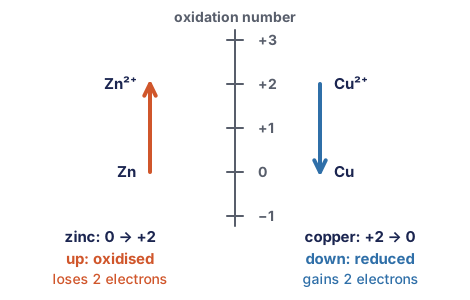
Now look at the zinc and the copper again, this time on a ladder of oxidation numbers. Zinc goes from 0 in the metal to +2 in the Zn2+ ion: up two steps. Copper goes from +2 in the Cu2+ ion to 0 in the metal: down two steps. Each step up is one electron lost, and each step down is one electron gained. So:
- oxidation is an increase in oxidation number;
- reduction is a decrease in oxidation number.
A reaction in which the oxidation number of one element goes up and that of another goes down is redox. If no oxidation number changes, it is not redox, even when oxygen atoms move from one substance to another.
 (enlarge)
Worked example
Part 1's reactions, checked again (Supplement)
Use oxidation numbers to decide whether each reaction is redox: (a) CuO + H2 → Cu + H2O, (b) 2Cu + O2 → 2CuO, (c) CuO + H2SO4 → CuSO4 + H2O.
- (a) Copper: +2 in CuO → 0 in Cu, down, so reduced. Hydrogen: 0 in H2 → +1 in H2O, up, so oxidised. Redox, as part 1 found by following the oxygen.
- (b) Copper: 0 → +2, up, so oxidised. Oxygen: 0 in O2 → −2 in CuO, down, so oxygen is reduced. This is the change part 1 couldn't name: as copper is oxidised, the oxygen gas is reduced.
- (c) Copper stays +2, oxygen −2, hydrogen +1 and sulfur +6. Nothing goes up or down, so this is not redox, even though the oxide seems to "lose" its oxygen. It is a neutralisation.
Oxidising and reducing agents
In the beaker, the copper(II) ions took electrons from the zinc. Which substance did the oxidising, and which did the reducing? The copper(II) ions oxidised the zinc, and the zinc reduced the copper(II) ions. Chemists name each substance by what it does to the other:
- an oxidising agent oxidises another substance and is itself reduced;
- a reducing agent reduces another substance and is itself oxidised.
| zinc, Zn | copper(II) ions, Cu2+ | |
|---|---|---|
| oxidation number | 0 → +2 | +2 → 0 |
| electrons | loses 2 | gains 2 |
| it is | oxidised | reduced |
| it acts as | the reducing agent | the oxidising agent |
In part 1, hydrogen took the oxygen from copper(II) oxide: hydrogen was the reducing agent, and copper(II) oxide was the oxidising agent.
Trap: "The oxidising agent is the substance that is oxidised." It is the other way round. The oxidising agent does the oxidising: it takes electrons from the other substance, so it is itself reduced. Here the copper(II) ions are the oxidising agent, and they are reduced to copper.
Worked example
Chlorine and iron(II) ions (Supplement)
Chlorine is bubbled through pale green iron(II) chloride solution, and the solution turns yellow-brown:
2FeCl2 + Cl2 → 2FeCl3
Which substance is oxidised, and which is the oxidising agent?
- Iron: +2 in FeCl2 → +3 in FeCl3. Up, so iron(II) chloride is oxidised: each Fe2+ ion loses one electron. Iron(II) chloride is the reducing agent.
- Chlorine from the gas: 0 in Cl2 → −1 in FeCl3. Down, so chlorine is reduced: each chlorine atom gains one electron. Chlorine is the oxidising agent.
- Check the chlorine that was already there. The chloride in FeCl2 is −1 before and −1 after: it doesn't change. Only the chlorine from the gas is reduced.
Case closed
Can a reaction be redox with no oxygen at all? Yes. In the beaker, zinc atoms lost electrons and went into the solution as colourless zinc ions; copper(II) ions gained those electrons through the metal and became the brown-pink crust; the sulfate ions only watched. Oxidation is loss of electrons and an increase in oxidation number; reduction is gain of electrons and a decrease. Oxidation numbers, found with four rules, show which is which in any equation. The substance that takes electrons is the oxidising agent and is reduced; the one that gives them is the reducing agent and is oxidised. In the next part you'll use two colour tests to tell an oxidising agent from a reducing agent.
About this model
The magnifier and the drawing of the zinc surface show a few particles, far larger and slower than real ones. Water molecules, which crowd round every ion in the solution, are left out, and electrons, which can't be seen, are drawn as orange dots. In the experiment, the strength of the blue falls to about 0.6 of its starting value in 10 minutes: a value chosen for the model, because a small strip uses only part of the copper(II) ions in that time. Oxidation numbers are bookkeeping: the +6 of sulfur in SO42− is not a real charge on that atom, only a count that makes the rules work. A few compounds don't follow the starting values for oxygen and hydrogen, but you won't need them in this course. The same element can be oxidised in one reaction and reduced in another: copper metal was oxidised by oxygen in part 1, and copper(II) ions were reduced by zinc here. Writing the loss and the gain of electrons as two separate equations comes later, with electrolysis.