Stir salt into water, dip in two carbon rods connected to a battery and a bulb, and the bulb lights: salt water conducts electricity. But what carries the current: the salt, the water, or only the two together? In this part you'll test pure water, and salt as a solid, dissolved in water and melted. Then you'll look inside the salt for the particles that carry the current.
A circuit with a gap
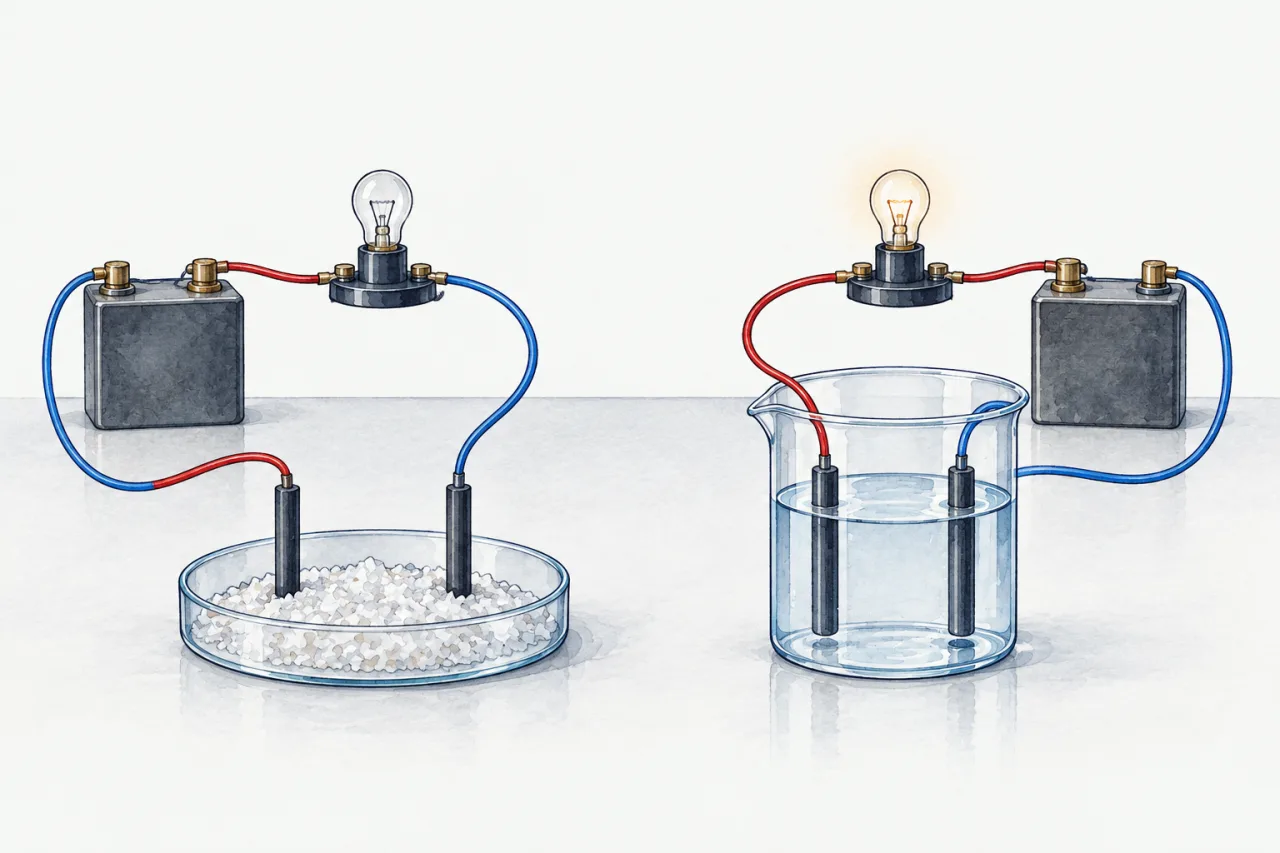
The tester is a circuit with a gap in it: a battery, a switch, a bulb and two carbon rods called electrodes. With the switch closed, the only gap left is between the electrodes, and the sample goes in that gap. If the sample lets an electric current pass, it closes the gap and the bulb lights; we say the sample conducts. If it doesn't, the bulb stays dark.
An electric current is a flow of charge. So a sample that conducts must contain charged particles, and those particles must be able to move from one electrode towards the other.
Predict, then test
Here's the question for the experiment. Which samples will light the bulb: dry salt, pure water, salt dissolved in water, or salt melted by strong heating? Salt dissolved in water is an aqueous solution, and salt melted into a liquid is molten. Make your prediction, then test the dry salt and the pure water. After that, dissolve the salt in the water, and melt some salt in a crucible. Look at each sample through the magnifier.
What the tests show
Dry salt crystals don't light the bulb. Pure water doesn't either: it conducts so little that the bulb can't show it. But salt dissolved in water lights the bulb, and so does salt melted at 801 °C.
 (enlarge)
So salt conducts when it's aqueous or molten, but not when it's solid. The water can't be the reason, because molten salt has no water in it. Salt itself must contain charged particles. In the solid they can't carry a current; once the salt is dissolved or melted, they can.
Where the charged particles come from
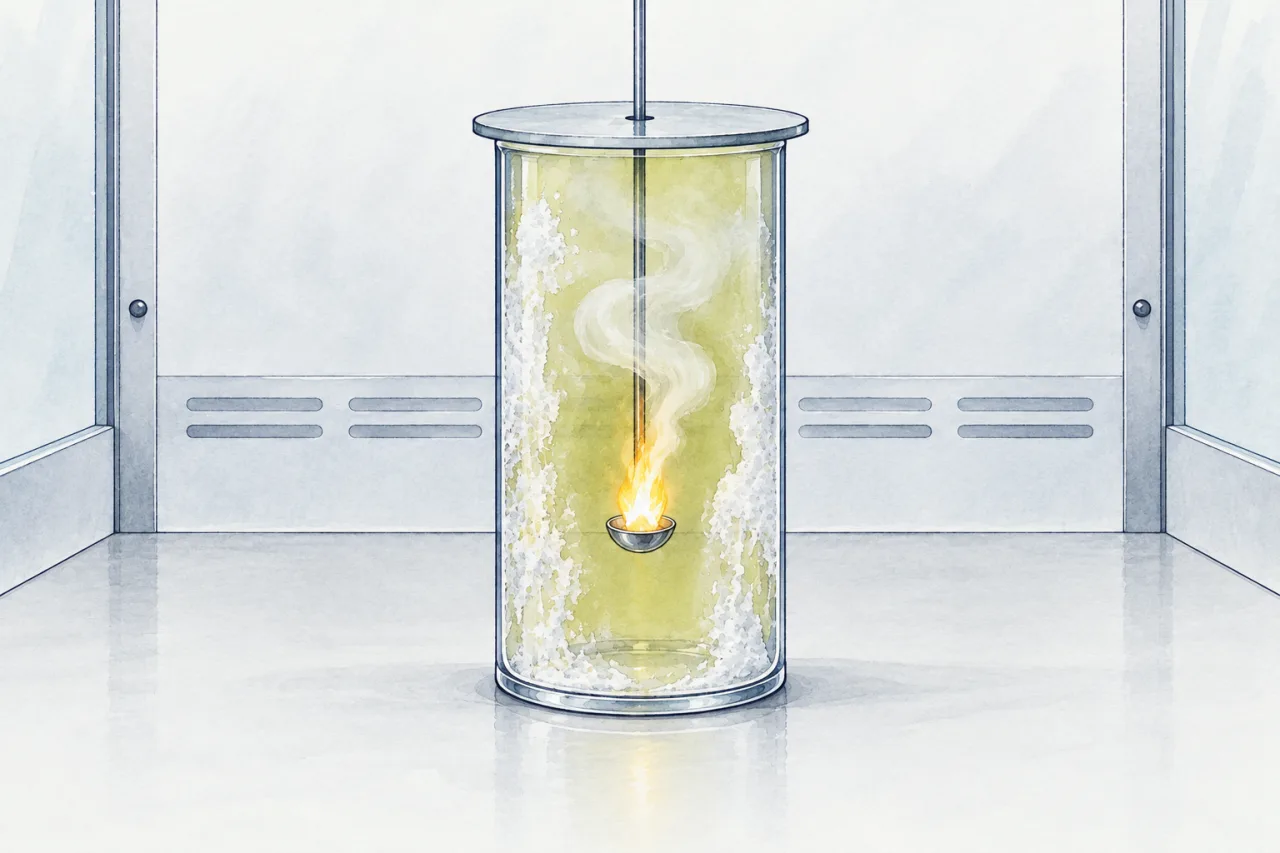
Salt is sodium chloride, and it can be made from its elements. A small piece of hot sodium, a soft metal, burns in a jar of chlorine, a poisonous green gas. A white smoke of tiny salt crystals forms and settles on the jar.
 (enlarge)
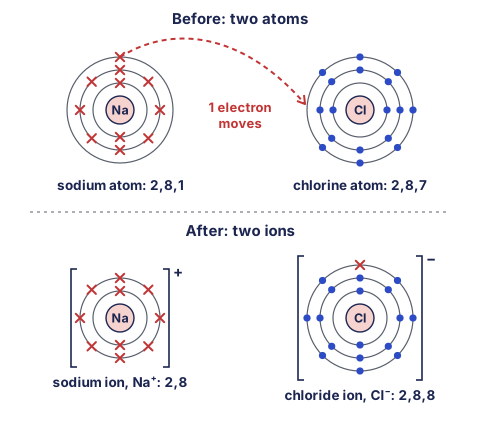
In the reaction, each sodium atom gives one electron to a chlorine atom. A sodium atom has 11 electrons arranged 2,8,1. When it loses its single outer electron, the outer shell left is the full second shell: 2,8. It still has 11 protons but only 10 electrons, so it has a charge of 1+. A chlorine atom has 17 electrons arranged 2,8,7. When it gains one electron, its outer shell is full: 2,8,8. It has 17 protons and 18 electrons, so its charge is 1−.
 (enlarge)
A charged particle formed when an atom loses or gains electrons is an ion. A positive ion is a cation: metal atoms lose electrons and form cations, such as the sodium ion, Na+. A negative ion is an anion: non-metal atoms gain electrons and form anions, such as the chloride ion, Cl−. The anion of a non-metal element has a name ending in -ide: chloride, oxide.
Trap: “The sodium ion is positive because it has gained a proton.” Only electrons move when ions form; the nucleus doesn't change. Na+ has 11 protons, as the atom had, but one electron fewer: 11 − 10 = 1+.
The ionic bond
Opposite charges attract. Each sodium ion attracts the chloride ions next to it, and each chloride ion attracts the sodium ions next to it. This strong electrostatic attraction between oppositely charged ions is an ionic bond. Compounds held together by ionic bonds are ionic compounds, and they form when a metal reacts with a non-metal.
Trap: “The ionic bond is the electron that moves from sodium to chlorine.” The transfer of the electron makes the ions. The bond is the attraction between the ions that holds them together afterwards.
Properties of ionic compounds
Ionic compounds share two properties that you can test.
- High melting points and boiling points. Sodium chloride melts at 801 °C and boils above 1400 °C. The ionic compounds in this course are all solids at room temperature.
- Electrical conductivity. They conduct electricity well when molten or aqueous, but poorly when solid, just as the salt did in the tester.
Supplement: a giant lattice
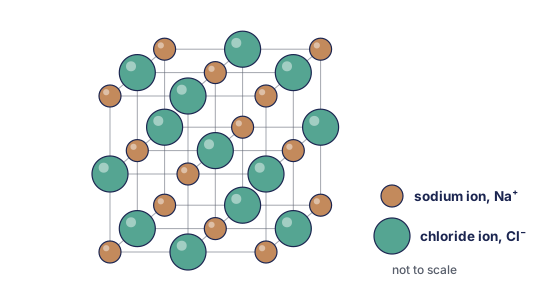
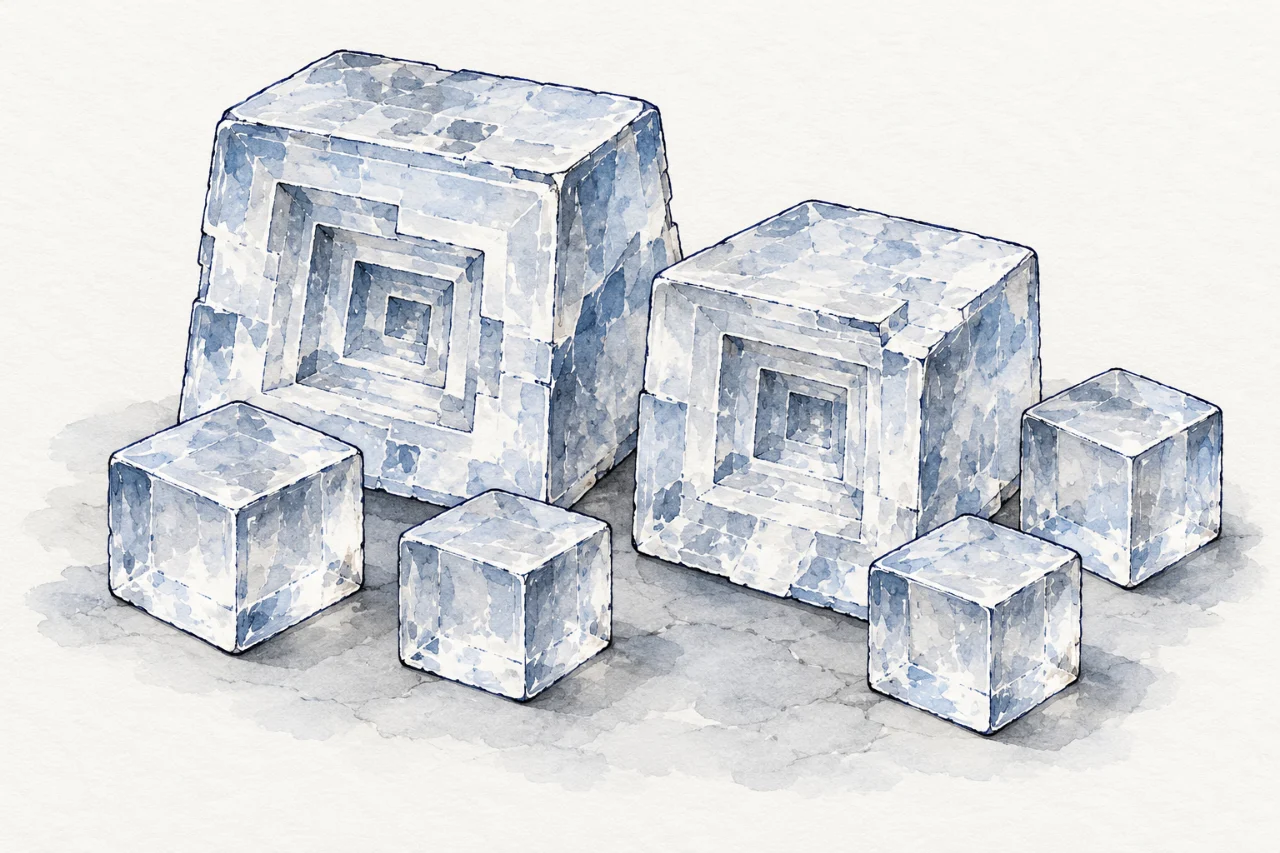
Look closely at salt crystals and you'll see tiny cubes. The cubes come from the way the ions are packed. In solid sodium chloride, the ions form a giant lattice: a regular arrangement of alternating positive and negative ions that repeats in every direction. Each sodium ion is surrounded by chloride ions, and each chloride ion by sodium ions. There are no separate pairs of ions: a single crystal is one structure of a huge number of ions.
 (enlarge)
 (enlarge)
Supplement: the properties explained
High melting and boiling points. In the lattice, every ion is attracted by all the oppositely charged ions around it, in every direction. To melt the solid, enough of these strong electrostatic attractions must be overcome for the ions to move past each other. That takes a lot of energy, so the melting point is high. In the liquid the ions still attract each other strongly; to boil it, the particles must move far apart, overcoming the attractions that remain in the liquid, which takes even more energy. So the boiling point is higher still.
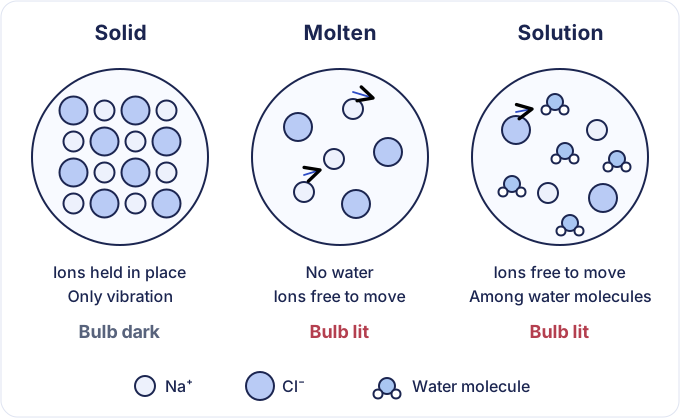
Conductivity. A current needs charged particles that can move. In the solid, the ions are held in fixed positions in the lattice: they only vibrate, so they can't carry the charge from one electrode to the other. When the solid melts, or dissolves in water, the lattice breaks up and the ions are free to move. Now they carry the current, and the bulb lights.
 (enlarge)
Trap: “Solid salt doesn't conduct because it has no charged particles.” Solid salt has just as many ions as molten salt. They don't conduct because they can't move, not because they aren't there.
Trap: “Salt solution conducts because electrons flow through the water.” In the solution it's the ions that move and carry the charge. Pure water, with no ions from salt, hardly conducts at all.
Key idea: A metal atom loses electrons to form a positive ion, a cation; a non-metal atom gains electrons to form a negative ion, an anion. An ionic bond is the strong electrostatic attraction between oppositely charged ions. Ionic compounds have high melting and boiling points, and they conduct electricity when molten or aqueous but not when solid. Supplement: the ions form a giant lattice, a regular arrangement of alternating positive and negative ions. Many strong attractions in every direction make the melting point high; in the solid the ions can't move, but in the melt or the solution they are free to move and carry the current.
Worked example
Sodium chloride from its atoms
Sodium, 2,8,1, reacts with chlorine, 2,8,7. Describe how the ions form, give their charges, and say what holds them together.
The sodium atom loses its one outer electron, which leaves 2,8 and a full outer shell. With 11 protons and 10 electrons, it becomes a sodium ion with a charge of 1+, Na+: a cation. The chlorine atom gains that electron, which gives 2,8,8 and a full outer shell. With 17 protons and 18 electrons, it becomes a chloride ion with a charge of 1−, Cl−: an anion.
The ions are held together by an ionic bond: the strong electrostatic attraction between the positive sodium ions and the negative chloride ions.
Check: one electron lost and one gained, and the charges +1 and −1 add up to zero, as they must in a compound.
Worked example
Will potassium bromide light the bulb?
Potassium bromide is a white solid made from potassium and bromine; it melts at 734 °C. Will it light the bulb (a) as a solid, (b) dissolved in water, (c) molten? Explain your answers.
Potassium is a metal and bromine is a non-metal, so potassium bromide is an ionic compound of K+ and Br− ions. Its high melting point fits. Like salt, it (a) won't light the bulb as a solid, but it will when it's (b) aqueous and (c) molten.
Supplement: the ions form a giant lattice, a regular arrangement of alternating K+ and Br− ions. In the solid they are held in fixed positions by strong attractions in every direction, so they can't move and can't carry the current. Dissolved or melted, the lattice breaks up and the ions are free to move, so they carry the current. Many strong electrostatic attractions must be overcome to melt the lattice, which is why the melting point is high.
Case closed
The current comes from the salt itself. Salt is sodium chloride, an ionic compound of sodium ions, Na+, and chloride ions, Cl−, formed when each sodium atom gives an electron to a chlorine atom. The ions are held together by ionic bonds, strong electrostatic attractions between opposite charges. In dry salt the ions are locked in place, so the bulb stays dark; dissolved or molten, the ions can move, so they carry the current and the bulb lights. Pure water stays dark because it has almost no ions of its own.
About this model
Salt melts at 801 °C. A crucible over a hot Bunsen flame only just reaches that temperature, and molten salt is dangerous, so the molten test here is virtual; schools show molten conduction with a compound that melts at a lower temperature, as a teacher's demonstration in a fume cupboard. Burning sodium in chlorine is a teacher's demonstration too, because chlorine is poisonous. When ions carry a current through a melt or a solution, new substances also form at the electrodes. That's electrolysis, in topic 4, and this experiment leaves it out. Real pure water contains a very small number of ions, so it conducts very slightly, too little to light a bulb. The ions in the magnifier and the diagrams aren't to scale, and their colours are only labels.
For teachers: Core 2.4.1–2.4.2, 2.4.4; Supplement 2.4.5 and 2.4.7, the sections "Supplement: a giant lattice" and "Supplement: the properties explained" (Cambridge 0620 syllabus, p14).