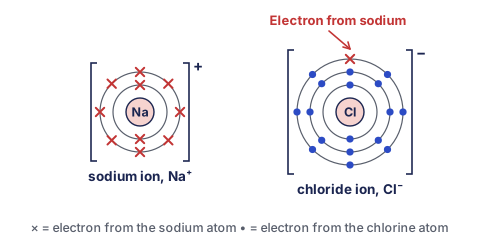
In part 1 one electron moved from a sodium atom to a chlorine atom, and two ions were made. Electrons all look the same, so how can a diagram show which electron moved, and where it came from? Chemists draw the electrons of one atom as crosses and the electrons of the other atom as dots. That's a dot-and-cross diagram. In this part you'll draw them for a Group I metal with a Group VII non-metal, and then, in the Supplement, for other metals and non-metals.
Why Group I and Group VII make 1+ and 1− ions
A Group I atom has 1 electron in its outer shell. Losing that one electron leaves a full outer shell, so a Group I metal forms ions with a charge of 1+: Li+, Na+, K+. A Group VII atom has 7 electrons in its outer shell. Gaining one more fills it, so a Group VII non-metal forms ions with a charge of 1−: F−, Cl−, Br−.
The electron one atom loses is the electron the other gains. So one Group I atom reacts with one Group VII atom, and the compound has the ions in the ratio 1 : 1, as in NaCl and KBr.
Drawing a dot-and-cross diagram
- Write the electronic configuration of each atom: sodium 2,8,1 and chlorine 2,8,7.
- Decide how many electrons each atom loses or gains to get a full outer shell: sodium loses 1, chlorine gains 1.
- Draw each ion's shells. Draw the metal's electrons as crosses and the non-metal's as dots. The electron that moved keeps its symbol: it's a cross in the chloride ion's outer shell.
- Put each ion in square brackets with its charge at the top right, outside the brackets.
- Check: the electrons lost equal the electrons gained, and the charges add up to zero.
 (enlarge)
The dots and crosses are only labels that show where each electron came from. Once it has moved, the electron is just like the chloride ion's other electrons. Some diagrams show only the outer shells, because those are the shells that change.
Trap: “The sodium ion has lost its outer shell, so draw it with no electrons.” Na+ has lost its third shell, the one with a single electron. Its outer shell now is the full second shell: 8 crosses.
Trap: “The chloride ion's outer shell has 7 electrons, the dots.” It has 8: 7 dots of its own and 1 cross from sodium. That's why its outer shell is full and its charge is 1−.
Worked example
Lithium fluoride
Lithium is in Group I and fluorine in Group VII. Draw a dot-and-cross diagram of lithium fluoride.
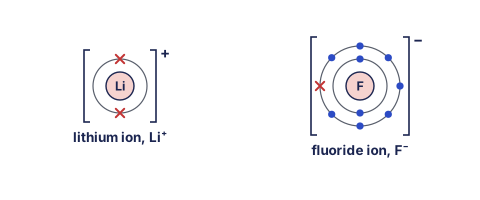
Lithium is 2,1 and fluorine is 2,7. The lithium atom loses its one outer electron, which leaves a single full shell of 2: a lithium ion, Li+. The fluorine atom gains that electron, which gives 2,8: a fluoride ion, F−. Draw Li+ as one shell of 2 crosses and F− as an inner shell of 2 dots and an outer shell of 7 dots and 1 cross. Put each in square brackets with its charge.
 (enlarge)
Check: one electron lost, one gained; charges +1 and −1 add up to zero.
Supplement: other metals and non-metals
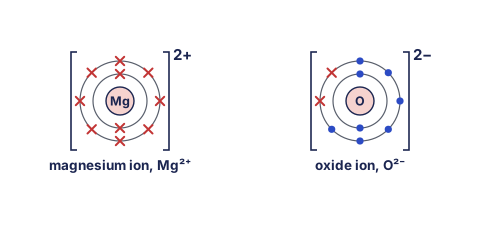
The same steps work for metals and non-metals in other groups. A metal atom loses all its outer electrons: a Group II atom loses 2 and forms a 2+ ion, such as Mg2+. A non-metal atom gains enough electrons to fill its outer shell: a Group VI atom gains 2 and forms a 2− ion, such as O2−.
When the numbers lost and gained don't match, use enough atoms of each element so that the electrons lost equal the electrons gained: sometimes more atoms of one element, sometimes more of both. Magnesium loses 2 and oxygen gains 2, so one of each is enough: MgO.
 (enlarge)
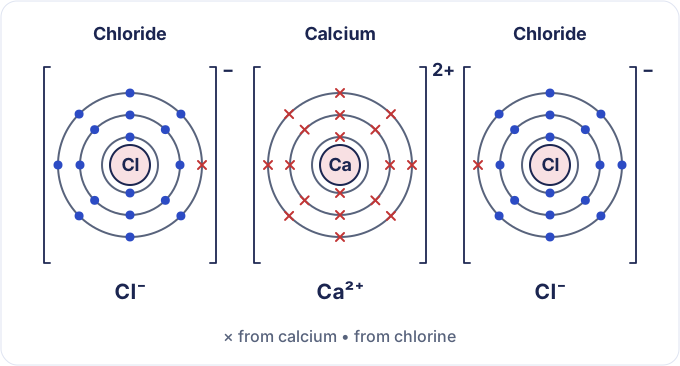
Trap: “Calcium gives one electron to each chlorine atom, so the calcium ion is 1+.” The calcium atom loses two electrons in total, one to each chlorine, so its ion is Ca2+. Each chloride ion gains one, so each is Cl−.
Key idea: In a dot-and-cross diagram, one atom's electrons are crosses and the other's are dots, so you can see which electrons moved. Each ion goes in square brackets with its charge outside. A Group I atom loses 1 electron to form a 1+ ion and a Group VII atom gains 1 to form a 1− ion, so they combine 1 : 1. Supplement: metal atoms lose all their outer electrons and non-metal atoms gain enough to fill their outer shell; use enough of each atom that the electrons lost equal the electrons gained.
Worked example
Calcium chloride
Calcium is 2,8,8,2 and chlorine is 2,8,7. Draw a dot-and-cross diagram of calcium chloride.
The calcium atom must lose 2 electrons to leave a full outer shell, 2,8,8: Ca2+. Each chlorine atom can take only 1 electron, to become 2,8,8: Cl−. So the 2 electrons go to 2 chlorine atoms, and the ions are in the ratio Ca2+ : Cl− = 1 : 2, CaCl2. Draw the calcium ion with crosses between two chloride ions, each with 1 cross in its outer shell.
 (enlarge)
Check: 2 electrons lost, 1 + 1 = 2 gained; charges +2 − 1 − 1 = 0.
Worked example
Sodium oxide
Sodium is 2,8,1 and oxygen is 2,6. Draw a dot-and-cross diagram of sodium oxide.
Oxygen needs 2 electrons to fill its outer shell, 2,8: O2−. Each sodium atom gives only 1, to become 2,8: Na+. So 2 sodium atoms are needed for 1 oxygen atom, and the ratio is Na+ : O2− = 2 : 1, Na2O. The oxide ion's outer shell has 6 dots and 2 crosses, one from each sodium.
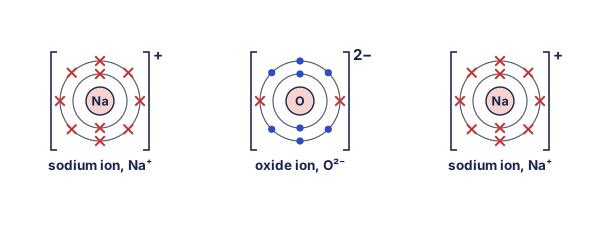 (enlarge)
Check: 1 + 1 = 2 electrons lost, 2 gained; charges +1 + 1 − 2 = 0.
Case closed
A dot-and-cross diagram shows which electrons moved by drawing each atom's electrons with its own symbol. A Group I metal atom gives its one outer electron to a Group VII non-metal atom, so the ions are 1+ and 1− and they pair 1 : 1. Supplement: other metals lose all their outer electrons and other non-metals gain enough to fill their outer shell; the number of each ion is set by making the electrons lost equal the electrons gained.
About this model
The diagrams follow the electrons, not real events: in a reaction, huge numbers of atoms react at once, and the ions end up in a giant lattice, not in the separate groups drawn here. Dots and crosses are only labels for where each electron came from; all electrons are identical. The shells are drawn as circles, which is a model of how electrons are arranged, not a picture of an atom. Writing formulae from ion charges for any compound comes in topic 3.
For teachers: Core 2.4.3; Supplement 2.4.6, the section "Supplement: other metals and non-metals" and worked examples W04 and W05 (Cambridge 0620 syllabus, p14).