When you added a proton in the experiment, the atom became magnesium: a nucleus with 12 protons, but still only sodium's 11 electrons, 2 in the first shell, 8 in the second and 1 in the third. Adding one more electron makes a neutral magnesium atom. But where does the 12th electron go: into the third shell beside the 1, into the second shell to make 9, or into a new fourth shell? The answer follows a simple rule, and the same rule tells you where each element sits in the Periodic Table.
Shells fill from the inside
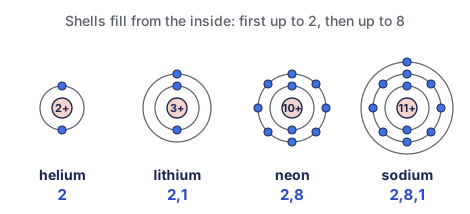
Electrons go into the shell closest to the nucleus first. The first shell holds up to 2 electrons. When it's full, the next electrons go into the second shell, which holds up to 8. Then the third shell fills. For the first 20 elements, the third shell takes 8 electrons, and then the fourth shell starts.
 (enlarge)
The way the electrons are arranged in shells is the atom's electronic configuration. You write it as the number of electrons in each shell, starting from the inside, separated by commas. Sodium, with 11 electrons, is 2,8,1: the first shell is full with 2, the second full with 8, and 1 is left over for the third.
To write any configuration, start with the number of electrons. In an atom it's the proton number. Fill the first shell with up to 2, the next with up to 8, the next with up to 8, and put any that are left in the fourth shell. Check that the numbers add up to the number of electrons.
Predict where the 12th electron goes
In the experiment, after adding the proton, you predict where the 12th electron will go, then add it and watch where it lands. Decide before you read on.
The second shell already has 8, so it's full; the third shell has room. The 12th electron joins the 1 in the third shell, so magnesium is 2,8,2. A second shell of 9 would break the rule that it holds up to 8, and a new fourth shell can't start while the third still has room.
The outer shell and the Periodic Table
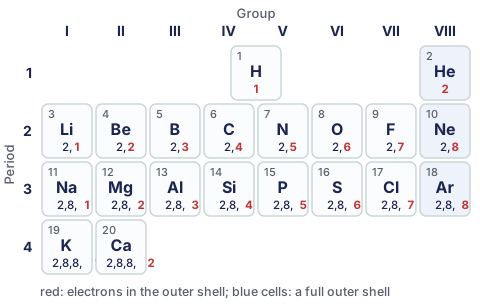
The outer shell is the last shell that has electrons in it. Look at where each element sits in the Periodic Table and compare it with its configuration.
 (enlarge)
Two patterns stand out. In Groups I to VII, the number of electrons in the outer shell is the same as the Group number: sodium, 2,8,1, is in Group I; chlorine, 2,8,7, is in Group VII. And the number of shells that have electrons in them is the same as the Period number: sodium has three occupied shells and is in Period 3. So magnesium, 2,8,2, is in Group II and Period 3.
The elements in Group VIII, the noble gases, all have a full outer shell: helium 2, neon 2,8 and argon 2,8,8. Helium has only 2 outer electrons, but its only shell is full, so it belongs in Group VIII with the other noble gases.
Trap: “The Group number is the number of shells.” It's the other way round: the number of shells is the Period, and the number of outer-shell electrons is the Group (in Groups I to VII).
Trap: “Helium has 2 outer electrons, so it's in Group II.” Helium's outer shell is the first shell, and that holds only 2, so it's full. Helium is a noble gas in Group VIII.
Ions have different configurations
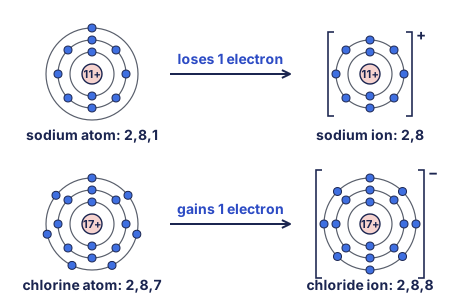
An ion has a different number of electrons from its atom, so it has a different configuration, even though its nucleus is unchanged. Use the number of electrons the ion has, then fill the shells by the same rule. A sodium ion, Na+, has 11 protons but only 10 electrons, so it's 2,8. A chloride ion, Cl−, has 17 protons and 18 electrons, so it's 2,8,8.
 (enlarge)
An ion's diagram is drawn in square brackets with its charge at the top right. In a symbol, the charge is written after it, number first: Mg2+ has a charge of +2, and O2− a charge of −2. To find the number of electrons in an ion, start from the proton number: a positive charge means fewer electrons (Mg2+ has 12 − 2 = 10), a negative charge means more (O2− has 8 + 2 = 10).
Read an element's Group and Period from its atom's configuration, not its ion's: Na+ is 2,8, but sodium is still in Group I and Period 3, because a sodium atom is 2,8,1.
Trap: “Na+ is 2,8,1 with a plus sign.” The plus sign means an electron has gone. Count the electrons again: 10, so 2,8.
Key idea: Electrons fill shells from the inside: up to 2 in the first shell, then up to 8, then up to 8 for the first 20 elements. Write the configuration as the number in each shell, such as 2,8,3. The number of outer-shell electrons is the Group number in Groups I to VII, the number of occupied shells is the Period number, and the noble gases in Group VIII have a full outer shell. For an ion, use its own number of electrons.
Worked example
Calcium
Calcium has proton number 20. Write its electronic configuration and use it to find its Group and Period.
A calcium atom has 20 protons, so 20 electrons. Fill the shells: 2 in the first (18 left), 8 in the second (10 left), 8 in the third (2 left), and the last 2 in the fourth. So calcium is 2,8,8,2. Check: 2 + 8 + 8 + 2 = 20.
It has 2 electrons in its outer shell, so it's in Group II. It has 4 occupied shells, so it's in Period 4.
Worked example
The oxide ion
Oxygen has proton number 8. Write the electronic configuration of an oxygen atom and of an oxide ion, O2−.
An oxygen atom has 8 electrons: 2 in the first shell and 6 in the second, so it's 2,6. Six outer electrons: Group VI. Two occupied shells: Period 2.
The oxide ion has a charge of −2, so it has 2 more electrons than protons: 8 + 2 = 10 electrons. That's 2,8. The nucleus still has 8 protons, so it's still oxygen.
Case closed
The 12th electron went into the third shell, because the first two shells were full: magnesium is 2,8,2. Every configuration from hydrogen to calcium follows the same rule, and it tells you where the element is: the outer-shell electrons give the Group, the number of shells gives the Period, and a full outer shell means a noble gas in Group VIII.
About this model
Real electrons don't sit still on rings: the shells are a model of how far from the nucleus the electrons are likely to be, and how much energy they have. The model is good enough for every element up to calcium. Beyond calcium the third shell can hold more than 8 electrons, which you don't need for this course. In the experiment the electrons are drawn spread evenly round each ring so that you can count them.