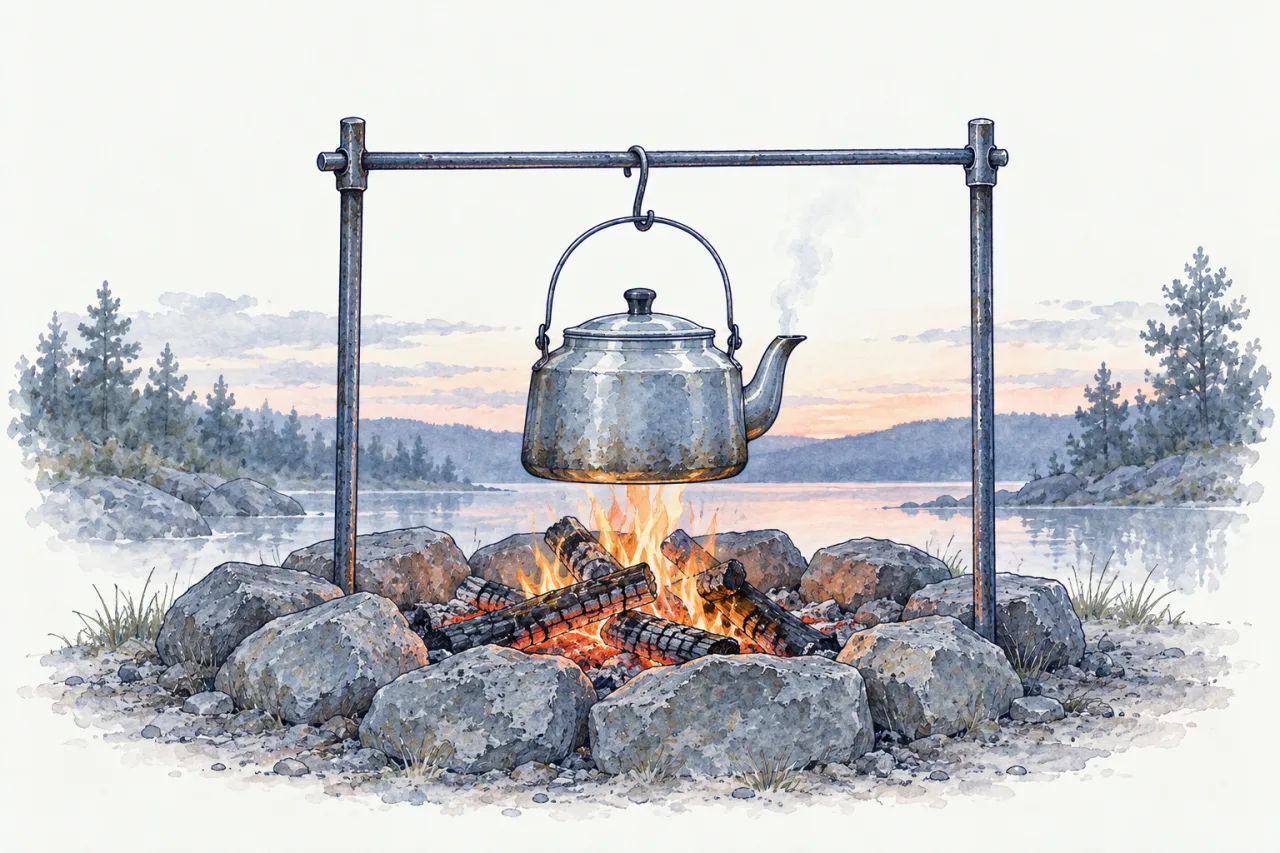
To light a campfire you strike a match. Once the wood is burning, though, it keeps going on its own for hours and boils the kettle hanging over it. The fire raises two questions. Where does all the energy that boils the kettle come from? And if burning gives out so much energy, why does it need a match to start? A reaction pathway diagram answers both. In this part you'll read these diagrams, and, for the Supplement, label them with the energy change and the energy needed to start.
 (enlarge)
Energy stored in chemicals
Every substance stores energy in its particles, a store called chemical energy. When a reaction happens, the products store a different amount of energy from the reactants, and the difference goes to or comes from the surroundings.
Wood and oxygen together store more energy than the carbon dioxide and water they turn into. When the wood burns, the energy the products no longer store goes to the surroundings, as thermal energy and light, and that's what boils the kettle. In run 3 of your investigation it was the other way round: the products stored more energy than the reactants, and the extra came from the water in the cup, which got colder.
Reading a reaction pathway diagram
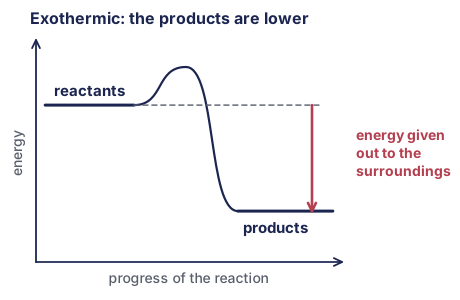
A reaction pathway diagram shows the energy stored in the chemicals as the reaction goes on. Energy goes up the side; the progress of the reaction goes along the bottom. The reactants sit on a level on the left and the products on a level on the right, with a curve over a hump between them.
 (enlarge)
Compare the two levels. If the products are lower than the reactants, the products store less energy, so the difference has gone out to the surroundings: the reaction is exothermic.
 (enlarge)
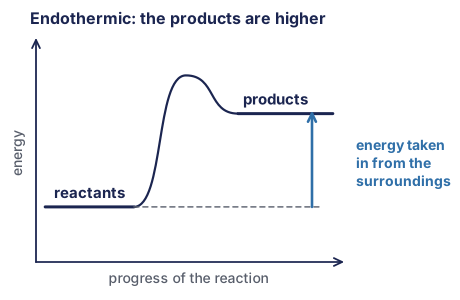
If the products are higher than the reactants, they store more energy, so the difference has been taken in from the surroundings: the reaction is endothermic. The bigger the gap between the levels, the more energy is given out or taken in.
Trap: “The diagram goes up in the middle, so the reaction is endothermic.” Every reaction pathway diagram has the hump, exothermic or endothermic. Look only at where the products end up compared with the reactants.
Worked example
Burning methane
The reaction pathway diagram for methane burning, CH4 + 2O2 → CO2 + 2H2O, has the reactants on a high level and the products on a much lower level. Is the reaction exothermic or endothermic, and what happens to the surroundings?
- The products are lower than the reactants, so they store less energy.
- The difference has gone to the surroundings: the reaction is exothermic.
- The surroundings, the pan on the gas cooker and the air around it, get warmer.
Worked example
Heating limestone
When calcium carbonate is heated strongly it breaks down: CaCO3 → CaO + CO2. On its reaction pathway diagram, the products are on a higher level than the reactant. Is the reaction exothermic or endothermic?
- The products are higher than the reactant, so they store more energy.
- The difference has been taken in from the surroundings: the reaction is endothermic.
- That's why you have to keep heating: the reaction takes in thermal energy from the flame all the time, and stops when the heating stops.
Supplement: the enthalpy change, ΔH
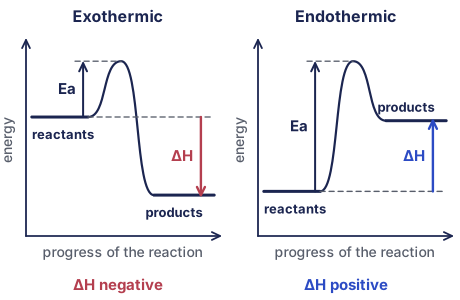
The transfer of thermal energy during a reaction is called the enthalpy change of the reaction, written ΔH (say "delta H"). It is measured in kJ/mol: kilojoules for the amounts, in moles, shown in the equation.
ΔH is counted from the point of view of the chemicals. In an exothermic reaction the chemicals lose energy to the surroundings, so ΔH is negative. In an endothermic reaction they gain energy from the surroundings, so ΔH is positive. On a reaction pathway diagram, the ΔH arrow goes from the level of the reactants to the level of the products: down for exothermic, up for endothermic.
 (enlarge)
Trap: “ΔH is negative, so the temperature goes down.” The minus sign belongs to the chemicals: they lose energy. The surroundings gain that energy, so in a reaction with a negative ΔH the temperature of the surroundings goes up.
Worked example
Three enthalpy changes (Supplement)
Three reactions and their enthalpy changes:
- neutralisation, HCl + NaOH → NaCl + H2O, ΔH = −57 kJ/mol;
- burning methane, CH4 + 2O2 → CO2 + 2H2O, ΔH = −890 kJ/mol;
- heating calcium carbonate, CaCO3 → CaO + CO2, ΔH = +178 kJ/mol.
Which are exothermic, and which gives out the most energy for the amounts in its equation?
- A negative ΔH means the chemicals lose energy: neutralisation and burning methane are exothermic.
- A positive ΔH means the chemicals gain energy: heating calcium carbonate is endothermic.
- Of the two exothermic reactions, burning methane has the bigger number, 890 kJ/mol, so it gives out the most energy: that's why methane is a good fuel.
Supplement: activation energy, Ea
Back to the match. Particles react only when they collide, and only if they collide with enough energy. The activation energy, Ea, is the minimum energy that colliding particles must have to react. On a reaction pathway diagram it is the height of the hump measured from the level of the reactants: the Ea arrow goes up from the reactants' level to the top of the hump.
At room temperature, very few of the particles in wood and air collide with that much energy, so the wood doesn't catch fire by itself. The match heats a small patch until its particles collide hard enough to react. That reaction is exothermic, so the energy it gives out heats the next patch above its activation energy, and so on: once started, the fire keeps itself going.
Endothermic reactions have an activation energy too. It is still measured from the reactants' level, so for an endothermic reaction Ea is always bigger than ΔH.
Trap: “Ea is the height of the top of the hump.” Measure Ea from the level of the reactants, not from the bottom of the graph. If the reactants are at 80 kJ/mol and the top of the hump is at 200 kJ/mol, Ea is 200 − 80 = 120 kJ/mol.
Free play: nothing here is marked or saved
Over the hump: a reaction under a camp kettle
Every reaction has a hump of energy to get over. Set the reactants, the top of the hump and the products: which of them decide whether the kettle steams or frosts, and what does the hump change?Supplement
Still picture: your device asks for less motion.
Try: Lift the products above the reactants.
- Enthalpy change ΔH
- −40 kJ/mol
- Activation energy Ea
- 120 kJ/mol
- Reaction
- exothermic
- Surroundings
- warmer
ΔH = products − reactants = 40 − 80 = −40 kJ/mol
Ea = top − reactants = 200 − 80 = 120 kJ/mol
- Only the two levels decide the direction. Products lower than the reactants: ΔH is negative and the reaction is exothermic. Products higher: ΔH is positive and it is endothermic.
- The hump changes only Ea, never ΔH or the direction. Every reaction has a hump, exothermic or endothermic.
- Ea is the minimum energy colliding particles must have to react: a higher hump means the match must give the particles more energy before the reaction starts.
- Both arrows start from the reactants’ level: Ea goes up to the top of the hump, ΔH goes to the products.
- The sign of ΔH is for the chemicals: when ΔH is negative they lose energy and the surroundings gain it, so the surroundings get warmer.
About this model. The fire pit stands for any reaction whose levels you set; real burning wood is always exothermic, so here the pit is only where the reaction happens. The levels are for the amounts in the equation, in kJ/mol, not for one particle, and the scale’s 0 is only a place to draw from: what matters is the difference between the levels. One arrow of thermal energy is drawn for every 20 kJ/mol of ΔH. The steam and the frost show which way the thermal energy flows, not real temperatures: real frost needs the kettle below 0 °C. The hump is drawn as a smooth curve; only the height of its top matters here.
Supplement: draw and label a pathway diagram
You may be given ΔH and Ea for a reaction and asked to draw its reaction pathway diagram. Build it in this order:
- Draw the axes: energy up the side, progress of the reaction along the bottom.
- Draw a short level on the left for the reactants and label it with "reactants" or their formulae.
- Draw the products' level on the right: lower than the reactants if ΔH is negative, higher if ΔH is positive. Label it.
- Join them with a curve over a hump that rises above both levels.
- Draw the ΔH arrow from the reactants' level to the products' level and label it ΔH.
- Draw the Ea arrow from the reactants' level up to the top of the hump and label it Ea.
Worked example
Draw a diagram from given information (Supplement)
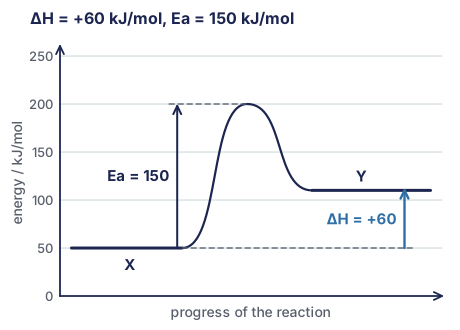
For the reaction X → Y, ΔH = +60 kJ/mol and Ea = 150 kJ/mol. Draw and label its reaction pathway diagram on an energy scale.
- ΔH is positive, so the reaction is endothermic and Y goes higher than X.
- Put X at 50 kJ/mol on the scale. Then Y goes at 50 + 60 = 110 kJ/mol.
- The top of the hump goes 150 kJ/mol above X: 50 + 150 = 200 kJ/mol.
- Draw the ΔH arrow up from X's level to Y's level, and the Ea arrow up from X's level to the top of the hump. Label both.
 (enlarge)
Starting X at a different level gives the same diagram, moved up or down: what matters is the gaps between the levels.
Case closed
The energy that boils the kettle comes from the chemicals: wood and oxygen store more energy than carbon dioxide and water, and the difference goes to the surroundings. On a reaction pathway diagram, products lower than the reactants mean an exothermic reaction; products higher mean an endothermic one. For the Supplement, the energy transferred is the enthalpy change ΔH, negative for exothermic and positive for endothermic reactions. The match is needed because of the activation energy, Ea, the minimum energy colliding particles must have to react: the hump on the diagram, measured from the reactants' level. Why the products store more or less energy than the reactants comes down to the bonds that break and form, in the next module.
About this model
The reaction pathway diagrams without an energy scale show which level is higher, not how much higher: they aren't to scale. The ΔH values in this part are typical data-book values. The levels stand for the energy stored in the amounts of the chemicals in the equation, not in one particle.
For teachers: Core 5.1.3 and Supplement 5.1.4, 5.1.5 and 5.1.6 (Cambridge 0620 syllabus, p18). Collisions and catalysts come in topic 6; bond breaking, bond making and bond energies in the next module.