On the energy board you watched the staircase climb and fall. On paper you can get the same answer in a few lines. An exam question gives you an equation and a table of bond energies and asks for the enthalpy change, ΔH. Which bonds do you count, how many of each, and which way round do you subtract? In this part you'll learn a method that works for any reaction, and use it to predict whether a reaction is exothermic or endothermic before anyone tries it. Like the whole module, this part is Supplement, for the Extended papers.
Five steps to ΔH
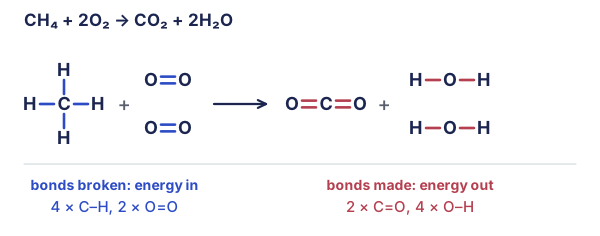
- Draw the bonds. Write the equation with displayed formulae. A displayed formula shows every atom as its symbol and every bond as a line: water is H–O–H, oxygen is O=O and nitrogen is N≡N. Then you can see every bond, including double and triple bonds.
- Bonds broken. List every bond in the reactants. Multiply by the number in front of each formula: 2O2 means two O=O bonds.
- Energy in. Multiply each number of bonds by its bond energy and add them up.
- Bonds made, energy out. Do the same for every bond in the products.
- Subtract. ΔH = energy in − energy out. Give the sign and the unit, kJ/mol: negative means exothermic, positive means endothermic.
 (enlarge)
A question always gives you the bond energies you need. Here are the common ones:
| Bond | Bond energy / kJ/mol | Bond | Bond energy / kJ/mol |
|---|---|---|---|
| H–H | 436 | C–H | 412 |
| Cl–Cl | 242 | C–C | 348 |
| H–Cl | 431 | C=C | 612 |
| Br–Br | 193 | C–O | 358 |
| H–Br | 366 | C=O | 805 |
| O=O | 498 | C–Cl | 338 |
| O–H | 463 | N≡N | 945 |
| N=O | 630 | N–H | 391 |
Worked example
Burning methane
Calculate ΔH for burning methane, CH4 + 2O2 → CO2 + 2H2O, using the bond energies in the table.
- Bonds broken: methane has 4 C–H bonds; 2O2 is two molecules, each with one O=O bond, so 2 O=O.
- Energy in = 4 × 412 + 2 × 498 = 1648 + 996 = 2644 kJ/mol.
- Bonds made: CO2 is O=C=O, so 2 C=O; each water molecule has 2 O–H bonds, and there are two water molecules, so 4 O–H.
- Energy out = 2 × 805 + 4 × 463 = 1610 + 1852 = 3462 kJ/mol.
- ΔH = energy in − energy out = 2644 − 3462 = −818 kJ/mol. It's negative, so burning methane is exothermic, as a gas flame should be.
Trap: “ΔH = energy out − energy in.” That gives +818, which would mean the flame takes energy in. ΔH is counted for the chemicals: start with the energy they take in, breaking bonds, and subtract the energy they give out, making bonds. Check the sign against what you know: fuels burn exothermically.
Trap: “2H2O has two O–H bonds.” Count the bonds in one molecule, then multiply by the number in front of the formula: each H2O has 2 O–H bonds, so 2H2O has 4. And use the right bond energy for a double bond: C=O is 805, not 2 × 358 (two C–O single bonds) and not 358.
Bonds that don't change
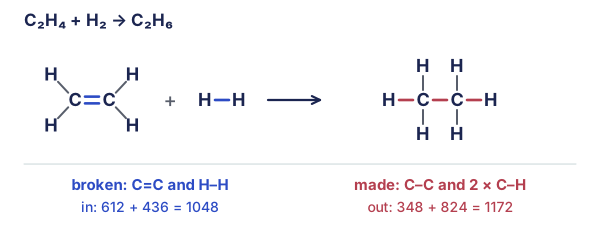
Some bonds are still there at the end. When ethene reacts with hydrogen to make ethane, C2H4 + H2 → C2H6, the four C–H bonds of ethene are still in the ethane.
 (enlarge)
Worked example
Ethene and hydrogen
Calculate ΔH for C2H4 + H2 → C2H6 in two ways: with every bond, and with only the bonds that change.
- Every bond. In: C=C + 4 C–H + H–H = 612 + 4 × 412 + 436 = 2696 kJ/mol. Out: C–C + 6 C–H = 348 + 6 × 412 = 2820 kJ/mol. ΔH = 2696 − 2820 = −124 kJ/mol.
- Only the bonds that change. In: C=C + H–H = 612 + 436 = 1048 kJ/mol. Out: C–C + 2 C–H = 348 + 2 × 412 = 1172 kJ/mol. ΔH = 1048 − 1172 = −124 kJ/mol.
- The same answer, −124 kJ/mol, because the four unchanged C–H bonds add 1648 to both totals and cancel when you subtract. Either way is correct; just treat both sides the same way.
Working backwards: find a bond energy
If you know ΔH, the same relationship tells you a missing bond energy: write energy in − energy out = ΔH, with the unknown bond as a letter, and solve.
Worked example
The H–F bond
Hydrogen and fluorine react explosively: H2 + F2 → 2HF, ΔH = −542 kJ/mol. The H–H bond energy is 436 kJ/mol and the F–F bond energy is 158 kJ/mol. Calculate the H–F bond energy.
- Energy in = 436 + 158 = 594 kJ/mol. Energy out = 2 × (H–F), because 2HF has two H–F bonds.
- Energy in − energy out = ΔH, so 594 − 2 × (H–F) = −542.
- 2 × (H–F) = 594 + 542 = 1136, so H–F = 1136 ÷ 2 = 568 kJ/mol.
- Check: 594 − 2 × 568 = 594 − 1136 = −542. ✓
Checking your answer
- The sign. A fuel burning, or any reaction you know warms its surroundings, must give a negative ΔH. A reaction that only goes with strong heating may be endothermic.
- The count. Count the atoms of each element on both sides of your bond lists. If the bonds broken hold different atoms from the bonds made, a bond is missing.
- The size. ΔH is usually much smaller than either total, because it's the difference between two big numbers. An answer as big as a total suggests you added where you should have subtracted.
Case closed
To calculate ΔH from bond energies, draw every bond, add up the energy taken in breaking the bonds in the reactants, add up the energy given out making the bonds in the products, and subtract: ΔH = energy in − energy out. Multiply by the numbers in the equation, use the right value for double and triple bonds, and check the sign: negative for exothermic, positive for endothermic. Bonds that don't change can be left out of both sides. Now you can predict, from a table of numbers, whether a reaction will warm or cool its surroundings, and by how much.
About this model
Bond energies are averages: a C–H bond in methane is not exactly the same strength as a C–H bond in ethane, so a table gives one typical value for each kind of bond. That's why a ΔH calculated from bond energies is close to the measured value, but not the same: burning methane comes out at −818 kJ/mol here, and the data-book value is −890 kJ/mol. Part of the difference is the water: the bond energies are for gases, and the data book gives ΔH for liquid water, which gives out a little more energy as the steam condenses. Use the values a question gives you: different books give slightly different averages.
For teachers: Supplement 5.1.8, using 5.1.7 (Cambridge 0620 syllabus, p18). Bond energies are given in every question; enthalpies of formation and Hess's law are beyond 0620.