Contents
Part 1 of 2
Diamond and graphite
state
Try it yourself
The diagram shows part of the structure of diamond. How many covalent bonds does each carbon atom form?
state: choose the short, clear answer.
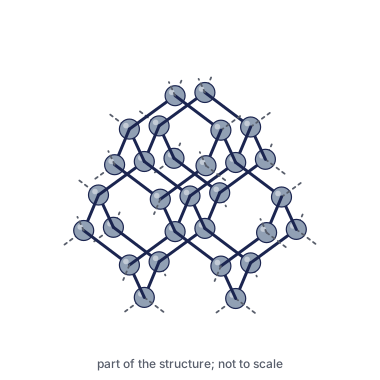 (enlarge)
Your saved work
Answers, earlier attempts and your Pause and check notes stay in this browser. Export a copy to keep, to move to another device or to hand to your teacher. Importing a copy keeps your current answers and adds earlier attempts.
Scope and sources
Cambridge IGCSE Chemistry 0620 · 2026–2028 v2 · Original learning materials.
Giant covalent and metallic structures (2.6 Core 1–2, Supplement 3–4; 2.7 Supplement 1–2): the giant covalent structures of diamond and graphite and their uses in cutting tools, as a lubricant and as an electrode, the giant covalent structure of silicon(IV) oxide and its similarity in properties to diamond, metallic bonding as the attraction between positive ions in a giant metallic lattice and a sea of delocalised electrons, and the electrical conductivity, malleability and ductility of metals. Simple molecules, ionic lattices, alloys, the uses of metals and electrolysis are left to other modules.
Apparatus, amounts and times in the experiment are illustrative. Real practical work follows a teacher-approved safety method.
Official Cambridge syllabus