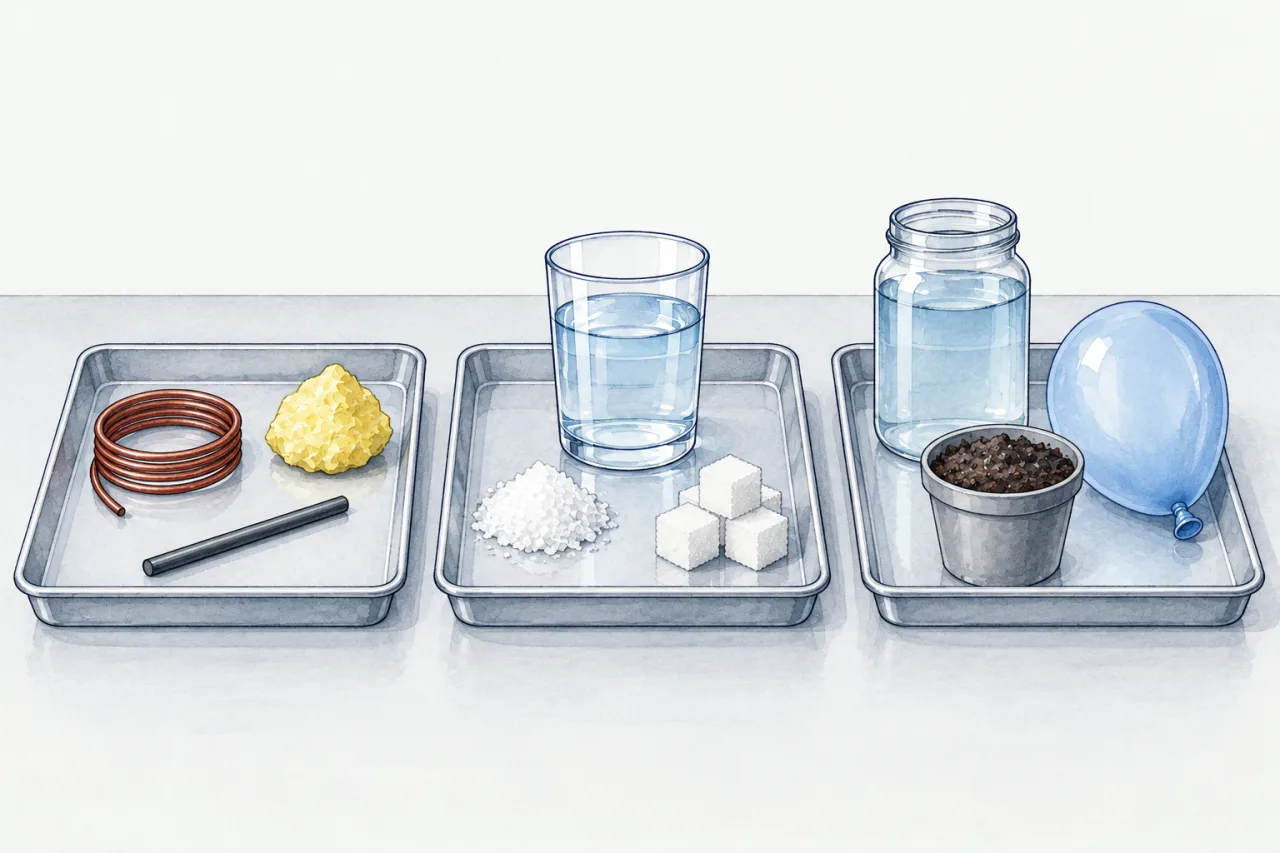
Someone has sorted nine substances onto three trays. The first holds copper wire, a lump of sulfur and a graphite rod; the second, a glass of pure water, a heap of salt and some sugar cubes; the third, a jar of sea water, a pot of soil and a balloon full of air. What rule did they use? Soil is easy: you can see the different bits in it. But the pure water and the sea water look exactly alike, and air looks like nothing at all. To sort substances like these, you need to know what's inside them: which atoms, and whether they're joined. In this part you'll learn to read particle diagrams, then find the rule behind the trays.
 (enlarge)
Reading a particle diagram
A particle diagram is a magnified view of a tiny part of a substance. Each circle is an atom, and each colour stands for one kind of atom, so the key tells you which elements are there. Circles drawn overlapping, like beads, are atoms joined together. A small group of atoms joined together is called a molecule. Circles drawn apart from each other are not joined.
Two things to ask of every diagram: how many kinds of atom are there, and how many kinds of particle? A particle can be a single atom or a whole molecule, and two particles are the same kind only if they contain the same atoms, joined in the same way.
Elements: one kind of atom
 (enlarge)
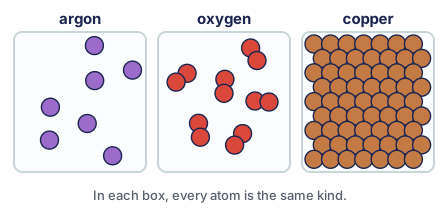
In each box, every atom is the same colour, because each is an element: a substance made of only one kind of atom. The atoms can be on their own, like those of argon, the gas in some light bulbs. They can be packed together in a solid, like copper: there the atoms all hold on to their neighbours in one big pack, so a metal has no separate molecules. Or they can be joined in small groups: in oxygen, the atoms are joined in pairs, so every particle of oxygen is a molecule of two oxygen atoms.
Trap: “Atoms joined together make a compound.” In oxygen, the atoms are joined, but they're all oxygen atoms. Only one kind of atom means an element, however the atoms are arranged.
Compounds: different atoms joined
 (enlarge)
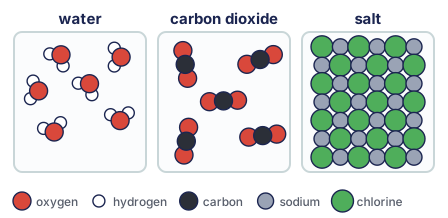
Each box now has two kinds of atom, joined together. In a compound, atoms of two or more different elements are chemically combined, so a compound is not an element. But every particle in the box is the same: each water molecule is one oxygen atom joined to two hydrogen atoms, never one or three. That's what the fixed ratio of a compound means at the scale of atoms. In solid salt there are no separate molecules; sodium and chlorine particles are joined in a regular pattern, one of each, like the iron and sulfur atoms in iron sulfide.
Trap: “Water is a mixture, because it contains hydrogen and oxygen.” The hydrogen and oxygen atoms are joined in every molecule, always two to one, and each molecule is the same. That's one substance, a compound.
Mixtures: more than one kind of particle
 (enlarge)
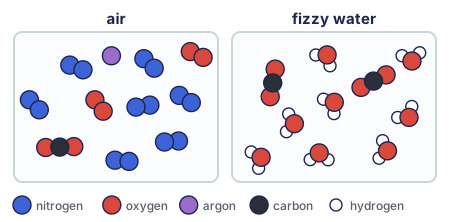
In a mixture, the box contains more than one kind of particle, and the different particles aren't joined to each other. Air is a mixture of mostly nitrogen and oxygen, with a little argon and carbon dioxide; fizzy water is a mixture of water and carbon dioxide. The substances in a mixture can be elements, compounds or both, and each one keeps its own particles, so it keeps its own properties.
A pure substance contains only one substance, so its box has only one kind of particle. Every element and every compound is a pure substance; a mixture is not.
Key idea: An element has only one kind of atom. A compound has atoms of two or more elements chemically combined, and all its particles are the same. A mixture has two or more substances, with different kinds of particle not chemically combined with each other.
Worked example
The rule behind the trays
Copper, sulfur and graphite each contain only one kind of atom: copper atoms, sulfur atoms and carbon atoms. So the left tray holds elements.
Water, salt and sugar each contain atoms of more than one element, chemically combined: water is hydrogen and oxygen; salt is sodium and chlorine; sugar is carbon, hydrogen and oxygen. Each is one substance with identical particles, so the middle tray holds compounds.
Sea water is water with salt and other substances dissolved in it; soil is bits of rock, sand, plant remains and water; air is nitrogen, oxygen, argon and carbon dioxide. Each has more than one kind of particle, so the right tray holds mixtures. That's why the glass of pure water and the jar of sea water are on different trays, although they look the same.
Worked example
Before and after a barbecue
 (enlarge)
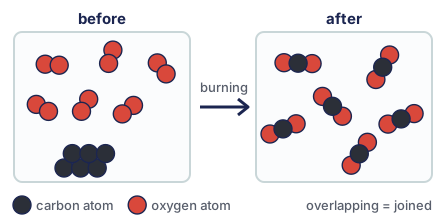
Charcoal is almost pure carbon. Classify the contents of each box.
Before: there are two kinds of particle, carbon atoms in the lump and oxygen molecules in the air, and they're not joined to each other. Each one has only one kind of atom, so this box is a mixture of two elements.
After: every particle is the same, one carbon atom joined to two oxygen atoms. That's one substance made of two elements chemically combined, so this box is a compound, carbon dioxide. The atoms are the same as before; burning joined them, just as heating joined the iron and sulfur.
Case closed
To classify a substance from a particle diagram, ask two questions. First: how many kinds of particle are there? More than one means a mixture. Then, if there's only one: how many kinds of atom does it contain? One kind means an element; two or more, joined in a fixed ratio, means a compound.
About this model
Particle diagrams are flat and show only a few atoms, hugely enlarged; a real drop of water contains about two thousand million million million molecules. The colours are only a key: atoms have no colour. In salt, the sodium and chlorine particles carry electric charges, which you'll meet with bonding.