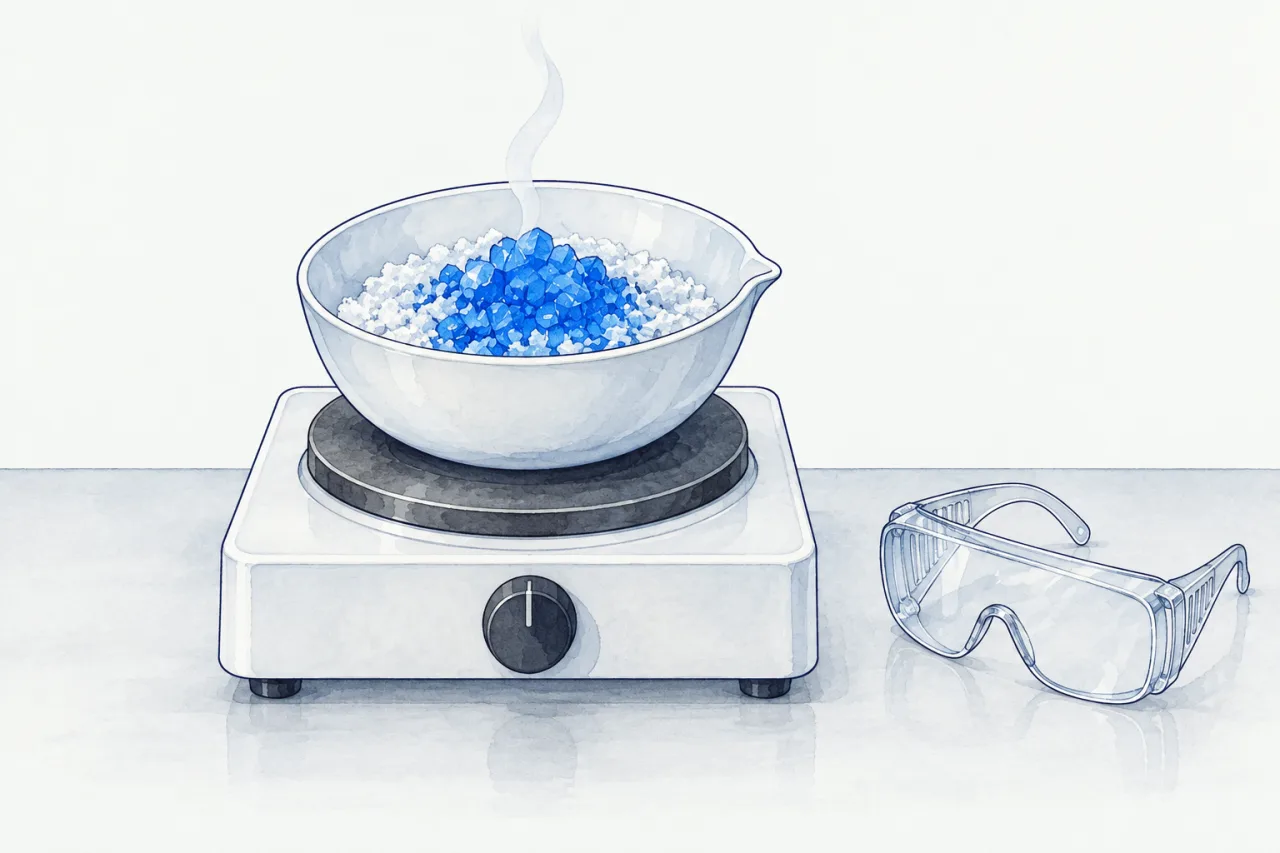
Heat blue copper(II) sulfate crystals in a basin and they slowly turn white, while a thin wisp of steam rises from them. The heap looks about the same size, but the balance says it has got lighter. In part 1 you found that the crystals are CuSO4·5H2O, with Mr 250, and that 90 of the 250 is water. If that's right, you can predict how much lighter the crystals get before you even switch the hotplate on. In this part you'll make that prediction, test it on a balance, and then use the same idea to work out the masses in any reaction from its equation.
 (enlarge)
Water leaves, the white solid stays
When hydrated copper(II) sulfate is heated, the water molecules leave the crystals and escape as steam, and a white powder is left behind. This white powder is anhydrous copper(II) sulfate: anhydrous means "containing no water". The equation shows where everything goes, and you can write the Mr of each substance under it:
CuSO4·5H2O(s) → CuSO4(s) + 5H2O(g) 250 → 160 + 90 (5 × 18 = 90)
No mass is destroyed, because 160 + 90 = 250. But the 90 drifts away from the basin as steam, so the basin only keeps the 160.
Masses go in the same ratio
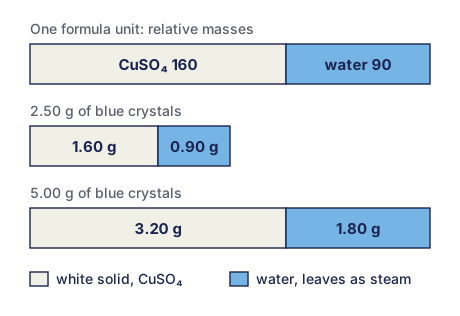
The Mr values compare the masses of one formula unit of each substance. A real heap of crystals has an enormous number of formula units, and every one of them splits in the same way, 250 into 160 and 90. So any mass of crystals splits in that same ratio. 250 g of crystals would leave 160 g of white solid and lose 90 g of water. 2.50 g is a hundred times less, so it leaves 1.60 g and loses 0.90 g. Double the crystals to 5.00 g and you double both, 3.20 g and 1.80 g. That's what calculating reacting masses in simple proportion means: the masses in a reaction keep the same ratio, however much you start with.
 (enlarge)
Trap: “Mass is always conserved, so the basin keeps its mass.” Mass is conserved in the reaction, but the water leaves the basin as steam. The balance only weighs what's still in the basin.
Predict, then heat
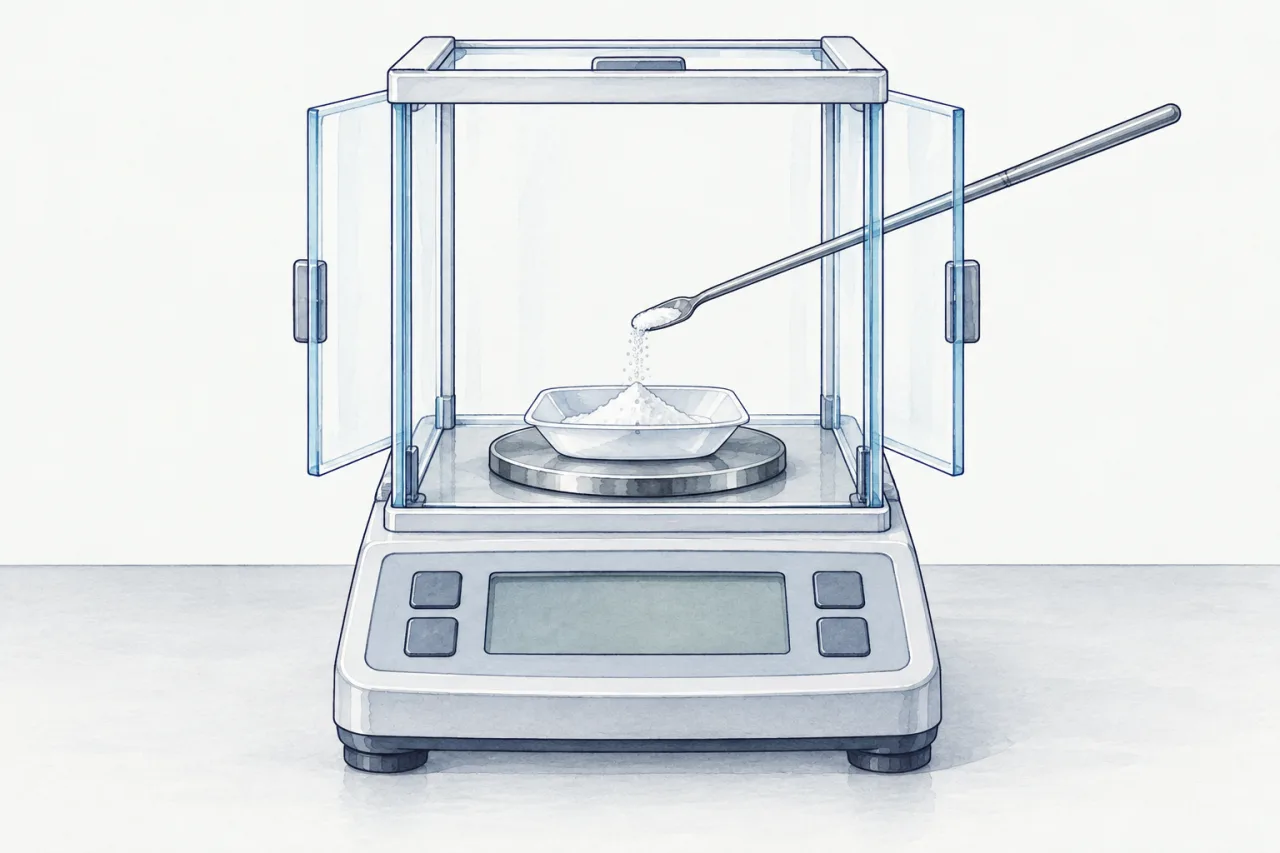
On the bench there's a digital balance that reads to 0.01 g, a hotplate, two clean evaporating basins and a jar of blue crystals. This is the method. Weigh an empty basin, then add the crystals and weigh it again; the difference is the mass of crystals. Heat the basin until the crystals look white, let it cool and weigh it again. Then heat and weigh again, and keep going until two readings in a row are the same. When the mass stops changing, all the water has gone. This is called heating to constant mass.
 (enlarge)
Predict the mass of white solid that 2.50 g of crystals will leave. Then heat them to constant mass and see if the balance agrees. At the end, test a little of the white solid with a drop of water, and try again with twice as many crystals.
What the balance shows
The empty basin reads 38.42 g, and 40.92 g with the crystals, so there are 2.50 g of crystals. After the first heating the reading is 40.20 g, but the middle of the heap is still blue, so some water is still inside. After the second heating it's 40.02 g and the heap is white all through, and the third heating gives 40.02 g again. Two readings in a row agree, so the mass is constant and all the water has gone.
The white solid has a mass of 40.02 − 38.42 = 1.60 g, and 40.92 − 40.02 = 0.90 g of water left as steam: exactly the 160 to 90 split that the Mr values predicted. A drop of water on a little of the white solid turns it blue again and makes it warm: the white solid is copper(II) sulfate without its water, and it takes water back. With 5.00 g of crystals, the balance shows 3.20 g of white solid and 1.80 g of water, twice as much of each.
Masses from an equation
The same idea works for any reaction, as long as you have its balanced equation. Take magnesium burning in oxygen to make magnesium oxide:
2Mg + O2 → 2MgO
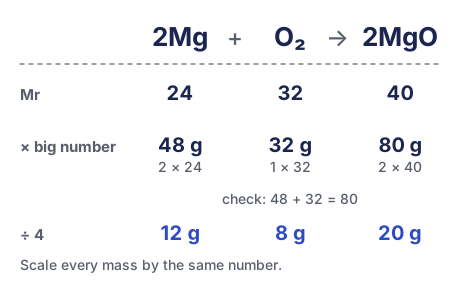
- *Find each Mr. Mg 24, O2 2 × 16 = 32, MgO 24 + 16 = 40
- Multiply by the big number in front. 2 × 24 = 48, 1 × 32 = 32, 2 × 40 = 80. So 48 g of magnesium reacts with 32 g of oxygen to make 80 g of magnesium oxide. Check: 48 + 32 = 80, so no mass is lost.
- Scale to the mass you have. How much magnesium oxide does 12 g of magnesium make? 12 g is 48 g divided by 4, so divide the magnesium oxide by 4 too: 80 ÷ 4 = 20 g.
 (enlarge)
The method works in any unit of mass, grams in a laboratory or tonnes in a factory, as long as both masses are in the same unit. You don't always need the equation: if an experiment tells you that 6.4 g of copper makes 8.0 g of copper oxide, the same scaling gives the mass from any other amount of copper.
Trap: “2 g of hydrogen makes 36.5 g of hydrogen chloride, because Mr of HCl is 36.5.” The equation is H2 + Cl2 → 2HCl: one H2 makes two HCl. Multiply by the big number, 2 × 36.5 = 73, so 2 g of hydrogen makes 73 g of hydrogen chloride.
Trap: “Add up all the Mr values and share the mass out.” Only the two substances in the question matter: the one whose mass you know and the one you're asked about. Find their masses from the equation, then scale.
Key idea: In a reaction, the masses of the substances keep the ratio of their Mr values multiplied by the big numbers in the balanced equation. Find that ratio, then multiply or divide both masses by the same number to reach the mass you have.
Worked example
Water from hydrogen
Hydrogen burns in oxygen to make water: 2H2 + O2 → 2H2O. What mass of water does 1 g of hydrogen make? (Ar: H 1, O 16.)
Mr: H2 = 2, H2O = 18. With the big numbers: 2 × 2 = 4 g of hydrogen makes 2 × 18 = 36 g of water. 1 g is 4 g divided by 4, so the water is 36 ÷ 4 = 9 g.
Worked example
Lime from limestone
Heating limestone, calcium carbonate, makes lime, calcium oxide: CaCO3 → CaO + CO2. What mass of lime does 50 tonnes of limestone make? (Ar: Ca 40, C 12, O 16.)
Mr: CaCO3 = 40 + 12 + 3 × 16 = 100; CaO = 40 + 16 = 56; CO2 = 12 + 2 × 16 = 44. Each big number is 1, so 100 tonnes of limestone makes 56 tonnes of lime and 44 tonnes of carbon dioxide. 50 tonnes is half of 100, so it makes 56 ÷ 2 = 28 tonnes of lime (and 22 tonnes of carbon dioxide; 28 + 22 = 50).
Worked example
From a measured mass
A pupil heats 6.4 g of copper in air and finds it makes 8.0 g of copper oxide. What mass of copper oxide would 1.6 g of copper make?
No Mr is needed: the experiment gives the ratio, 6.4 g to 8.0 g. 1.6 g is 6.4 g divided by 4, so the copper oxide is 8.0 ÷ 4 = 2.0 g.
Case closed
How heavy is a water molecule? 18 on the carbon-12 scale, and that's what the balance confirmed: in the blue crystal, five water molecules make 90 of every 250, so 2.50 g of crystals lost 0.90 g of water and left 1.60 g of white solid, and twice the crystals lost twice the water. In any reaction, the masses keep the ratio of the Mr values times the big numbers in the equation. Find that ratio, check that the masses add up, then scale it to the mass you have.
About this model
The readings are simulated: the model calculates them from the Mr values, with a balance that reads to 0.01 g, so they match the prediction exactly. Real results are rarely so neat. Anhydrous copper(II) sulfate takes water back from the air as it cools, so a real final mass can come out a little high, and heating it far too strongly breaks the white solid down further into black copper(II) oxide and gases, so the mass then drops too low. In the scene, the steam is drawn as a pale mist so that you can see it, and the first heating stops with a blue core so that you can see why one reading isn't enough. The magnifier shows the ions and water molecules of the crystal as a model, not to scale.
For teachers: Core 3.2.3, the whole part; 3.2.2 is used throughout (Cambridge 0620 syllabus, p15). Hydrated and anhydrous are introduced here as words and are defined in topic 7.3; the water test returns in topic 10.