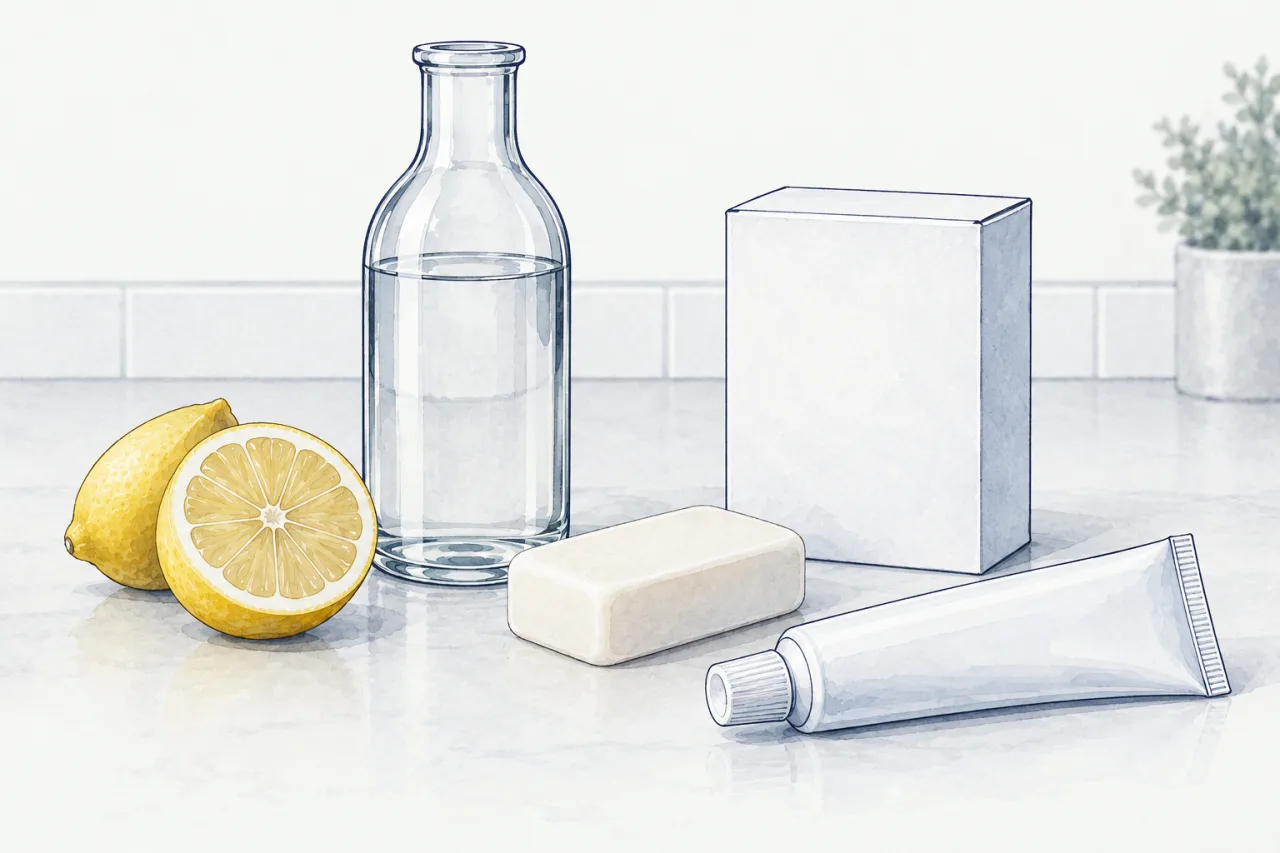
Look along a kitchen counter: a cut lemon, a bottle of vinegar, a bar of soap, a box of baking soda and a tube of toothpaste. The lemon and the vinegar taste sour because they contain acids. The soap and the baking soda feel slippery when wet because they are alkaline. If acids are in the food we eat, why do bottles of acid in a laboratory carry a hazard sign?
In part 1 you used indicators to tell acids from alkalis. Now you'll see what acids actually do: to metals, to bases and to carbonates. Along the way you'll meet the difference between a base and an alkali, and find out what happens to the ions when an acid meets an alkali.
 (enlarge)
Trap: "All acids are dangerous." Some are: a concentrated acid can burn skin, which is why laboratory bottles carry a hazard sign. But the citric acid in a lemon and the ethanoic acid in vinegar are weak and dilute enough to eat. How dangerous an acid is depends on which acid it is and how much of it is dissolved.
Acids and metals
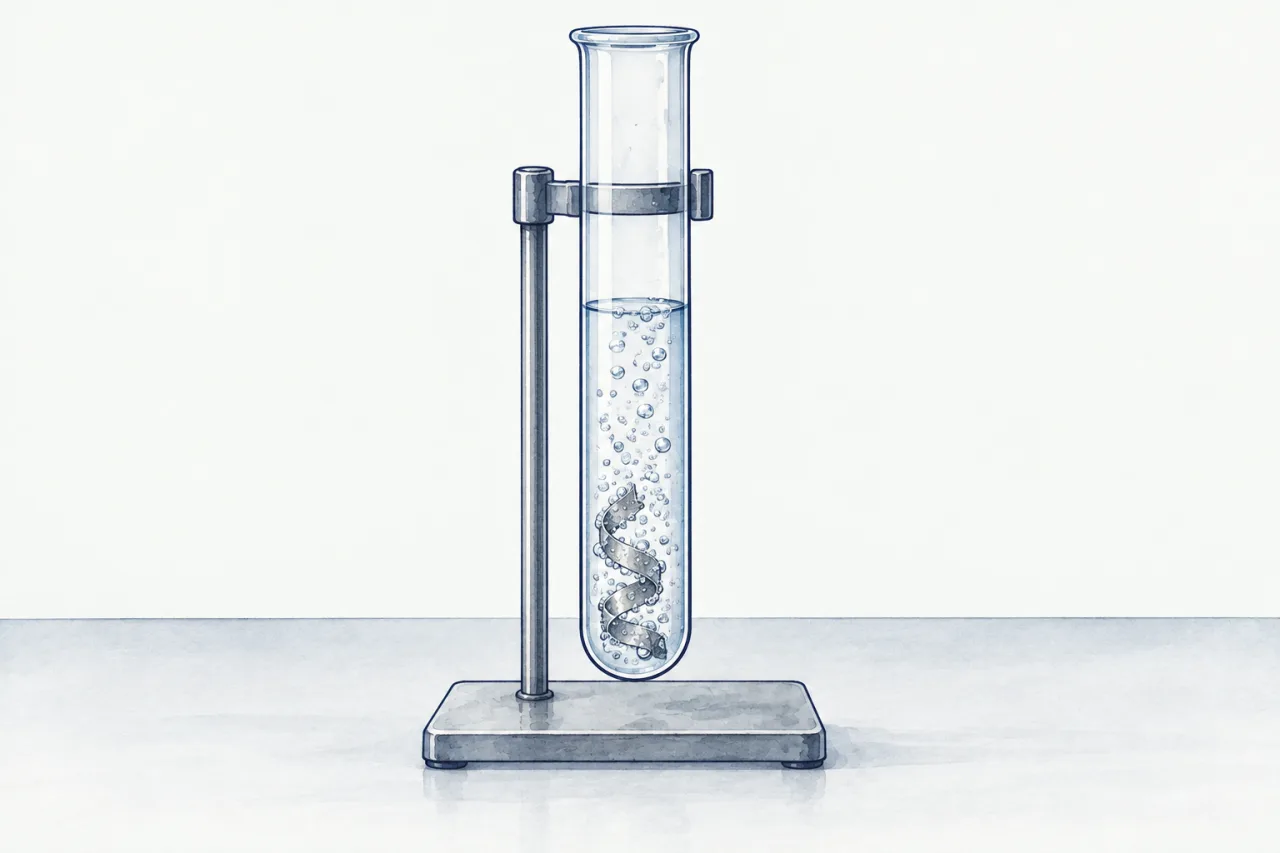
Drop a short strip of magnesium ribbon into a test tube of dilute hydrochloric acid. Within a second it is fizzing hard, and the ribbon gets smaller until it is gone. What is the gas, and where did the magnesium go?
 (enlarge)
Hold a lighted splint at the mouth of the tube and the gas burns with a squeaky pop. That is the test for hydrogen. The magnesium hasn't vanished: it has become magnesium ions, dissolved in the solution. Evaporate the water and you'd find a white solid, magnesium chloride.
Magnesium chloride is a salt: a compound formed when the hydrogen of an acid is replaced by a metal, or by ammonium ions, as you'll see at the end of this part. Each acid gives its own family of salts. Hydrochloric acid gives chlorides, sulfuric acid gives sulfates and nitric acid gives nitrates. The reaction, as a word equation:
magnesium + hydrochloric acid → magnesium chloride + hydrogen
Dilute hydrochloric acid and dilute sulfuric acid do the same with a reactive metal such as magnesium, zinc or iron: acid + metal → salt + hydrogen. A few metals, such as copper, are too unreactive to give hydrogen with these dilute acids. Nitric acid is different: with most metals it gives other gases, not hydrogen, so keep this rule for hydrochloric and sulfuric acids.
Acids and bases
Now drop a spatula of black copper(II) oxide powder into warm dilute sulfuric acid and stir. There is no fizzing this time, but the black powder disappears and the liquid turns blue. Where did the oxide go, and what made the blue?
The acid has reacted with the oxide to make a salt, copper(II) sulfate, which gives the blue colour, and water:
copper(II) oxide + sulfuric acid → copper(II) sulfate + water
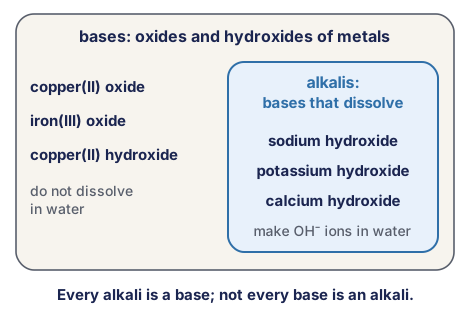
Copper(II) oxide is a base: a metal oxide or a metal hydroxide, which reacts with an acid to give a salt and water. Bases cancel out acids. So acid + base → salt + water.
Some bases dissolve in water and some don't. Copper(II) oxide doesn't dissolve. Sodium hydroxide does, and its solution contains OH− ions. A base that dissolves in water is called an alkali.
 (enlarge)
Trap: "Bases and alkalis are the same thing." Every alkali is a base, but only a base that dissolves in water is an alkali. Copper(II) oxide neutralises acid, so it is a base; it doesn't dissolve, so it is not an alkali.
Acids and carbonates
A lump of marble is dropped into dilute hydrochloric acid. It fizzes steadily, just as the magnesium did. Is this gas hydrogen too?
A lighted splint gives no pop: instead, the flame goes out. Bubble the gas through limewater and the limewater turns milky. That is the test for carbon dioxide. Marble is calcium carbonate, and every carbonate gives carbon dioxide with an acid, as well as a salt and water:
calcium carbonate + hydrochloric acid → calcium chloride + water + carbon dioxide
So acid + carbonate → salt + water + carbon dioxide.
The same reaction can be written as a symbol equation, with formulae. State symbols show the state of each substance: (s) solid, (l) liquid, (g) gas and (aq) dissolved in water. Then balance it: the same number of each kind of atom on both sides. CaCl2 has two chlorine atoms, so two HCl are needed; their two hydrogen atoms make one H2O. Change only the numbers in front, never a formula:
CaCO3(s) + 2HCl(aq) → CaCl2(aq) + H2O(l) + CO2(g)
Trap: "The gas from a carbonate and an acid is hydrogen." Both reactions fizz, but the gases are different. A carbonate gives carbon dioxide, which turns limewater milky. Only a metal gives hydrogen, which pops.
Worked example
One acid, three reactions
Dilute sulfuric acid is added to three test tubes: one with iron filings, one with magnesium oxide powder and one with sodium carbonate powder. Give the word equation for each, and say which tubes fizz.
- Sort the solids. Iron is a metal; magnesium oxide is a metal oxide, a base; sodium carbonate is a carbonate.
- Name the salts. Sulfuric acid gives sulfates: iron(II) sulfate, magnesium sulfate and sodium sulfate.
- Iron, a metal: iron + sulfuric acid → iron(II) sulfate + hydrogen. It fizzes, and the gas pops.
- Magnesium oxide, a base: magnesium oxide + sulfuric acid → magnesium sulfate + water. No gas, so no fizzing.
- Sodium carbonate, a carbonate: sodium carbonate + sulfuric acid → sodium sulfate + water + carbon dioxide. It fizzes, and the gas turns limewater milky.
Neutralisation
A pupil adds sodium hydroxide solution, drop by drop, to dilute hydrochloric acid with universal indicator in it. The red slowly turns orange, then yellow, and at one drop, green: pH 7. What has happened to the H+ ions of the acid?
The acid and the alkali have cancelled each other out. This is neutralisation: the reaction of an acid with a base to give a salt and water. Here:
sodium hydroxide + hydrochloric acid → sodium chloride + water
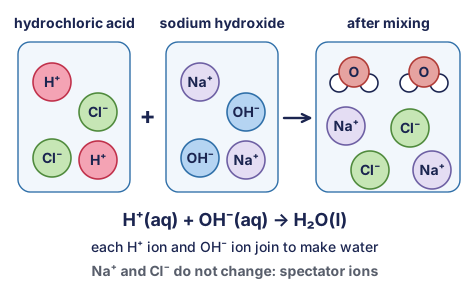
Look at the ions. The acid gives H+ and Cl− ions; the alkali gives Na+ and OH− ions. Each H+ ion joins an OH− ion to make a water molecule. The Na+ and Cl− ions are in the solution before and after, unchanged: they are spectator ions. So the reaction is only this, written as an ionic equation, with state symbols:
H+(aq) + OH−(aq) → H2O(l)
 (enlarge)
In every neutralisation of an acid by an alkali, this is the step that makes the water: H+ ions from the acid join OH− ions from the alkali. The spectator ions change from one reaction to another; H+ + OH− → H2O stays.
Trap: "Neutralisation always leaves the solution at pH 7." With acids and alkalis like the ones in this part, hydrochloric, sulfuric or nitric acid and sodium or potassium hydroxide, the pH is 7 only if the acid and the alkali exactly cancel. Stop too soon and some H+ ions are left: the pH is below 7. Add too much alkali and spare OH− ions are left: the pH is above 7.
Worked example
Potassium hydroxide and sulfuric acid
Potassium hydroxide solution neutralises dilute sulfuric acid. Give the word equation and the ionic equation, and name the spectator ions.
- Name the salt. Potassium from the alkali, sulfate from the acid: potassium sulfate.
- Word equation: potassium hydroxide + sulfuric acid → potassium sulfate + water.
- Ionic equation: the H+ ions from the acid join the OH− ions from the alkali: H+(aq) + OH−(aq) → H2O(l).
- Spectator ions: the potassium ions, K+, and the sulfate ions, SO42−, stay in the solution unchanged.
Bases and ammonium salts
A gardener stores a bag of ammonium sulfate fertiliser next to a bag of lime, a base. When both get damp, a sharp smell fills the shed. Where does the smell come from?
Ammonium salts contain the ammonium ion, NH4+. Warm an ammonium salt with a base and it gives off ammonia gas, NH3, which has a sharp smell. Ammonia is an alkaline gas, so it turns damp red litmus paper blue: that is the test for it. In the laboratory, warm ammonium chloride with sodium hydroxide solution:
ammonium chloride + sodium hydroxide → sodium chloride + water + ammonia
So ammonium salt + base → salt + water + ammonia. The fertiliser loses its nitrogen into the air as ammonia, which is why farmers don't spread lime and ammonium fertilisers together.
Key idea: Dilute hydrochloric or sulfuric acid + a reactive metal → salt + hydrogen. Acid + base → salt + water. Acid + carbonate → salt + water + carbon dioxide. Ammonium salt + base, warmed → salt + water + ammonia. A base is a metal oxide or hydroxide; an alkali is a base that dissolves. Neutralisation of an acid by an alkali makes water: H+(aq) + OH−(aq) → H2O(l).
Case closed
Why do acids in food and acids in the laboratory behave so differently? They don't: acids react in the same few ways. Dilute hydrochloric or sulfuric acid gives a salt and hydrogen with a reactive metal. With a base, an acid gives a salt and water, and with a carbonate a salt, water and carbon dioxide. Bases are metal oxides and hydroxides, and alkalis are the bases that dissolve. When an acid meets an alkali, H+ ions and OH− ions join to make water, while the other ions look on. What differs is how much acid there is, and how readily it gives up its H+ ions: the subject of part 3, which is Supplement.
About this model
Word equations show what reacts and what forms, not how much. The gas tests here are the standard laboratory tests: a squeaky pop for hydrogen, limewater turning milky for carbon dioxide and damp red litmus turning blue for ammonia. Some salts are coloured, like copper(II) sulfate, and some are white. Ammonia and some other bases contain no metal at all, so "a metal oxide or hydroxide" covers the bases you'll meet most often, not every one. How to make a pure dry salt, and how to measure the exact volume of alkali that neutralises an acid, come in later modules. Which oxides are bases and which are not also comes later. With a weak acid, such as the ethanoic acid of part 3, the solution is slightly alkaline at the point where the acid and the alkali exactly cancel.