Look up chlorine on the Periodic Table and you'll find the number 35.5 beside its symbol. Yet in part 1 you met chlorine's two isotopes, chlorine-35 and chlorine-37, and neither has a mass number of 35.5. No atom can have half a neutron, so no single chlorine atom has that mass. Where does 35.5 come from, then? In this part you'll find out what the number means and work it out for chlorine, then for an element with three isotopes. This whole part is Supplement: for pupils taking the Extended papers.
A mixture of two atoms
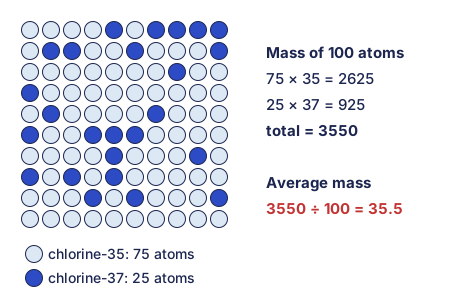
Even a tiny bubble of chlorine gas contains far more than a billion atoms, and they're always a mixture of both isotopes. Wherever chlorine comes from, the mixture is almost the same: in every 100 chlorine atoms, about 75 are chlorine-35 and 25 are chlorine-37. The share of an element's atoms that belong to one isotope is that isotope's abundance, usually given as a percentage. Chlorine-35 has an abundance of 75 % and chlorine-37 of 25 %.
 (enlarge)
An average that counts every atom
To find the average mass of a chlorine atom, take a sample of 100 atoms and find their total mass. 75 atoms of mass 35 have a mass of 75 × 35 = 2625, and 25 atoms of mass 37 have a mass of 25 × 37 = 925. Together that's 3550, so the average mass of one atom is 3550 ÷ 100 = 35.5.
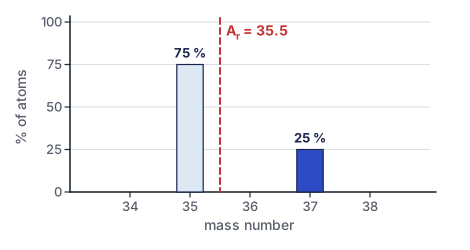
This average counts each isotope as many times as it has atoms, so the common isotope counts most. That's why the answer is 35.5 and not 36, which is halfway between 35 and 37: three out of four atoms are chlorine-35, so the average is pulled towards 35. The average mass of an element's atoms, counting every isotope by its abundance, is the element's relative atomic mass, Ar. In topic 3 you'll see exactly what it's measured against; for these calculations, the mass of each isotope is its mass number.
Ar = (mass number × abundance + mass number × abundance + …) ÷ 100
 (enlarge)
Trap: “The relative atomic mass is the mean of the mass numbers: (35 + 37) ÷ 2 = 36.” That would be right only if both isotopes had the same abundance. There are three times as many chlorine-35 atoms, so each mass must be multiplied by its abundance.
Trap: “Some chlorine atoms have a mass of 35.5.” Every chlorine atom is either chlorine-35 or chlorine-37. 35.5 is the average of the mixture, not the mass of any one atom.
Free play: nothing here is marked or saved
Where does 35.5 sit? Chlorine atoms on the classroom whiteboard
Every chlorine atom has a mass of 35 or 37, yet the Periodic Table says 35.5. Change the mixture of the two isotopes. Where does the relative atomic mass, Ar, sit? When is it 36?Supplement
Try: Slide to 50 %. Where does Ar sit now?
- Chlorine-37
- 25 %
- Mass of 100 atoms
- 3550
- Relative atomic mass Ar
- 35.5
- On the line
- nearer 35
Ar = (35 × 75 + 37 × 25) ÷ 100 = 3550 ÷ 100 = 35.5
Halfway: (35 + 37) ÷ 2 = 36; Ar is 36 only at 50 %
- Ar counts every atom: each mass number is multiplied by its abundance. The more common isotope counts more, so Ar sits nearer to its mass number.
- Ar is never outside 35–37: it is 35 only if every atom is chlorine-35 and 37 only if every atom is chlorine-37. It is 36, halfway, only when the two are equally common, 50 % each.
- No magnet is 35.5. Every atom is either chlorine-35 or chlorine-37; 35.5 is the average of the mixture.
- Chlorine from anywhere on Earth is about 75 % chlorine-35, so the table prints 35.5. Every other setting here is an imagined mixture.
About this model. One magnet stands for one atom; a real sample has billions of billions of atoms in the same proportions. Each atom’s mass is taken as its mass number, as in the reading: really chlorine-35 is 34.97 and chlorine-37 is 36.97, each compared with 1/12 of the mass of a carbon-12 atom. The abundances are rounded to whole numbers, and the slider moves in steps of 5 %. The tile shows Ar to one decimal place for every mixture; the Periodic Table in the exam gives most elements’ Ar as a whole number, but chlorine’s as 35.5.
Check before you trust the answer
Two quick checks catch most mistakes. Ar always lies between the lightest and the heaviest isotope, because an average can't be outside the values it averages. And it lies nearest the most abundant isotope. For chlorine, 35.5 is between 35 and 37 and close to 35, where three quarters of the atoms are. If your answer is outside the range, or nearer a rare isotope, look again at the sum.
The Periodic Table you'll use in the exam rounds most Ar values to whole numbers. It gives chlorine as 35.5 because chlorine's value is so close to a half.
Trap: “Ar is the mass number of the most common isotope.” The common isotope pulls the average towards it, but the rarer isotopes still count. For chlorine, the most common isotope is 35, but Ar is 35.5.
Key idea: Most elements are a mixture of isotopes, each with its own abundance. The relative atomic mass, Ar, is the average mass of the atoms, counting each isotope by its abundance: multiply each mass number by its percentage abundance, add the results and divide by 100. Ar lies between the lightest and heaviest isotope, nearest the most abundant one.
Worked example
Chlorine
Chlorine is 75 % chlorine-35 and 25 % chlorine-37. Calculate its relative atomic mass.
Multiply each mass number by its abundance: 35 × 75 = 2625 and 37 × 25 = 925. Add them: 2625 + 925 = 3550. Divide by 100: Ar = 35.5.
Check: 35.5 is between 35 and 37, and nearer 35, the more abundant isotope.
Worked example
Three isotopes of magnesium
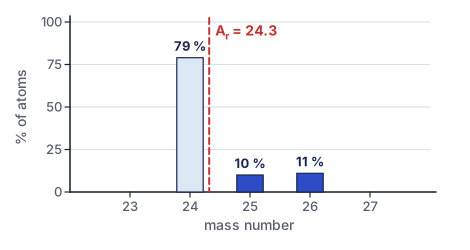
Magnesium has three isotopes: magnesium-24 (79 %), magnesium-25 (10 %) and magnesium-26 (11 %). Calculate the relative atomic mass of magnesium to one decimal place.
The method is the same however many isotopes there are. 24 × 79 = 1896, 25 × 10 = 250 and 26 × 11 = 286. The total is 1896 + 250 + 286 = 2432, and 2432 ÷ 100 = 24.32, so Ar = 24.3 to one decimal place.
 (enlarge)
Check: the abundances add up to 100 %, and 24.3 is between 24 and 26, close to 24, where most of the atoms are. Rounded to a whole number it's 24, the value on the Periodic Table.
Case closed
Chlorine is 35.5 because every sample of chlorine is a mixture: 75 % chlorine-35 and 25 % chlorine-37. The relative atomic mass is the average mass of those atoms, with each isotope counted by its abundance, so it's nearer 35 than 37. To calculate any Ar, multiply each mass number by its percentage abundance, add, divide by 100, then check that the answer lies between the isotopes and nearest the most common one.
About this model
The abundances here are rounded. Real samples vary very slightly with where the element comes from, so the most precise values of Ar have more decimal places than these. The mass of an isotope isn't exactly its mass number either: chlorine-35 atoms have a relative mass of 34.97, not exactly 35. Using mass numbers is close enough for these calculations. The picture of 100 atoms is a model: a real sample has so many atoms that its mixture matches the abundances almost perfectly. Abundances are measured with an instrument called a mass spectrometer, which isn't part of this course; here they're given as data.
For teachers: Supplement 2.3.4, the whole part (Cambridge 0620 syllabus, p13).