Each sandwich needs two slices of bread and one slice of cheese. With ten slices of bread and eight slices of cheese you can make five sandwiches, and then you stop: the bread has run out, and three slices of cheese are left over. Chemical reactions stop in the same way, when one reactant runs out. In this part you'll find out which one runs out first, and how much product you get when it does.
Your investigation
Put the same acid, 10.0 cm³ of 0.500 mol/dm³ hydrochloric acid, in five conical flasks. Into each flask goes a bigger piece of magnesium ribbon: 0.020 g, 0.040 g, 0.060 g, 0.080 g and 0.100 g. A gas syringe collects the hydrogen:
Mg + 2HCl → MgCl2 + H2
Predict first: as the mass of magnesium goes up, will the volume of hydrogen keep rising in proportion, rise and then level off, or stay the same? Then run the five reactions, read the syringe each time and plot your results.
What the syringe shows
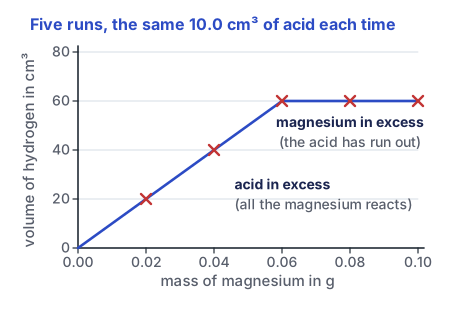
The 0.020 g, 0.040 g and 0.060 g pieces give 20 cm³, 40 cm³ and 60 cm³ of hydrogen: double the magnesium, double the gas. The 0.080 g and 0.100 g pieces give 60 cm³ again, and pieces of magnesium are left in the flask when the fizzing stops. The graph rises in a straight line and then levels off.
 (enlarge)
Part 1 explains both halves of the graph:
- The rising part. All the magnesium reacts. 0.020 g is 0.020 ÷ 24 = 0.000833 mol of Mg, which makes 0.000833 mol of H2: 0.000833 × 24 000 = 20 cm³.
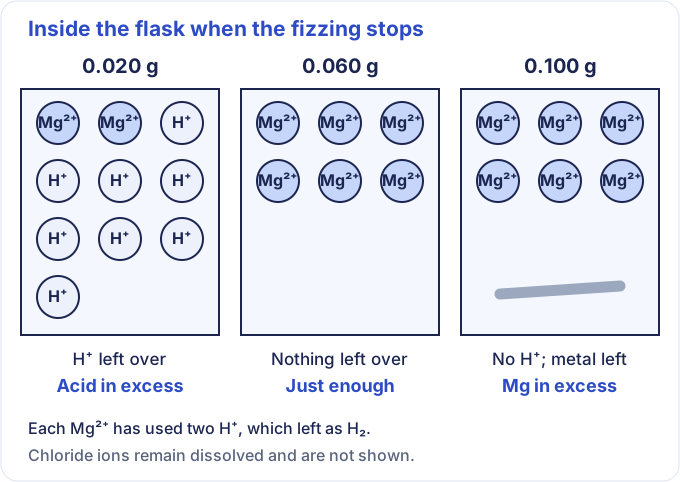
- The flat part. The acid holds n = c × V = 0.500 × 0.0100 = 0.00500 mol of HCl. Two HCl make one H2, so it can make at most 0.00250 mol of hydrogen: 0.00250 × 24 000 = 60 cm³. That much hydrogen needs 0.00250 mol of magnesium, 0.00250 × 24 = 0.060 g. Any magnesium beyond 0.060 g has no acid left to react with.
 (enlarge)
The limiting reactant
The reactant that is used up completely is the limiting reactant: it decides, or limits, how much product forms. The other reactant is in excess: some of it is left over. With 0.020 g and 0.040 g the magnesium is limiting and the acid is in excess. From 0.080 g on, the acid is limiting and the magnesium is in excess. At 0.060 g they are just used up together.
Adding more of the reactant in excess doesn't give more product. Only more of the limiting reactant does, until it stops being the limiting one.
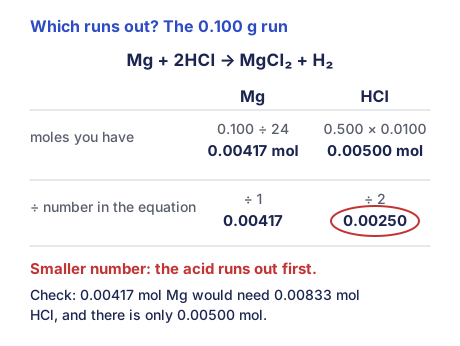
Trap: “The limiting reactant is the one with fewer moles.” In the 0.100 g run there is 0.00417 mol of magnesium and 0.00500 mol of HCl, so the acid has more moles, yet it runs out first: each magnesium atom needs two HCl. Use the equation.
Trap: “The limiting reactant is the one with the smaller mass.” Masses aren't counts of particles. Change them to moles first.
Find the limiting reactant
- Find the amount, in moles, of each reactant.
- Divide each amount by its number in the equation.
- The smaller answer is the limiting reactant. Use its amount to find the product.
You can check by asking “have or need?”: work out how much of the other reactant the first one needs, and compare it with what you have.
 (enlarge)
Worked example
Iron and sulfur
5.60 g of iron is heated with 4.00 g of sulfur: Fe + S → FeS. Which reactant is limiting? What mass of iron(II) sulfide forms, and what mass of the other reactant is left? (Ar: S 32, Fe 56.)
- n(Fe) = 5.60 ÷ 56 = 0.100 mol; n(S) = 4.00 ÷ 32 = 0.125 mol.
- Both numbers in the equation are 1, so compare 0.100 with 0.125: iron is limiting.
- 0.100 mol of Fe makes 0.100 mol of FeS. M(FeS) = 56 + 32 = 88 g/mol, so m = 0.100 × 88 = 8.80 g.
The iron uses 0.100 mol of sulfur, so 0.125 − 0.100 = 0.0250 mol is left: 0.0250 × 32 = 0.800 g of sulfur. Check: 5.60 + 4.00 = 9.60 g before; 8.80 + 0.800 = 9.60 g after.
Worked example
Two solutions
25.0 cm³ of 0.200 mol/dm³ calcium chloride solution is mixed with 30.0 cm³ of 0.200 mol/dm³ sodium carbonate solution. A white precipitate of calcium carbonate forms: CaCl2 + Na2CO3 → CaCO3 + 2NaCl. What mass of calcium carbonate can form? (Ar: C 12, O 16, Ca 40.)
- n(CaCl2) = 0.200 × 0.0250 = 0.00500 mol; n(Na2CO3) = 0.200 × 0.0300 = 0.00600 mol.
- The ratio is 1 : 1, so calcium chloride is limiting.
- 0.00500 mol of CaCO3 forms: 0.00500 × 100 = 0.500 g.
Why chemists use an excess
A chemist often puts in more of one reactant than the equation needs, on purpose. The reactant in excess makes sure that all of the other one, often the more expensive one, reacts. When you make a salt from an acid and an insoluble base, you add the base in excess so that no acid is left, then filter off the solid that is left over. In your investigation, the smaller pieces had the acid in excess, so all the magnesium reacted and the volume of hydrogen told you its mass.
Case closed
When does the acid run out? 10.0 cm³ of 0.500 mol/dm³ acid holds 0.00500 mol of HCl, enough for 0.060 g of magnesium and 60 cm³ of hydrogen. Below 0.060 g the magnesium is limiting and the volume rises in proportion; above it the acid is limiting, the volume stays at 60 cm³ and magnesium is left over. To find the limiting reactant, change each reactant to moles, divide by its number in the equation, and take the smaller. The limiting reactant, not the one in excess, decides how much product you get.
About this model
The readings are simulated: the model calculates them with the molar gas volume, 24 000 cm³ at r.t.p., from magnesium that is pure, acid of exactly 0.500 mol/dm³ and a syringe that catches all the hydrogen. A real gas syringe reads to about 1 cm³, some hydrogen stays in the flask and tubes, and the ribbon has a thin coat of oxide, so real results scatter a little and come out slightly low. The balance reads to 0.001 g, and 1 cm of ribbon is taken as 0.010 g, close to real magnesium ribbon. The magnifier shows the ions in the acid as a model, not to scale: twelve H+ and twelve Cl− stand for the whole 0.00500 mol, and the chloride ions stay in the solution throughout.
For teachers: Supplement 3.3.5, its parts on limiting reactants, reacting masses, gas volumes at r.t.p. and volumes of solutions (Cambridge 0620 syllabus, p16). Making salts with an excess of base is in topic 7; titration comes in topic 12.