A factory that makes medicine tablets knows from the equation how much of the drug each batch should give. It never collects all of it, and every batch is tested to show how much of the powder really is the drug. In this part you'll compare what you made with what the equation predicts, find how much of a sample is the substance you want, and work out a formula from the masses that react.
 (enlarge)
Percentage yield
The mass the equation predicts, from the limiting reactant, is the theoretical yield: what you would get if every particle reacted and you kept every crumb. The mass you actually collect is the actual yield. The percentage yield compares them:
percentage yield = actual yield ÷ theoretical yield × 100
Worked example
The precipitate
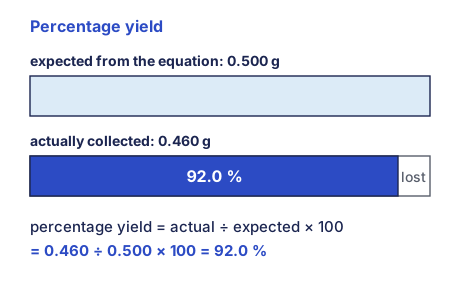
In part 2, worked example W08, mixing the two solutions can make 0.500 g of calcium carbonate. After filtering, washing and drying, the precipitate has a mass of 0.460 g. What is the percentage yield?
percentage yield = 0.460 g ÷ 0.500 g × 100 = 92.0 %.
 (enlarge)
Where did the other 0.040 g go? A real yield is below 100 % because:
- some product is lost when it is moved: it sticks to the filter paper, the beaker and the glass rod;
- some product stays dissolved in the solution;
- the reaction may not finish, or a different reaction may use up some of the reactants.
A yield above 100 % means something is wrong with the product, not that you made extra: it is still wet, or it contains other substances. Dry it and weigh it again until its mass stops changing.
Trap: “Percentage yield = theoretical ÷ actual × 100.” Put the mass you actually collected on top. 0.500 ÷ 0.460 × 100 = 109 %, which is impossible for a dry, pure product.
Percentage composition by mass
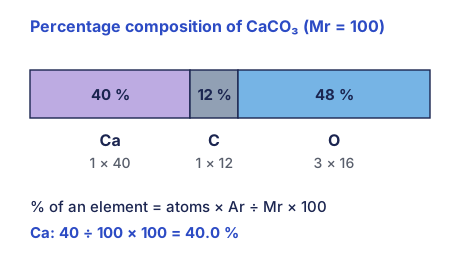
The percentage by mass of an element in a compound is the share of the compound's mass that comes from that element:
*% of an element = number of atoms of it in the formula × Ar ÷ Mr × 100*
 (enlarge)
Worked example
Nitrogen in a fertiliser
What is the percentage by mass of nitrogen in ammonium nitrate, NH4NO3? (Ar: H 1, N 14, O 16.)
Mr = 14 + 4 × 1 + 14 + 3 × 16 = 80. The formula has two nitrogen atoms, so the nitrogen is 2 × 14 = 28 of the 80. Percentage of nitrogen = 28 ÷ 80 × 100 = 35.0 %.
Trap: “Use one nitrogen atom.” Count every atom of the element in the whole formula: NH4NO3 has one in NH4 and one in NO3. One atom would give 17.5 %.
Percentage purity
A sample may be mixed with other substances. Its percentage purity is the share of its mass that is the substance you want:
percentage purity = mass of the pure substance ÷ mass of the whole sample × 100
You find the mass of the pure substance from a reaction that only it takes part in.
Worked example
How pure is the limestone?
A 2.50 g lump of limestone reacts with excess hydrochloric acid and gives 0.540 dm³ of carbon dioxide at r.t.p.: CaCO3 + 2HCl → CaCl2 + H2O + CO2. The other substances in the limestone make no gas. What is the percentage purity of the calcium carbonate? (Ar: C 12, O 16, Ca 40.)
- n(CO2) = 0.540 ÷ 24 = 0.0225 mol.
- The ratio is 1 : 1, so the sample held 0.0225 mol of CaCO3: 0.0225 × 100 = 2.25 g.
- percentage purity = 2.25 ÷ 2.50 × 100 = 90.0 %.
Empirical formula from masses
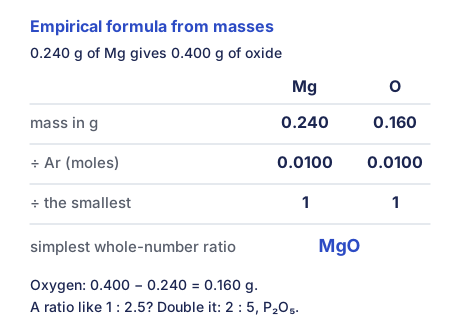
The empirical formula of a compound is the simplest whole-number ratio of the atoms of each element in it. Masses give it in four steps: the mass of each element, ÷ its Ar (moles of atoms), ÷ the smallest of these, then whole numbers.
Worked example
Magnesium oxide
0.240 g of magnesium burns and gives 0.400 g of oxide. Find its empirical formula. (Ar: O 16, Mg 24.)
The oxygen that joined the metal has a mass of 0.400 − 0.240 = 0.160 g.
 (enlarge)
Mg : O = 0.0100 : 0.0100 = 1 : 1, so the empirical formula is MgO.
Sometimes the ratio isn't whole. 0.620 g of phosphorus (Ar 31) joins with 0.800 g of oxygen: P = 0.620 ÷ 31 = 0.0200 mol and O = 0.800 ÷ 16 = 0.0500 mol, a ratio of 1 : 2.5. Double it to 2 : 5: the empirical formula is P2O5. Percentages work the same way: treat 40.0 % as 40.0 g in a 100 g sample.
Trap: “Round 1 : 2.5 to 1 : 3.” Only round a number that is very close to a whole one, such as 2.98. A ratio ending in .5 is doubled; one ending in .33 or .67 is multiplied by 3.
Molecular formula
The molecular formula gives the actual number of atoms of each element in one molecule. It is a whole number of empirical formulae. Find how many: divide the Mr of the molecule by the mass of one empirical formula.
Worked example
A hydrocarbon
A hydrocarbon, a compound of carbon and hydrogen only, has 80.0 % carbon and 20.0 % hydrogen by mass, and Mr = 30. Find its empirical and molecular formulae. (Ar: H 1, C 12.)
In 100 g: C = 80.0 ÷ 12 = 6.67 mol and H = 20.0 ÷ 1 = 20.0 mol. Divide by the smaller: C : H = 1 : 3.00, so the empirical formula is CH3, with mass 12 + 3 = 15. Mr ÷ 15 = 30 ÷ 15 = 2, so the molecular formula is 2 × CH3 = C2H6, ethane.
An ionic compound such as MgO is a giant lattice, not separate molecules, so its formula is always the empirical formula.
Case closed
How much did you really make? The equation gives the theoretical yield from the limiting reactant; the percentage yield compares what you collected with it, and is always below 100 % for a dry, pure product. The percentage by mass of an element is its atoms × Ar ÷ Mr × 100, and the percentage purity is the mass of the pure substance ÷ the mass of the sample × 100. From the masses that react, divide by Ar and by the smallest to find the empirical formula; divide the Mr by its mass to find the molecular formula.
For teachers: Supplement 3.3.8 and 3.3.7 (Cambridge 0620 syllabus, p16). Titration calculations (3.3.6) come in topic 12.