A bell is ringing inside a glass jar. You can see its hammer moving, yet the sound becomes fainter when a pump removes the air. Has the bell stopped making vibrations, or has something changed between the bell and your ear? Predict what will happen when the air is let back in. In this part you will explain the result and use the speed of sound to estimate a travel time or distance.
 (enlarge)
The bell keeps vibrating
Air carries sound because its particles can vibrate and pass the disturbance on to neighbouring regions. A material that carries a wave is called a medium. A gas such as air, a liquid such as water and a solid such as steel can all be media for sound.
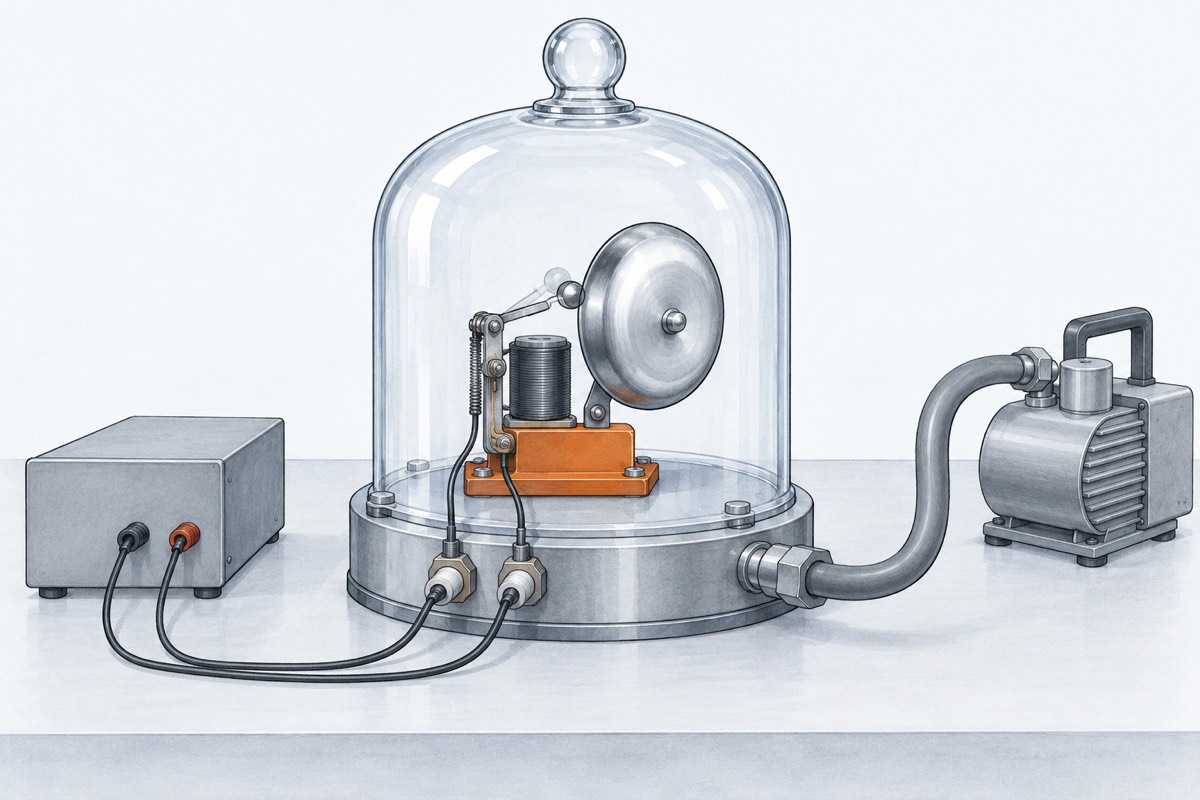
In a bell-jar demonstration, an electric bell rings inside the jar while a vacuum pump removes air. The electrical connections pass through sealed fittings, so the bell can keep working as the air is removed. Watch the hammer: it still hits the gong, so the vibrating source is still present. However, the sound heard outside becomes fainter as less air remains to carry it. When air is admitted again, the sound becomes louder.
A vacuum is a region with no matter. In an ideal vacuum there are no particles to pass the vibration on, so sound cannot travel through a vacuum. This separates two requirements: a vibrating source produces sound, and a medium is needed to transmit it to a listener.
The real apparatus is not a perfect vacuum, and some vibrations can travel through the bell's supports and the base. A soft mounting reduces that route. A faint remaining sound is therefore not evidence that sound crosses a vacuum. The glass lets you see the hammer, but that is light travelling, not sound travelling through the empty space.
Trap: “The pump stops the bell.” Check the moving hammer before drawing that conclusion. In this demonstration the source keeps vibrating; removing air weakens the path carrying sound to the outside.
Worked example
Quiet, but still moving
A teacher pumps air from the jar. The hammer keeps hitting, the outside microphone signal becomes smaller, and letting air back in restores the larger signal. What conclusion do these observations support?
The moving hammer shows that the vibrating source has not stopped. The smaller microphone signal shows less sound reaching the microphone, with its position and gain fixed. Restoring the air restores the sound, so air is needed to carry the sound through the space inside the jar. We infer the need for a medium; we do not claim that a real jar becomes perfectly silent or contains absolutely no particles.
Why space is silent
Imagine two astronauts separated by empty space, with no solid connection between them. One bangs a metal tool. The tool can vibrate, but no sound wave can cross the vacuum to the other astronaut. The other astronaut may see the action because light can cross a vacuum. Through a radio, an electromagnetic signal can carry a message across space, and a speaker then makes sound inside the other astronaut's air-filled helmet.
Water and steel do carry sound, so “sound needs air” is too narrow a rule. Sound needs a medium, which can be a solid, liquid or gas. Sound travelling through a continuous solid connection is a different route from sound trying to cross an empty gap.
Light first, thunder later
During a storm you see a distant lightning flash before you hear its thunder. The flash and thunder are produced at almost the same time, but light travels much faster than sound. At these distances the light's travel time is negligible compared with the sound's travel time, so the delay is approximately the time the sound spent travelling to you.
 (enlarge)
The speed of sound in air is approximately 330–350 m/s. Use 340 m/s when a question needs one representative value. That means sound travels about 340 metres each second. The exact value depends on conditions such as air temperature; 340 m/s is an approximation, not a universal constant.
For steady travel, distance = speed × time, and time = distance ÷ speed. Write distance in metres, time in seconds and speed in metres per second. 1 km = 1000 m. These calculations use a supplied speed; they do not measure it.
Worked example
Three seconds after the flash
Thunder arrives 3.0 s after a flash. Estimate the distance to the part of the lightning that produced the sound, using 340 m/s.
Neglect the light's travel time, so the sound's travel time is approximately 3.0 s. Distance = 340 m/s × 3.0 s = 1020 m, or 1.02 km, about 1 km. This is a single journey from source to listener, so use the whole distance without halving it. Real lightning is extended, so this is an estimate, not an exact position of a point source. Watch storms from shelter; this calculation is not an instruction to go outside.
Worked example
Across a playing field
A sound source and a listener are 170 m apart in air. How long does the sound take to reach the listener, using 340 m/s?
Time = distance ÷ speed = 170 m ÷ 340 m/s = 0.50 s. A useful check is that 170 m is half of the distance sound covers in one second. Doubling the source amplitude would make the sound louder; it would not halve this travel time under the same air conditions.
Trap: “A louder sound reaches you faster.” Amplitude changes loudness. For these ordinary sound waves in the same air conditions, use the same speed whether the sound is loud or quiet.
Supplement: Air, water and steel
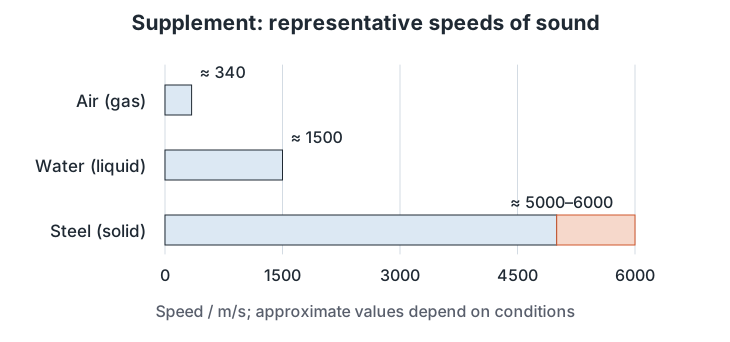
Does a medium that carries sound also determine how fast it travels? Yes. In general, sound travels faster in solids than in liquids, and faster in liquids than in gases. This is a general comparison, not a rule that every solid is faster than every liquid in every condition. The table gives representative reading values, not values you must memorise for every material.
| Medium | State | Approximate speed of sound |
|---|---|---|
| Air | Gas | 340 m/s |
| Water | Liquid | 1500 m/s |
| Steel | Solid | 5000–6000 m/s |
 (enlarge)
In a solid, particles vibrate about their positions and pass the disturbance through forces between neighbours. They do not have to flow along with the sound. Both the strength of these restoring forces (the forces that pull particles back towards their positions) and the material's density affect speed, so particle spacing alone is not a reliable explanation for every material. The table supplies the evidence for these three media.
Worked example
Which arrives first?
Supplement. Three separate paths are each 100 m long: one through air, one through water and one through steel. Sounds start at the same time. Use the table to order their arrivals and explain why steel can carry sound even though it does not flow.
For the same distance, a greater speed means a shorter time. The steel path gives the earliest arrival, the water path next and the air path last. Steel → water → air is the arrival order. Steel's particles can vibrate about their positions and pass on the disturbance; the whole solid does not need to move along the path. Compare equal distances: a greater speed alone does not guarantee an earlier arrival if paths have different lengths.
Try the bell jar in the experiment
In the experiment you can compare the bell's visible motion with the sound reaching the outside microphone as air is removed. Predict which observation changes and which stays before pumping, then let the air back in to check your explanation. The virtual jar is a model; a real bell jar and vacuum pump are a teacher demonstration using suitable apparatus.
Do not repeat the whole experiment to answer a practice calculation. Use the supplied speed, decide whether you need distance or time, and check the units. Supplement: when using the table, keep “faster” separate from “louder” and compare equal distances for arrival order.
Echoes, ultrasound and a method for measuring the speed of sound belong to the later ECHO01 module.
Returning to these ideas
Try the return questions at the next lesson without rereading first, then mix them with earlier wave questions after one or two weeks and again several weeks later. These are suggested review intervals, adjustable by your teacher. An immediate correct retry is useful practice; it does not show that you remembered the idea days later. The final check uses new cases, and its self-check criteria are teaching points, not official Cambridge marks.