A piece of coal can sit in a bucket in the air for years and nothing happens. Coal dust floating in the air of a mine can explode from a single spark. The coal and the air are the same; the only difference is how they meet. In this Supplement part you'll look at the particles and find one idea that explains all five ways of speeding up a reaction: particles have to collide, and collide hard enough.
Particles must collide
Particles of the reactants have to meet before they can react. In a solution or a gas they are always moving and bumping into each other; in a solid, only the particles on its surface can be reached. A reaction happens when particles collide.
So anything that makes collisions happen more often, more frequent collisions, makes a reaction faster.
Not every collision works
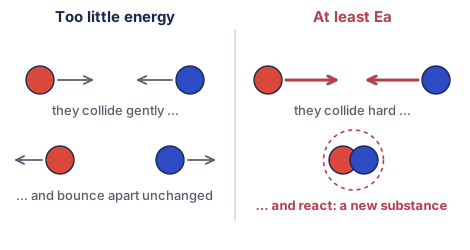
In a gas or a solution, particles collide millions of times every second. If every collision made the particles react, every reaction would be over in an instant. Most collisions are too gentle: the particles bounce apart unchanged. Only a collision with enough energy breaks bonds so that new ones can form.
 (enlarge)
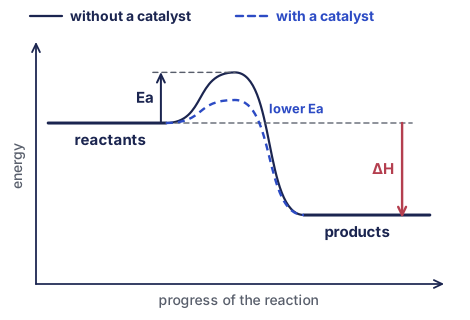
The minimum energy that colliding particles need to react is the activation energy, Ea. You met it as the hump on a reaction pathway diagram. A collision with at least Ea is a successful collision.
Try it with the particles below: make them hotter or more crowded, add a catalyst, and watch the count of successful collisions each second.
Free play: nothing here is marked or saved
The crowded box: which collisions count?
Particles react only when they collide, and collide hard enough. Make the particles more crowded or hotter, or add a catalyst: which change makes more collisions, and which makes more of them succeed?Supplement
Still picture: your device asks for less motion.
Try: Crowd in more blue particles. Which numbers change?
- Collisions each second
- 10
- Share with at least Eₐ
- 5.0%
- Successful each second
- 0.50
successful = collisions × share = 10 × 5.0% = 0.50 each second
- Only a blue particle meeting a green one can react. Every such meeting is a collision (a violet ring); one with at least the activation energy, Ea, is a successful collision (an orange star).
- The column shows each collision of the last five seconds as a dash, as high as its energy. Dashes above the Ea line react; dashes below bounce apart.
- More blue particles in the same space: more collisions each second, the same share.
- Hotter: the particles move faster, so they collide a little more often, and a much larger share of the collisions have at least Ea. The share is the bigger effect.
- A catalyst lowers Ea: the particles collide just as often, but a larger share of the collisions succeed.
About this model. The model is flat and slowed right down: real particles collide millions of times a second, and in a real reaction only a tiny share of the collisions succeed. The temperatures are named, not measured, and their effect is made bigger so that it shows. A collision’s energy comes from how fast the two particles move towards each other. A successful pair flashes and carries on, as if fresh particles took the place of the ones that react, so the numbers stay steady; the readout gives the averages for the box, and the flashes vary from second to second. Real particles must also meet the right way round, which this model leaves out. How a catalyst gives a new route depends on the reaction; here it simply lowers Ea, so it is shown only as a tag on the tube and a lower line.
The four ideas of collision theory
Collision theory explains rates with four ideas:
- Particles per unit volume. The more reacting particles there are in each cm³, the more often they meet.
- Collision frequency. The rate depends on how many collisions happen each second.
- Kinetic energy. Kinetic energy is the energy a particle has because it moves. Faster particles have more kinetic energy, so they collide more often and harder.
- Activation energy. Only collisions with at least Ea succeed.
The rate depends on the number of successful collisions each second.
Explaining the five factors
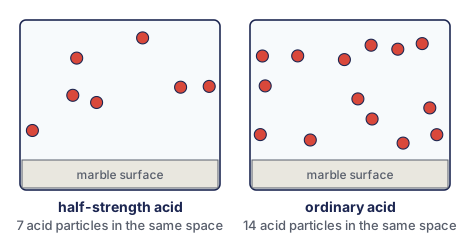
- Concentration. A more concentrated solution has more reacting particles per unit volume, so collisions are more frequent: more successful collisions each second.
- Pressure of gases. A higher pressure pushes the gas particles closer together: more particles per unit volume, more frequent collisions.
 (enlarge)
- Surface area. Only particles on the surface of a solid can be hit. A powder has far more of its particles exposed, so collisions with the other reactant are more frequent. It doesn't have more particles: the same mass has the same number.
- Temperature. Hotter particles have more kinetic energy and move faster. They collide more often, and, more importantly, a larger share of their collisions have at least Ea. Both mean more successful collisions each second, which is why a small rise in temperature makes such a big difference.
- A catalyst. A catalyst gives the reaction a different route with a lower activation energy. The particles collide just as often as before, but a larger share of the collisions have enough energy to succeed.
Key idea: A reaction goes faster when there are more successful collisions each second. Concentration, pressure and surface area make collisions more frequent; a higher temperature makes them more frequent and more energetic; a catalyst lowers the activation energy, so more collisions succeed.
Trap: "Heating just makes the particles collide more often." It does, but that's the smaller part. The bigger reason is energy: at a higher temperature a much larger share of the collisions have at least the activation energy.
A catalyst lowers Ea
On a reaction pathway diagram, the catalysed route has a lower hump. The reactants and products are the same, so their levels don't move, and the energy given out or taken in, ΔH, is the same.
 (enlarge)
Worked example
Why powder is faster, in three steps
Explain why 1 g of powdered marble reacts with acid faster than 1 g of lumps.
- The factor: the powder has a much larger surface area.
- The particles: more of the marble's particles are exposed on a surface where the acid particles can reach them.
- The collisions: so collisions between acid particles and marble particles are more frequent: more successful collisions each second, a faster rate.
Don't write "the powder has more particles": it is the same mass, so the same number of particles.
Worked example
Temperature, two reasons
Explain why the marble and acid react faster at 40 °C than at 20 °C.
- Energy: at 40 °C the particles have more kinetic energy and move faster.
- Reason 1, frequency: they collide more often.
- Reason 2, energy of collisions: a greater proportion of the collisions have at least the activation energy.
- Conclusion: more successful collisions each second, so the reaction is faster.
Pause and check
Use collision theory to explain why your half-strength acid made gas more slowly than the ordinary acid. Answer in your head, then read on.
Half-strength acid has fewer acid particles per unit volume, so they collide with the marble surface less often: fewer successful collisions each second, a slower rate.
Case closed
Why can coal dust explode when a lump of coal just sits there? The dust has an enormous surface, so the oxygen particles collide with far more coal particles each second, and a spark gives the first collisions the activation energy they need. One idea explains all five factors: the rate depends on the number of successful collisions each second. More particles per unit volume or more surface give more frequent collisions; heat gives more frequent and more energetic ones; a catalyst lowers the activation energy.
About this model
Collision theory as told here is a simple picture. Particles are drawn as balls, and "a share of the collisions with enough energy" is shown as a count, not as the curve chemists use for the spread of energies. Real particles must also meet the right way round. How a catalyst gives a different route depends on the reaction, and is beyond this course.
For teachers: Supplement 6.2.5, 6.2.6 and 6.2.7 (Cambridge 0620 syllabus, p19). Builds on activation energy and reaction pathway diagrams (energy changes) and the particle model (states of matter). Maxwell–Boltzmann distributions are not in the syllabus.