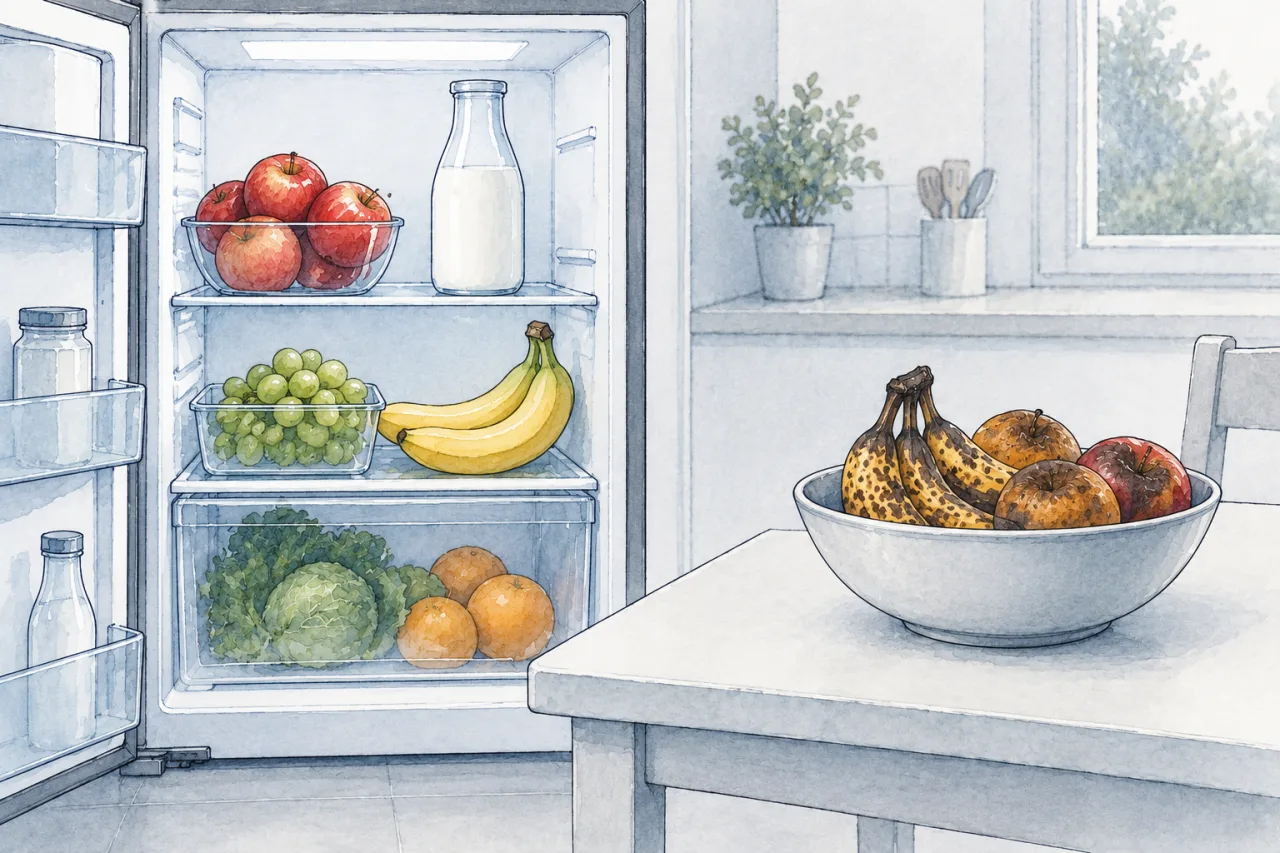
Bananas in a fruit bowl on the kitchen table turn brown and spotty within a few days, and the apples go soft and wrinkly. The same fruit in the fridge stays fresh for much longer. Nothing was added to it and nothing was taken away; only one thing was different. Going off is a set of chemical reactions, and something about the fridge slows them down. In this part you'll meet the five things that change how fast a reaction goes, and learn how to test one of them fairly.
 (enlarge)
Concentration
In your investigation, half-strength acid made gas more slowly than the ordinary acid: 20 cm³ in the first 20 seconds instead of 40 cm³. A more concentrated solution has more of the dissolved substance in the same volume, so there is more of it near the solid to react each second. Adding water does the opposite: the same amount of acid spreads through a bigger volume, so the solution is less concentrated and the reaction slower.
The more concentrated a solution, the faster the reaction.
As any reaction goes on, its reactants are used up and their concentrations fall. That is why every curve you drew got less steep with time.
Pressure of gases
For a reaction between gases, a higher pressure squeezes the same gas into a smaller space, so there is more gas in each cm³. It is like a more concentrated solution: the reaction is faster.
Pressure only matters when gases react. Squeezing a solid or a liquid hardly changes it, so pressure makes almost no difference to marble and acid.
Surface area
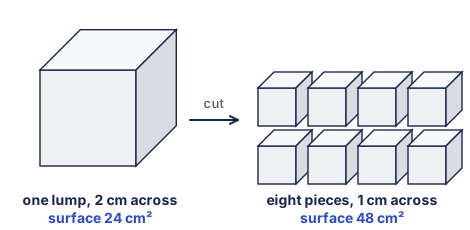
A lump of marble reacts only on its outside, its surface, where the acid can reach it. Cut the lump into smaller pieces and more of the same marble is on a surface. A powder has an enormous surface.
 (enlarge)
The larger the surface area of a solid, the faster the reaction. That's why your powder raced ahead of the lumps, and why the total gas was the same: it was the same mass of marble, with the same amount of acid.
Temperature
The higher the temperature, the faster the reaction: reactions go faster when they are warmer and slower when they are colder. As a rough guide, warming a reaction by 10 °C can make it about twice as fast. That's why food keeps longer in a fridge, and longer still in a freezer: the reactions that make it go off are slower when it is cold.
Catalysts and enzymes
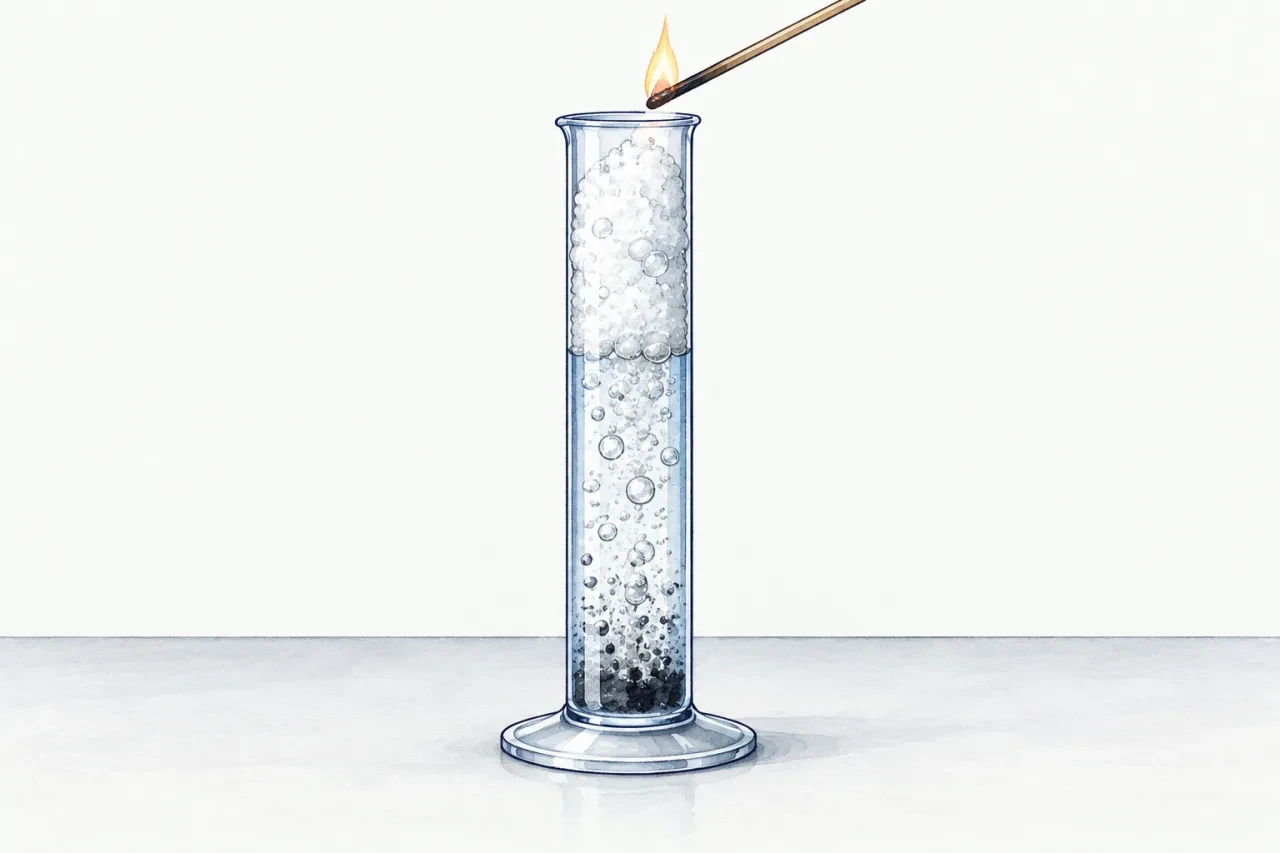
Hydrogen peroxide slowly breaks down into water and oxygen; on its own you can hardly see it happen. Add a pinch of black manganese(IV) oxide powder and it froths at once, giving off so much oxygen that a glowing splint relights in it.
hydrogen peroxide → water + oxygen
 (enlarge)
Manganese(IV) oxide is a catalyst. A catalyst is a substance that increases the rate of a reaction and is unchanged at the end. Filter off the black powder when the fizzing stops, dry it and weigh it: it has the same mass as at the start. Add it to fresh hydrogen peroxide and it froths again. Removing the catalyst slows the reaction back down. A catalyst doesn't make more product; it makes the same product faster.
Enzymes are biological catalysts, made by living things. They speed up reactions in cells, and in foods as they go off. Most work best at a temperature like body temperature, and stop working if they get too hot.
Key idea: A reaction goes faster with a more concentrated solution, a higher pressure (for gases), a larger surface area, a higher temperature, or a catalyst. A catalyst increases the rate and is unchanged at the end.
Trap: "A catalyst gets used up." It doesn't: it's the same substance, with the same mass, at the end. And it doesn't make more product: the amount of product is set by the limiting reactant, as in your investigation.
A fair test
To find out how one thing affects the rate, change only that one thing and keep everything else the same: a fair test. In your third run you changed the acid to half-strength and kept the lumps, the volume of acid and the method the same. Had you used powder as well, you couldn't have told which change slowed or sped up the reaction.
What you measure, such as the volume of gas after 20 seconds or the time the reaction takes, is the result: it is not one of the things you keep the same. For marble and acid, the things to keep the same are the mass of marble, the size of the pieces, the volume and concentration of the acid, and the temperature, apart from the one you are testing.
Worked example
Four predicted curves
The standard run is 1 g of marble lumps in 50 cm³ of acid at 20 °C, with marble in excess; it makes 80 cm³ of gas. Predict each new curve compared with the standard one.
- The acid at 40 °C: steeper at the start (a higher temperature), and it levels off at the same 80 cm³ (the same acid).
- A catalyst added: steeper at the start, the same 80 cm³: a catalyst doesn't change the amount of product.
- Larger lumps of the same mass: less steep (a smaller surface area), the same 80 cm³.
- Half the volume of the same acid: half as much acid, so the curve levels off at 40 cm³. It starts at about the same steepness, because the acid has the same concentration.
Worked example
Is it a catalyst?
Zinc reacts slowly with dilute sulfuric acid. A pupil adds a piece of copper and the zinc fizzes much faster. Is copper a catalyst?
- Does it increase the rate? Yes: the zinc fizzes faster.
- Is it unchanged at the end? Dry and weigh the copper: if it has the same mass and still looks like shiny copper, it wasn't used up.
- Conclusion: both are true, so copper acts as a catalyst here. If the copper had lost mass, it would have been reacting, not acting as a catalyst.
Pause and check
You want to find out whether the size of marble pieces affects the rate. What do you change, and what do you keep the same? Answer in your head, then read on.
Change only the size of the pieces: lumps, small chips, powder. Keep the same mass of marble, the same volume and concentration of acid and the same temperature, and measure the gas in the same way.
Case closed
Why does fruit keep in the fridge? It's colder, so the reactions that make it go off are slower. Temperature is one of five things that change a rate: concentration, the pressure of gases, surface area, temperature and a catalyst. A catalyst speeds a reaction up and is still there, unchanged, at the end; enzymes are the catalysts of living things. To test one of the five, change only that one. In the next part you'll find out why all five work, by looking at the particles.
About this model
"About twice as fast for each 10 °C" is a rough rule for many reactions near room temperature, not a law. The fridge picture simplifies going off: microbes and enzymes both play a part, and both slow down in the cold. How a catalyst works on its surface is beyond this course. Manganese(IV) oxide is the syllabus name; you may also see it called manganese dioxide.
For teachers: Core 6.2.1 and 6.2.2 (Cambridge 0620 syllabus, p19). Enzymes are developed in Biology 0610 (enzymes); the test for oxygen belongs to topic 12.