Pupil sheet · Xylem, phloem and water uptake
Translocation — questions
Name ______________________ Date ____________
Try every question before you use a nudge. Write in full sentences where you are asked to explain.
1. identify
Supplement. Which is the best description of translocation?
Circle one answer.
- The movement of sucrose and amino acids in the phloem, from sources to sinks.
- The movement of water and mineral ions up the xylem, from the roots to the leaves.
- The loss of water vapour from the leaves through the stomata.
- The movement of glucose in the xylem, from the roots to the leaves.
Nudge (only if you are stuck): Which tissue carries sucrose, and from where to where?
2. classify
Supplement. For a potato plant in summer, match each part to source or sink.
Write the number of the matching option.
- source
- sink
- a full-grown leaf in the light: ______
- the growing shoot tip: ______
- the flowers: ______
- the roots: ______
- the new tubers: ______
Nudge (only if you are stuck): Which part can make more sugar than it uses? The rest use or store sugar.
3. complete
Supplement. Complete the definitions of a source and a sink.
A source is a part of a plant that … sucrose or amino acids.
A sink is a part of a plant that … sucrose or amino acids, for example to grow.
A sink can also … sucrose, for example as starch in a tuber.
Nudge (only if you are stuck): Does a sink give sucrose out, or take it in?
4. explain
Supplement. Explain why the roots of a plant are a sink for sucrose.
Nudge (only if you are stuck): Can a root photosynthesise? What does a root do with sucrose?
5. state / explain
Supplement. Sucrose leaves a full-grown leaf halfway up a stem. In which direction does the phloem carry it (a) to the shoot tip; (b) to the roots? (c) Explain why translocation can go both up and down, but water in the xylem goes only up.
(a) To the shoot tip
(b) To the roots
(c) Why both ways
Nudge (only if you are stuck): Where is the shoot tip, and where are the roots, compared with the leaf? Where does water enter, and where is it lost?
6. explain
Supplement. A potato tuber is a sink in summer. Why is it a source when it sprouts in spring?
Circle one answer.
- It breaks its stored starch down to sucrose and releases it into the phloem for the new shoots.
- It starts to photosynthesise in the soil.
- It takes in sucrose from the soil and passes it on.
- It stores even more starch than in summer.
Nudge (only if you are stuck): What does the tuber do with its stored starch when it sprouts?
7. explain
Supplement. Explain why (a) a young, growing leaf is a sink, and (b) a full-grown leaf in the light is a source.
(a) The young leaf
(b) The full-grown leaf
Nudge (only if you are stuck): Which leaf makes more sugar than it uses?
8. identify
Supplement. The drawing shows a potato plant in summer. Match each lettered part to source or sink.
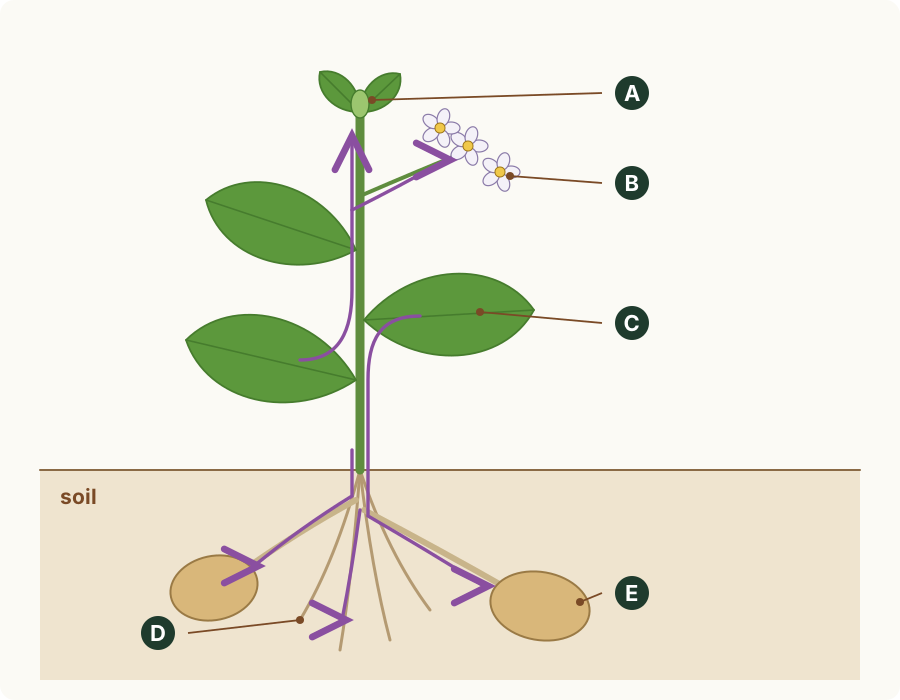
Write the number of the matching option.
- source
- sink
- A: ______
- B: ______
- C: ______
- D: ______
- E: ______
Nudge (only if you are stuck): Which part is full-grown, green and in the light?
9. explain
Supplement. A tomato fruit grows bigger and sweeter for several weeks. Explain where its sugar comes from and how it gets to the fruit.
Nudge (only if you are stuck): Which part of the plant makes sugar, and which tissue carries it?
10. explain
Supplement. A carrot plant lives for two years. Explain why its swollen root is a sink in its first summer and a source in its second spring.
Nudge (only if you are stuck): In which season is the root filling up, and in which is it emptying?
11. suggest
Supplement. A ring of bark, with the phloem just under it, is cut away all round the trunk of a young tree. The xylem, deeper in, is left. After some weeks the bark just above the ring is swollen, and the roots slowly start to die. Suggest why (a) the bark above the ring swells; (b) the roots die.
(a) Why the bark swells
(b) Why the roots die
Nudge (only if you are stuck): Which tissue was removed, and which way was it carrying sucrose to the roots?
12. suggest / explain
Supplement. In early spring, before its leaves open, an apple tree's buds start to grow. (a) Suggest where the sucrose for the growing buds comes from, and name a source and a sink at this time. (b) Explain how this changes by midsummer.
(a) Early spring
(b) Midsummer
Nudge (only if you are stuck): In early spring, where can sugar come from if there are no full-grown leaves?
13. state / explain
Supplement. Aphids are small insects that push their mouthparts into the phloem of a stem and feed on the liquid inside. (a) Identify two nutrients the aphids get from this liquid. (b) Explain why many aphids on a tomato plant can slow the growth of its fruits.
(a) Two nutrients
(b) Why the fruits grow more slowly
Nudge (only if you are stuck): What does the phloem carry, and to where?