Pupil sheet · Xylem, phloem and water uptake
Tracing water with a dye — questions
Name ______________________ Date ____________
Try every question before you use a nudge. Write in full sentences where you are asked to explain.
1. identify
Match each job to the transport tissue that does it.
Write the number of the matching option.
- xylem
- phloem
- transport of water and mineral ions: ______
- transport of sucrose and amino acids: ______
- helping to support the plant: ______
Nudge (only if you are stuck): One tissue carries what the roots take in from the soil; the other carries what the leaves make.
2. explain
Stalks A, B and C stand in red dye. Stalk D, matched to them, stands in plain water for 6 hours and is then cut at the same heights. Why is stalk D set up?
Circle one answer.
- It is a control: it shows the slices with no dye, so any red in A, B and C came from the dye.
- It is a spare, in case one of the other stalks breaks.
- It measures how fast celery takes up plain water.
- It tests whether a stronger dye climbs faster.
Nudge (only if you are stuck): Without stalk D, what could you compare the red slices with?
3. describe
Stalk B stood in red dye for 2 hours. It was then cut across 4 cm from its cut end. Which description of the slice matches the results?
Circle one answer.
- Red in separate dots, in a row near the curved, ridged side; the rest pale green.
- Red all over the cut surface.
- Red only in the outer skin.
- Red only in the middle of the slice.
Nudge (only if you are stuck): Was the whole slice red, or only some parts of it?
4. explain
A pupil wants to see how far the dye has climbed after 30 minutes, 2 hours and 6 hours. They plan to use one stalk: cut slices from it at 30 minutes, put it back in the dye, and cut it again later. Explain why it is better to use a different, matched stalk for each time.
Nudge (only if you are stuck): What happens to a stalk when you cut slices from it?
5. interpret
Use the results table. Choose all the statements that the results support.
| Stalk | In | Time | 4 cm | 10 cm | 16 cm | Leaf veins |
|---|---|---|---|---|---|---|
| A | red dye | 30 minutes | faint pink dots | no red | no red | not red |
| B | red dye | 2 hours | dark red dots | red dots | no red | not red |
| C | red dye | 6 hours | dark red dots | dark red dots | dark red dots | red |
| D | plain water | 6 hours | no red | no red | no red | not red |
Tick every correct statement.
- The longer a stalk stood in the dye, the higher the red reached.
- After 6 hours the dye had reached the veins of the leaves.
- The stalk in plain water had no red at any height.
- The dye climbs at a steady 2 cm every minute.
- The dye soaked through the whole of each slice.
- The celery made the red colour itself.
Nudge (only if you are stuck): Read down the columns: what changes from A to B to C? Then compare them with D.
6. describe / explain
After 6 hours in red dye, the veins in the leaves of stalk C were red. (a) Describe the route the dye took from the beaker to the leaf veins. (b) What does this show about the job of the vascular bundles?
(a) The route
(b) The job of the vascular bundles
Nudge (only if you are stuck): Where did the dye go in, which way did it move, and in which parts of each slice was it?
7. identify / state
Under the microscope, one strand of a red-stained slice has groups of small, pale cells on its outer side, and wide, empty tubes with thick red walls on its inner side. (a) Identify the tissue with the red walls. (b) Identify the tissue that stayed pale, and state what it carries. (c) State one job of the red-walled tissue besides carrying water.
(a) The red-walled tissue
(b) The pale tissue, and what it carries
(c) Another job of the red-walled tissue
Nudge (only if you are stuck): The dye goes where the water goes. Which tissue carries water, and which carries food?
8. identify
The drawing shows a cross-section of the stem of a non-woody dicotyledonous plant. Which letter shows the xylem, and which shows the phloem?
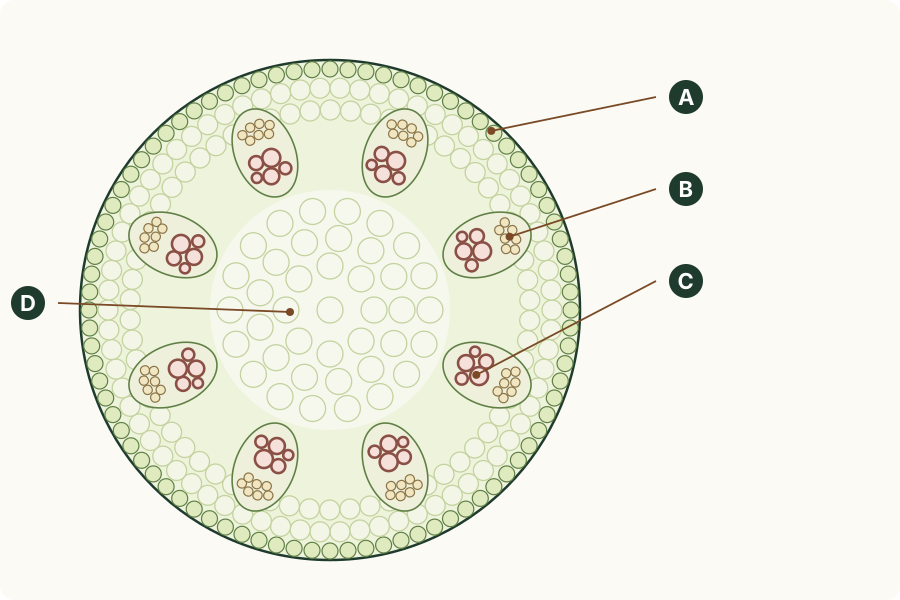
Write the number of the matching option.
- A
- B
- C
- D
- Xylem: ______
- Phloem: ______
Nudge (only if you are stuck): In each bundle of a stem, which tissue is towards the outside?
9. explain
Supplement. Match each feature of a xylem vessel to how it helps the vessel carry water.
Write the number of the matching option.
- keeps the tube open and helps to support the plant
- nothing inside blocks the water
- makes one long, continuous tube
- thick walls with lignin: ______
- no cell contents: ______
- no cross walls between the cells: ______
Nudge (only if you are stuck): Think of a long pipe: what keeps it open, and what keeps it clear?
10. explain
Supplement. A pupil writes: "Xylem vessels are full of living cytoplasm, which pushes the water up from one cell to the next through the cross walls." Explain what is wrong, using the structure of a xylem vessel.
Nudge (only if you are stuck): What is inside a finished xylem vessel? What is between its cells?
11. explain / predict
A white carnation stands with its cut stem in blue dye for 6 hours. Thin blue lines appear along the veins of its petals. (a) Explain how the dye got into the petals. (b) A thin slice is cut across the flower stalk. Predict where the blue will be in the slice.
(a) How the dye got into the petals
(b) Where the blue will be in the slice
Nudge (only if you are stuck): It is like your celery. Where did the dye go in, and in which tissue did it travel?
12. explain
A florist splits the bottom of a white carnation stem lengthways into two halves. One half stands in red dye and the other half in blue dye. Next day the flower is half red and half blue. Which explanation fits?
Circle one answer.
- Each half of the stem has its own xylem vessels: separate tubes leading to different petals.
- The two dyes mixed in the stem, then separated again in the flower.
- The phloem sorted the dyes and sent each one to a different side.
- The flower took up red on one side because it prefers red.
Explain your choice: why do the two colours stay apart?
Nudge (only if you are stuck): Do the tubes that carry water in one half of the stem join the tubes in the other half?
13. predict / explain
A busy lizzie plant has a pale, see-through stem. Its stem is cut and stood in red dye. An hour later red lines show through the stem, running up it in a ring near the outside. (a) Identify the tissue the red is in. (b) In a slice across the stem, each red dot is a vascular bundle. Will the red be on the side of each dot towards the outside of the stem, or towards the middle? Explain.
(a) The tissue
(b) Which side, and why
Nudge (only if you are stuck): Where are the xylem and the phloem in each bundle of a stem?
14. suggest
Supplement. Plant scientists grew a mutant plant whose xylem vessels make far less lignin than normal. In a slice across its stem the xylem vessels have thin walls and look squashed flat, and its leaves wilt more easily than those of normal plants in the same moist soil. Suggest why.
Nudge (only if you are stuck): What does lignin do for the walls of a xylem vessel? What happens to a tube whose walls are weak?