Pupil sheet · Xylem, phloem and water uptake
From root hair to leaf — questions
Name ______________________ Date ____________
Try every question before you use a nudge. Write in full sentences where you are asked to explain.
1. identify
The drawing shows a cross-section of a young root. Which letter shows a root hair cell, and which shows the root cortex cells?
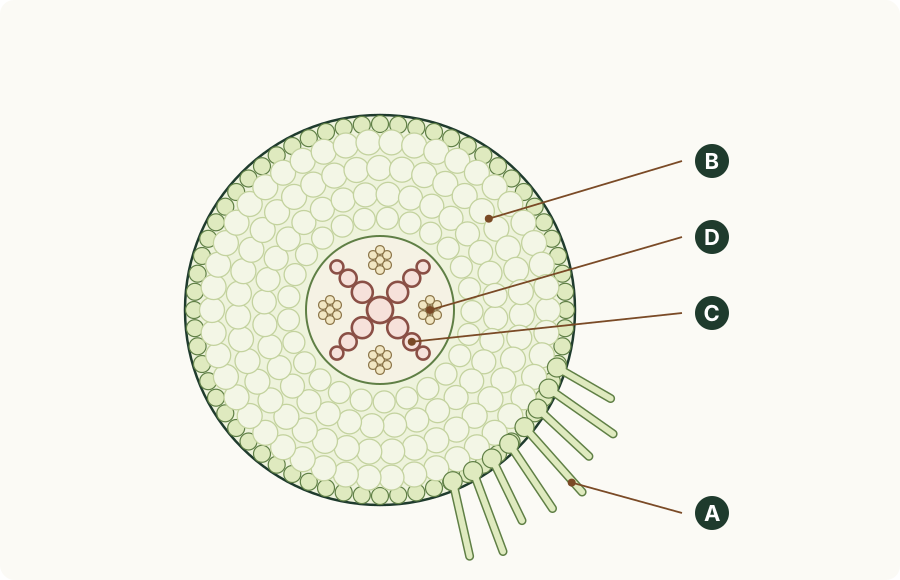
Write the number of the matching option.
- A
- B
- C
- D
- Root hair cell: ______
- Root cortex cells: ______
Nudge (only if you are stuck): Which cells touch the soil? Which cells lie between them and the middle of the root?
2. state
Which of these are functions of root hair cells? Choose all that apply.
Tick every correct statement.
- Taking in water from the soil.
- Taking in mineral ions from the soil.
- Making sugar by photosynthesis.
- Storing water for dry days.
- Carrying sucrose up to the leaves.
Nudge (only if you are stuck): What does a root take in from the soil? Can a cell in the dark photosynthesise?
3. explain
How does water get into a root hair cell from the soil?
Circle one answer.
- By osmosis, from the dilute soil water into the more concentrated cell sap, through the partially permeable cell membrane.
- By osmosis, from the cell into the soil, because the cell sap is more dilute.
- It is sucked in through an open hole at the end of the hair.
- Through stomata on the surface of the root.
Nudge (only if you are stuck): Which is the more dilute solution: the soil water or the cell sap?
4. complete
Complete the sentence about root hairs.
Root hairs give the root a large … area,
which increases the … of water and mineral ions.
Nudge (only if you are stuck): What do thousands of thin hairs add to a root?
5. explain
A gardener pulls a lettuce seedling roughly out of the soil and plants it somewhere else. Its leaves soon droop: it wilts. A second seedling is moved with a ball of soil around its roots, and does not wilt. Explain the difference.
Nudge (only if you are stuck): What happens to the fine root hairs when a seedling is pulled roughly out of the soil?
6. sequence
Put the cells and tissues in the order that water passes through them, from the soil to a leaf.
Write the number of each step in order.
- Root hair cells
- Root cortex cells
- Xylem
- Mesophyll cells
- First: ______
- Second: ______
- Third: ______
- Last: ______
Nudge (only if you are stuck): Where in a root is the xylem: near the outside, or in the middle?
7. evaluate
A pupil writes: "Water goes into the root hairs, straight into the xylem, up the phloem of the stem, and into the mesophyll cells." Find two mistakes, and correct each one.
Mistake 1, corrected
Mistake 2, corrected
Nudge (only if you are stuck): Which cells lie between the root hairs and the middle of the root? Which tissue did your dye go up in?
8. identify
Use the lettered drawing of the root again. Which letter shows the xylem, and which shows the phloem?
Write the number of the matching option.
- A
- B
- C
- D
- Xylem: ______
- Phloem: ______
Nudge (only if you are stuck): In a root, which tissue makes the shape in the very middle?
9. identify
The drawing shows a leaf cut across, with its upper surface at the top. Which letter shows the xylem, and which shows the phloem?
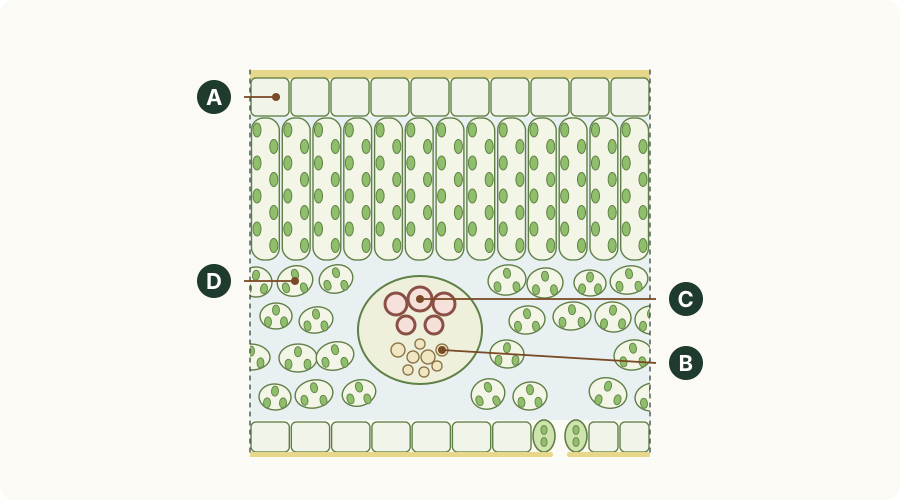
Write the number of the matching option.
- A
- B
- C
- D
- Xylem: ______
- Phloem: ______
Nudge (only if you are stuck): Picture a leaf vein: which half of the vascular bundle has the wide tubes?
10. compare
Match each section of a non-woody dicotyledonous plant to where its xylem is.
Write the number of the matching option.
- on the inner side of each bundle, in a ring near the outside
- in the middle, like a star or a cross
- in each vein, towards the upper surface
- Stem: ______
- Root: ______
- Leaf: ______
Nudge (only if you are stuck): Which section has its xylem right in the middle?
11. predict / explain
Two seedlings of the same kind and size have their roots in the same solution of mineral ions. Seedling P has many root hairs. Seedling Q has had most of its root hairs damaged. Which will take up mineral ions faster?
Circle one answer.
- Seedling P, with many root hairs.
- Seedling Q, with damaged root hairs.
- Both the same: root hairs make no difference.
Explain your choice.
Nudge (only if you are stuck): Which seedling has more surface touching the solution?
12. state / explain
In a tall tree, water reaches leaves 30 m above the ground. (a) Identify the tissue that carries the water up the trunk. (b) Explain why the mesophyll cells in a leaf at the top need a steady supply of this water.
(a) The tissue
(b) Why the mesophyll cells need water
Nudge (only if you are stuck): What do leaf cells make with water, carbon dioxide and light? And where does much of the water in a leaf go?
13. suggest
Plants that grow in dry, sandy soil often have very long roots, covered in root hairs. Suggest how this helps them.
Nudge (only if you are stuck): Where is the water in a dry, sandy soil? What does a large surface area do?
14. suggest / explain
A spinach leaf stood with its cut stalk in red dye for a few hours. A pupil then cut a thin slice across the leaf, but lost track of which surface was the upper one. Under the microscope, the red is in the part of each vein nearer surface X; the part of each vein nearer surface Y stays pale. (a) Suggest which surface, X or Y, is the upper surface of the leaf. (b) Explain your answer, and name the tissue in the pale part of each vein.
(a) The upper surface: X or Y
(b) Why, and the tissue in the pale part
Nudge (only if you are stuck): Water, and the dye with it, travels in the xylem. Where is the xylem in a vein of a leaf?