Pupil sheet · The heart and double circulation
Twice through the heart — questions
Name ______________________ Date ____________
Try every question before you use a nudge. Write in full sentences where you are asked to explain.
1. sequence
Supplement. A red blood cell leaves the lungs in the pulmonary vein. Put in order the places it passes through until it is pumped back towards the lungs.
Write the number of each step in order.
- the vena cava
- the aorta
- the left atrium
- the left ventricle
- the right atrium
- the right ventricle
- the capillaries of an organ
- Step 1: ______
- Step 2: ______
- Step 3: ______
- Step 4: ______
- Step 5: ______
- Step 6: ______
- Step 7: ______
Nudge (only if you are stuck): From the lungs, which side of the heart does the blood reach first?
2. identify
Supplement. In which part of a fish's circulation is the blood at the highest pressure?
Circle one answer.
- the vessel carrying blood from the heart to the gills
- the capillaries inside the organs of the body
- the vein carrying blood from the body to the heart
- the vessel carrying blood from the gills to the body
Nudge (only if you are stuck): The heart is the only pump in a fish's circulation.
3. state
Supplement. Which is an advantage of a double circulation?
Circle one answer.
- Each side of the heart pumps half of the blood, so each side does less work.
- Blood is pumped a second time after the lungs, so it reaches the body at a high pressure.
- The heart only has to beat half as often, because each beat sends blood twice as far.
- The blood passes through the lungs twice, so it picks up twice as much oxygen.
Nudge (only if you are stuck): Count the times the blood passes through the heart, and through the lungs, on one trip round the body.
4. identify
Supplement. Which row is correct for a fish?
| Row | Chambers in the heart | Times the blood passes through the heart on one trip round the body |
|---|---|---|
| A | two atria and two ventricles | once |
| B | one atrium and one ventricle | twice |
| C | two atria and two ventricles | twice |
| D | one atrium and one ventricle | once |
Circle one answer.
- A
- B
- C
- D
Nudge (only if you are stuck): Check the chambers first. Then ask: does the fish's blood come back to the heart between the gills and the body?
5. identify
Supplement. The diagram shows the circulation of a mammal, with four blood vessels numbered. Which two vessels carry oxygenated blood?
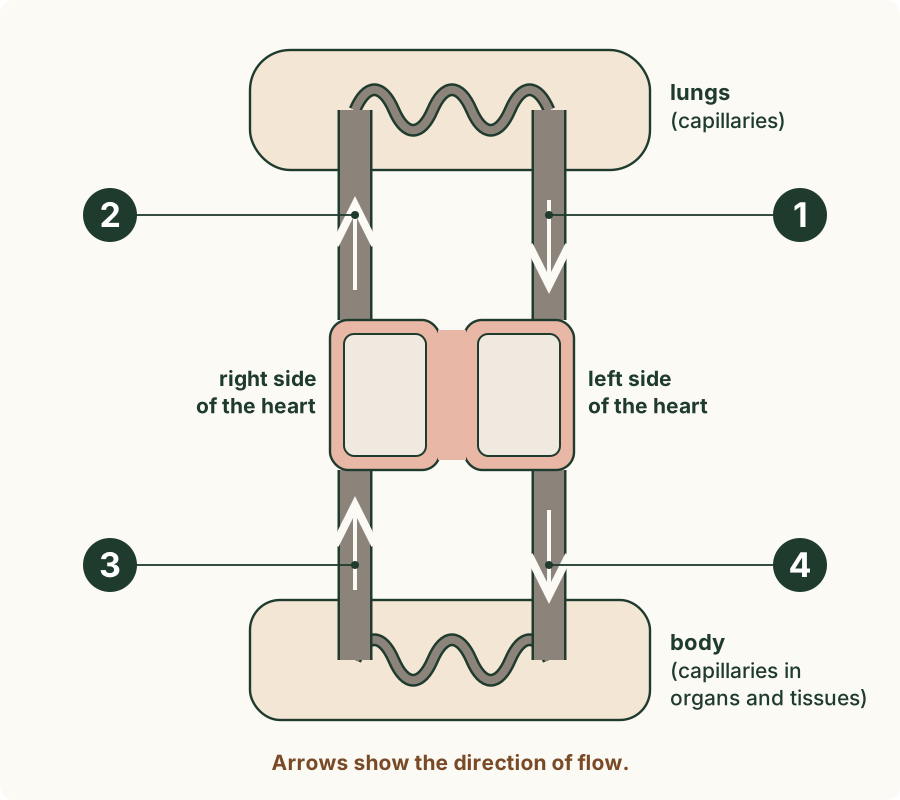
Tick every correct statement.
- 3
- 1
- 4
- 2
Nudge (only if you are stuck): Oxygenated blood has just been to the lungs.
6. suggest
Supplement. Suggest why a fish's heart pumps its blood to the gills first, and not straight to the body.
Nudge (only if you are stuck): What is in the blood that comes back to the fish's heart, and what do the body's cells need?
7. explain
Supplement. The table shows blood pressures measured in a carp and in a rabbit. Explain, using the data, why blood reaches the rabbit's body at a much higher pressure than it reaches the carp's body.
| Animal | Leaving the heart for the gills or the lungs / kPa | After the gills or the lungs / kPa | Reaching the body / kPa |
|---|---|---|---|
| carp | 4.0 | 2.6 | 2.6 |
| rabbit | 3.0 | 0.9 | 13 |
Nudge (only if you are stuck): Compare the last two columns for each animal. What happens to the rabbit's blood between them?
8. calculate
Supplement. A trout's heart pumps blood out at 4.8 kPa, and the blood reaches the body at 3.2 kPa. (a) Calculate the pressure lost in the gills. (b) Calculate this loss as a percentage of the pressure leaving the heart. Give your answer to 2 significant figures.
(a) Pressure lost in the gills: ______________ unit ________
(b) Loss as a percentage of the pressure leaving the heart: ______________ unit ________
Nudge (only if you are stuck): First find the loss, then compare it with the pressure the blood started with.
9. explain
Supplement. A pupil writes: "The right ventricle should be as strong as the left one, so that blood is pushed through the lungs at the same high pressure as it is pushed round the body." Explain why this would harm the lungs.
Nudge (only if you are stuck): What are the walls of the lung capillaries like, and what lies just outside them?
10. explain
Supplement. A medicine is injected into a vein in the arm. It reaches the lungs before it reaches the brain. Explain why.
Nudge (only if you are stuck): Follow the medicine from the vein back to the heart, and on.
11. suggest
Supplement. Birds have a double circulation, like mammals, and keep their bodies warm. Most fish have a single circulation and a body temperature close to that of the water. Suggest how a double circulation helps a bird keep its body warm.
Nudge (only if you are stuck): Respiration releases energy, and some of it is released as heat.
12. explain
Supplement. A fish's heart contains only deoxygenated blood. Explain why.
Nudge (only if you are stuck): Where does the blood entering the fish's heart come from, and where does it go next?