Pupil sheet · The heart and double circulation
A pump, pipes and valves — questions
Name ______________________ Date ____________
Try every question before you use a nudge. Write in full sentences where you are asked to explain.
1. identify
A garden fountain has an electric pump that pushes water round a loop of plastic pipes. A rubber flap in one pipe lets the water pass in one direction only. Match each part of the fountain to the part of the circulatory system that does the same job.
Write the number of the matching option.
- the blood
- a valve
- the septum
- the heart
- the blood vessels
- the electric pump: ______
- the plastic pipes: ______
- the rubber flap: ______
- the water: ______
Nudge (only if you are stuck): For each part of the fountain, ask what it does: does it move the liquid, carry it, keep it going one way, or is it the liquid itself?
2. identify
The diagram shows a section through a mammal's heart, seen from the front. Which letter shows the left ventricle?
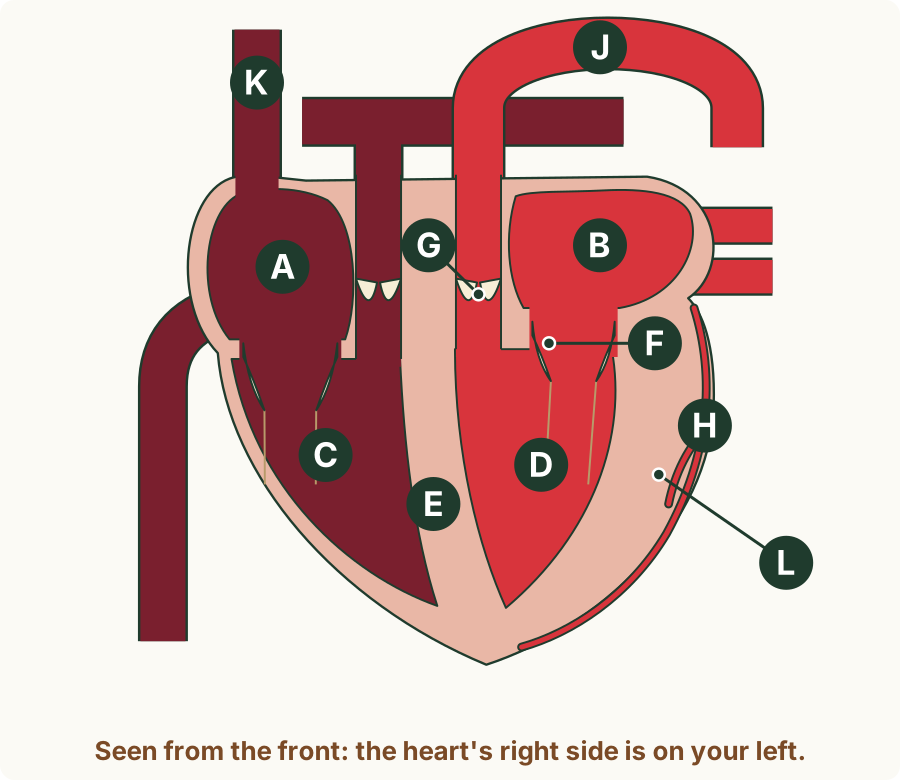
Circle one answer.
- D
- A
- B
- C
Nudge (only if you are stuck): The diagram is drawn as if you face the person. Which lower space has the thickest wall?
3. sequence
Blood is pumped out of the heart down to a working muscle in the leg, and then flows back to the heart. Put in order the vessels it passes through, starting as it leaves the heart.
Write the number of each step in order.
- the vena cava
- a vein in the leg
- an artery in the leg
- capillaries in the leg muscle
- First: ______
- Second: ______
- Third: ______
- Last: ______
Nudge (only if you are stuck): Which kind of vessel carries blood away from the heart, and which brings it back?
4. identify
The diagram shows a section through a mammal's heart. Match each letter to the part it shows.
Write the number of the matching option.
- left ventricle
- coronary artery
- muscular wall
- septum
- right atrium
- left atrium
- one-way valve
- A: ______
- E: ______
- F: ______
- H: ______
- L: ______
Nudge (only if you are stuck): The diagram is drawn as if you face the person. Then look for what is inside the heart and what runs over its outside.
5. explain
A hand pump for emptying water out of a boat is a rubber bulb with a tube at each end, and each tube has a one-way valve. Squeezing the bulb pushes water out through one tube; when the bulb springs back, it draws water in through the other. Explain why the pump would no longer move water along if both valves were taken out.
Nudge (only if you are stuck): Without valves, which ways could the water go when the bulb is squeezed, and when it springs back?
6. classify
The diagram shows the circulation of a mammal, with four blood vessels lettered. Which two of the vessels are arteries?
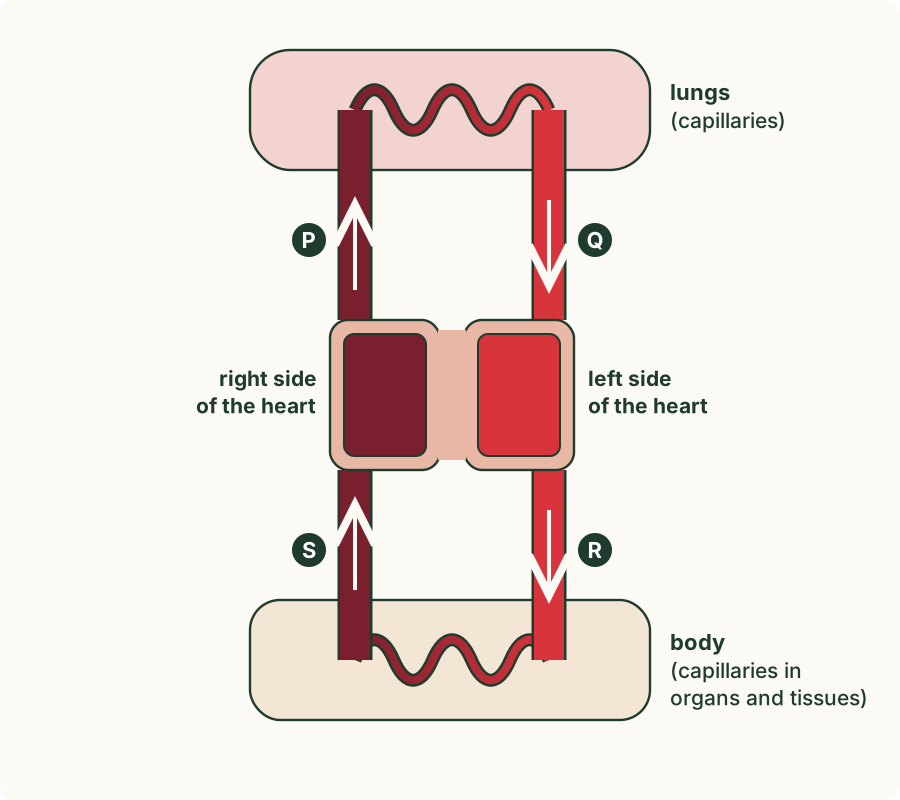
Tick every correct statement.
- Q
- R
- S
- P
Nudge (only if you are stuck): Follow each arrow: is the blood going away from the heart, or back to it?
7. explain
Before birth, a baby's blood flows along the umbilical cord to the placenta and back. The umbilical arteries carry deoxygenated blood from the baby to the placenta. Explain why they are called arteries.
Nudge (only if you are stuck): Is the blood going towards the baby's heart, or away from it?
8. identify / explain / suggest
A student has a heart from a butcher's shop and cannot tell which way round it is. She pushes a glass rod down each of the two large arteries at its top, then cuts along each rod into the ventricle below. Rod 1 ends in a ventricle with a thin wall; rod 2 ends in a ventricle whose wall is about three times as thick. (a) Identify the artery that rod 2 is in, and explain how you know. (b) Suggest how the student could have told the two ventricles apart before cutting the heart open.
(a) The artery and how you know
(b) A check before cutting
Nudge (only if you are stuck): Which ventricle has the thicker wall, and which artery leaves it?
9. suggest
An insect's heart is a long tube along its back. When the tube relaxes, blood flows into it through small openings in its side. When it contracts, small flaps close the openings and blood is pushed forwards towards the head. Suggest why the flaps are needed.
Nudge (only if you are stuck): What would the blood do when the tube contracts if the openings stayed open?
10. identify
The picture shows a real mammal's heart from a butcher, cut open from top to bottom and seen from the front, so its right side is on the left of the picture. Match each letter to the part it shows.
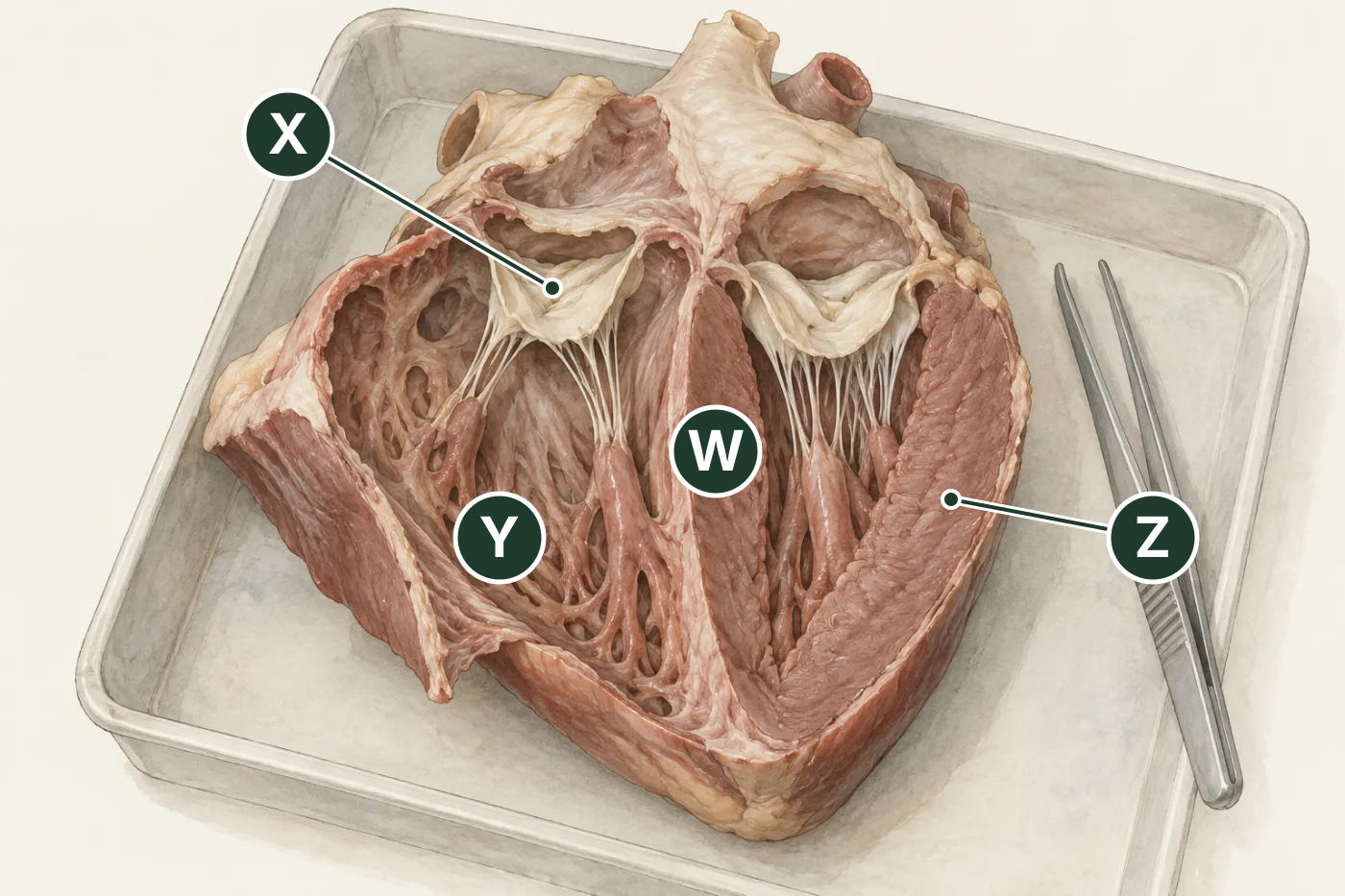
Write the number of the matching option.
- coronary artery
- right ventricle
- muscular wall
- left ventricle
- one-way valve
- septum
- W: ______
- X: ______
- Y: ______
- Z: ______
Nudge (only if you are stuck): Find the wall down the middle first. Which side has the thicker outer wall?