Pupil sheet · The heart and double circulation
The heart and double circulation — final check
Name ______________________ Date ____________
Work alone, with the lesson closed. Answer every question; there are no hints.
1. identify
The diagram shows a section through a mammal's heart. Identify the parts numbered 1 to 6 by matching each number to its name. Two of the names are not used.
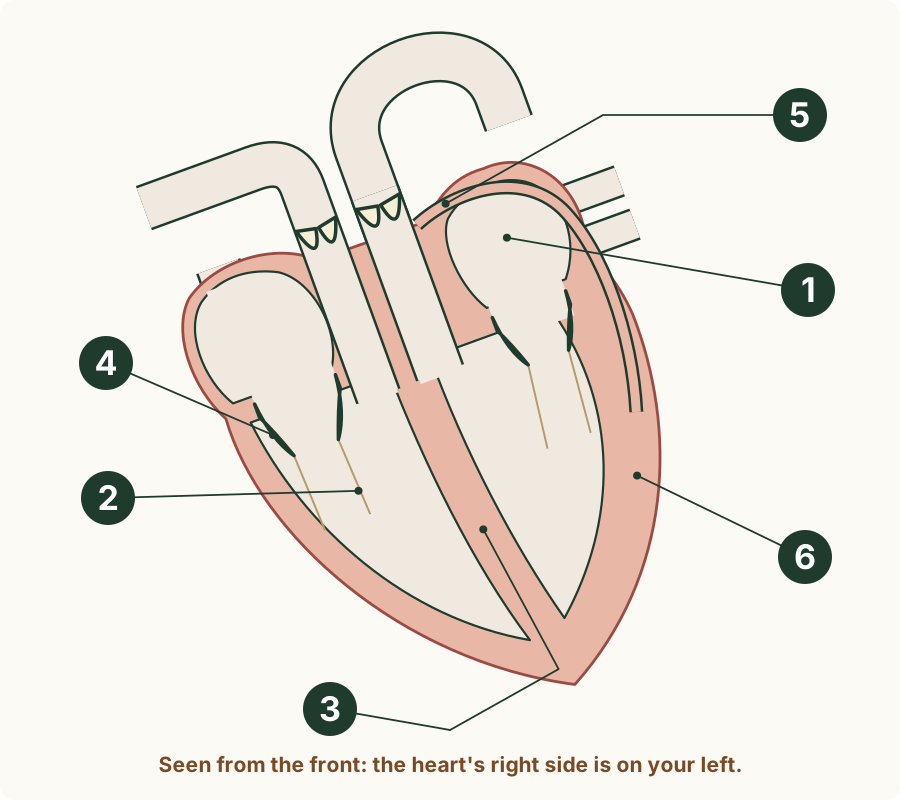
Write the number of the matching option.
- right ventricle
- muscular wall
- coronary artery
- left atrium
- left ventricle
- right atrium
- one-way valve
- septum
- 1: ______
- 2: ______
- 3: ______
- 4: ______
- 5: ______
- 6: ______
2. explain / state / give
(a) A pupil writes: "The valves push the blood round the body, and the heart stops it flowing backwards." Explain why this statement is incorrect. (b) Blood flows from the brain, down the neck, back to the heart in the jugular vessels. State whether these vessels are arteries or veins, and give the reason.
(a) Why the statement is incorrect
(b) Arteries or veins, and the reason
3. identify / state / explain / describe
Supplement. The diagram shows a section through a mammal's heart at one moment of a heartbeat. The valve at M is shut and the valve at N is open. (a) Identify the kind of valve at M. (b) Identify the kind of valve at N. (c) State which stage of the heartbeat the diagram shows, and explain how the valves at M and N show this. (d) Describe what the muscles and the valves do in the next stage.
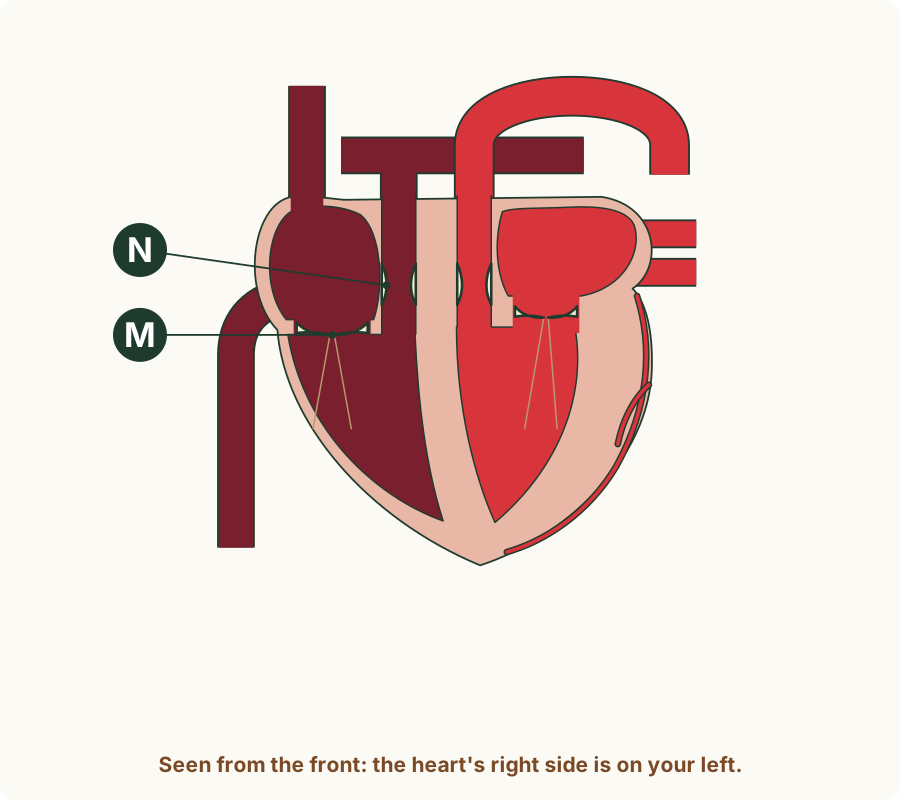
(a) The valve at M
(b) The valve at N
(c) The stage and the evidence
(d) The next stage
4. explain
Supplement. A pupil writes: "The right ventricle has a thinner wall than the left ventricle because its blood is deoxygenated. The atria have thin walls because they do not contract." (a) Explain why the first sentence is incorrect. (b) Explain why the second sentence is incorrect.
(a) The first sentence
(b) The second sentence
5. identify / explain
Supplement. Doctors measure how much oxygen the blood in each ventricle carries, as a percentage of the most it can carry, in two people. (a) Identify the person whose septum does not keep the two sides apart. (b) Explain, using the data, why this matters for the cells of the body.
| Person | Right ventricle / % | Left ventricle / % |
|---|---|---|
| 1 | 74 | 97 |
| 2 | 84 | 89 |
(a) The person
(b) Why it matters
6. explain / describe
Supplement. (a) A pupil writes: "A fish has a single circulation because its blood passes through only one set of capillaries on each trip." Explain why this statement is incorrect. (b) Describe the route of a red blood cell from a capillary in a mammal's kidney until it is back in a capillary of the kidney, using the words pulmonary and systemic.
(a) Why the statement is incorrect
(b) The double circulation
7. explain
Supplement. Before birth, a short vessel joins the aorta to the pulmonary artery. In some babies it stays open after birth, and blood then flows through it from the aorta into the pulmonary artery. (a) Explain why the blood flows in this direction. (b) Explain why this can harm the baby's lungs.
(a) Why the blood flows this way
(b) Why the lungs can be harmed