Pupil sheet · Exercise and heart health
Coronary heart disease — questions
Name ______________________ Date ____________
Try every question before you use a nudge. Write in full sentences where you are asked to explain.
1. describe
Which describes coronary heart disease?
Circle one answer.
- Fatty deposits narrow the coronary arteries, so the lungs get too little blood.
- Fatty deposits narrow the coronary arteries, so the heart muscle gets too little oxygen.
- Fatty deposits narrow the coronary arteries, so blood in the heart chambers cannot leave.
- Fatty deposits block the heart valves, so the coronary arteries get too little blood.
Nudge (only if you are stuck): Which part of the heart do the coronary arteries supply?
2. identify
A patient's notes describe three events over several years. Match each event to what was happening in one of his coronary arteries.
Write the number of the matching option.
- the fatty deposit has grown overnight and closed the artery
- the heart muscle beyond the block has died
- a valve between an atrium and a ventricle no longer closes
- a fatty deposit has left a channel too narrow for extra blood
- a blood clot has suddenly blocked the narrow channel
- At 56: chest pain when he climbs stairs, which stops when he rests: ______
- At 61: sudden, severe chest pain while he sits still, which does not stop: ______
- Six weeks later: a scan shows one part of his heart muscle no longer contracts: ______
Nudge (only if you are stuck): Which change in an artery takes years to build up, and which can happen within minutes?
3. identify
Which of these are possible risk factors for coronary heart disease? Choose all that apply.
Tick every correct statement.
- eating plenty of fibre
- smoking
- lack of exercise
- stress
- eating oily fish
- age
Nudge (only if you are stuck): For each one, ask: are people with it more likely to develop coronary heart disease?
4. explain
How does a diet low in saturated fat reduce the risk of coronary heart disease?
Circle one answer.
- It lowers blood pressure, so fatty deposits in the coronary arteries dissolve away.
- It removes fatty deposits already in the coronary arteries, so they widen again.
- It lowers blood glucose, so fatty deposits build up more slowly in the coronary arteries.
- It lowers blood cholesterol, so fatty deposits build up more slowly in the coronary arteries.
Nudge (only if you are stuck): Check two things in each option: the substance it names, and what it says happens to the deposits.
5. identify
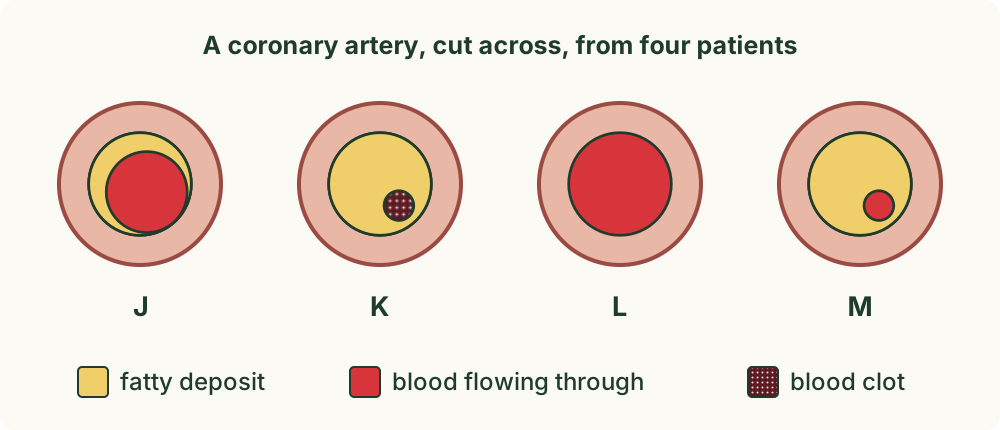
The figure shows a coronary artery cut across, from four patients, J, K, L and M. One patient gets chest pain when he climbs stairs, but never when he sits still. Which section is most likely to be from him?
Circle one answer.
- J
- K
- L
- M
Nudge (only if you are stuck): Use the key. For each section, ask: does enough blood pass at rest? Does enough pass when the heart works harder?
6. explain
A clot blocks a coronary artery that supplies part of the wall of the left ventricle. That part of the wall stops contracting, although the left ventricle it surrounds still fills with blood rich in oxygen at every beat. Which statement explains why?
Circle one answer.
- The blood in the left ventricle has already given up its oxygen to the rest of the body.
- The clot stops the electrical signal spreading, so that part of the wall is not told to contract.
- The wall is too thick for oxygen to diffuse in from the chamber; it relies on coronary blood.
- The clot has moved on into the left ventricle, so the blood in the chamber cannot flow.
Nudge (only if you are stuck): How does oxygen get from the blood into a cell, and how far can it travel that way?
7. identify
Two brothers, Ade and Femi, are both 45. Their father had a heart attack at 50. Ade has a very stressful job; Femi does not. Which statement is correct?
Circle one answer.
- Both will develop coronary heart disease, because a genetic predisposition makes it certain, whatever their stress.
- Both may have inherited a genetic predisposition, but stress cannot change the risk, because it is only a feeling.
- Both may have inherited a genetic predisposition, and Ade's stress can add to his risk by raising his blood pressure.
- Only Ade may have inherited a genetic predisposition, because his stress shows it, and stress can raise blood pressure.
Nudge (only if you are stuck): What could both brothers have inherited from their father? And what can stress do in the body?
8. explain
Kofi started cycling to work every day. After a year his body mass had fallen from 98 kg to 88 kg, his blood pressure was lower, his resting heart rate had fallen from 82 to 66 beats per minute, and he felt less stressed. Explain how two of these changes reduce his risk of coronary heart disease.
Nudge (only if you are stuck): For each change you choose, follow it to the walls of the coronary arteries or to the work the heart does.
9. explain
A man smoked all his life and lived to 90 without coronary heart disease. His grandson says this proves that smoking is not a risk factor. Why is the grandson wrong?
Circle one answer.
- A risk factor raises the chance across many people; one person's case cannot disprove it.
- Smoking is a risk factor only for people who also eat a diet high in saturated fat.
- The man must have had the disease without knowing it, because every smoker gets it.
- He was protected by his age, because older people are less likely to develop it.
Nudge (only if you are stuck): What would you need to know about many smokers and many non-smokers to decide?
10. identify
The table shows the new cases of coronary heart disease each year per 1000 people in one study. Which conclusion do the data support?
| Age / years | Men, non-smokers | Men, smokers | Women, non-smokers | Women, smokers |
|---|---|---|---|---|
| 40–49 | 2 | 5 | 1 | 3 |
| 60–69 | 9 | 18 | 5 | 11 |
Circle one answer.
- Every smoker aged 60–69 in the study developed coronary heart disease.
- Women in the study did not develop coronary heart disease at any age.
- Smoking, older age and being male are each linked to a higher rate.
- A smoker aged 40–49 has a higher rate than a non-smoker aged 60–69.
Nudge (only if you are stuck): Test each statement against the numbers. Compare one factor at a time, keeping the others the same.
11. suggest
The figure shows two places, X and Y, where a clot could block a coronary artery. Suggest why a block at X is more dangerous than a block at Y.
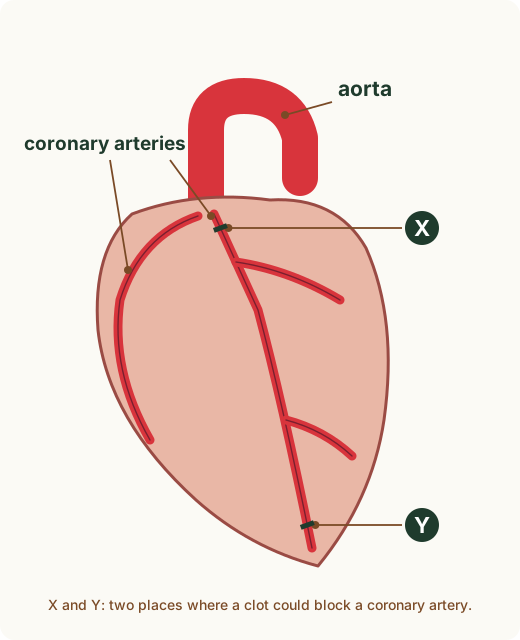
Nudge (only if you are stuck): Follow the artery on from each mark: which parts of the heart muscle would lose their blood?
12. suggest
Tobacco smoke makes the platelets in the blood stickier, so clots form more easily. Suggest why smoking raises the chance of a heart attack in someone whose coronary arteries are already narrowed.
Nudge (only if you are stuck): How much space is left inside a narrowed artery, and what could fill it?
13. identify / calculate / suggest
The table shows nutrition labels for two ready meals. (a) Identify the meal with less saturated fat, and calculate the difference in grams. (b) Suggest one reason why the other meal could still be the better choice for reducing the risk of coronary heart disease.
| In one meal | Meal X | Meal Y |
|---|---|---|
| saturated fat / g | 12 | 2 |
| salt / g | 0.3 | 2.4 |
(a) Less saturated fat
(b) A reason for the other meal
Nudge (only if you are stuck): Compare both rows, not just one.