Pupil sheet · Exercise and heart health
Watching the heart — questions
Name ______________________ Date ____________
Try every question before you use a nudge. Write in full sentences where you are asked to explain.
1. identify
Which list gives three ways of monitoring the activity of the heart?
Circle one answer.
- an ECG, the pulse rate and listening to the valves closing
- the blood pressure, the pulse rate and listening to the valves opening
- an ECG, the pulse rate and listening to the heart muscle contracting
- an ECG, the breathing rate and listening to the valves closing
Nudge (only if you are stuck): Test every part of each list: does it pick up the heart's own activity, and is each sound one the heart really makes?
2. calculate
A pulse is counted for 15 seconds. 20 beats are felt. Calculate the heart rate in beats per minute.
Heart rate (beats per minute): ______________ unit ________
Nudge (only if you are stuck): Is a minute longer or shorter than 15 seconds? How many lots of 15 seconds fit into it?
3. determine / calculate
An ECG strip is 4 seconds long. The table gives the time of each tall spike on it. Determine the time between two tall spikes. Then calculate the heart rate in beats per minute.
| Tall spike | Time on the strip / s |
|---|---|
| 1st | 0.3 |
| 2nd | 1.1 |
| 3rd | 1.9 |
| 4th | 2.7 |
| 5th | 3.5 |
Time between two tall spikes: ______________ unit ________
Heart rate (beats per minute): ______________ unit ________
Nudge (only if you are stuck): Find the time from one spike to the next. How many of those gaps fit into 60 seconds?
4. identify
Match each way of monitoring the heart to what it picks up.
Write the number of the matching option.
- the oxygen carried in the blood
- the sounds of the valves closing
- the sound of the heart muscle contracting
- the electrical activity of the heart
- the surge of blood stretching an artery wall
- ECG: ______
- Pulse: ______
- Stethoscope: ______
Nudge (only if you are stuck): Match the one you are surest of first, then check the other two against what is left.
5. identify
The figure shows the ECG and the sounds heard through a stethoscope for two beats. The tall spike is the signal that sets off the contraction of the ventricles. A valve shuts when blood would otherwise flow back through it. Which row names the valves that shut to make each sound?
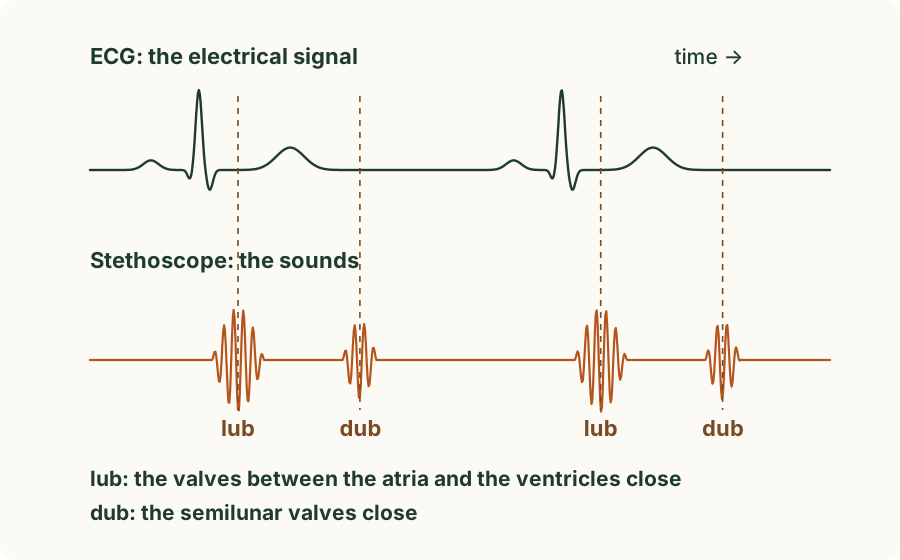
| Row | Lub | Dub |
|---|---|---|
| A | the semilunar valves shut | the valves between the atria and the ventricles shut |
| B | the valves between the atria and the ventricles shut | the semilunar valves shut |
| C | the valves between the atria and the ventricles open | the semilunar valves open |
| D | the ventricle walls contract | the ventricle walls relax |
Circle one answer.
- A
- B
- C
- D
Nudge (only if you are stuck): Find the lub on the figure: is it at the start of the contraction or at its end? Where would blood flow back at that moment?
6. calculate
A pupil's resting heart rate is 87 beats per minute. Calculate how many beats she should feel if she counts her pulse for 20 seconds.
Beats counted in 20 seconds: ______________ unit ________
Nudge (only if you are stuck): What fraction of a minute is 20 seconds?
7. calculate
On an ECG trace the tall spikes are 0.9 seconds apart. Calculate the heart rate in beats per minute.
Heart rate (beats per minute): ______________ unit ________
Nudge (only if you are stuck): One beat takes 0.9 s. How many of those fit into 60 s?
8. explain
Which statement explains why the pulse rate is the same as the heart rate?
Circle one answer.
- Each heartbeat sends one electrical signal along the nerves to the wrist.
- Each contraction of the right ventricle sends one surge of blood to the wrist.
- Each contraction of the left ventricle sends one surge of blood to the wrist.
- Each heartbeat makes a lub and a dub, and each sound is felt as one pulse.
Nudge (only if you are stuck): What do you feel under your fingertip at the wrist, and where does it come from?
9. calculate
A heart-rate sensor shows a steady 78 beats per minute. At the same time a coach counts 26 beats at the athlete's wrist. Calculate how long, in seconds, the coach counted for.
Time the coach counted for: ______________ unit ________
Nudge (only if you are stuck): Is 26 more or fewer than the beats in a whole minute? So is the time more or less than a minute?
10. calculate
A school nurse listens through a stethoscope and counts 54 heart sounds in 20 seconds. Calculate the heart rate in beats per minute.
Heart rate (beats per minute): ______________ unit ________
Nudge (only if you are stuck): Is every sound a separate beat?
11. suggest
A doctor listening with a stethoscope hears a clear "lub" but a soft whooshing sound instead of a clean "dub". Suggest which part may not be working properly.
Circle one answer.
- the muscle in the walls of the ventricles
- the semilunar valves at the start of the arteries
- the valves between the atria and the ventricles
- the air moving in and out of the lungs
Nudge (only if you are stuck): Which sound has changed, and what makes that sound?
12. identify / calculate
A pupil counts his resting pulse three times, for 15 seconds each time: 21, 14 and 23 beats. Identify the anomalous count. Then calculate his mean heart rate in beats per minute, leaving the anomalous count out.
Anomalous count: ______________ unit ________
Mean heart rate (beats per minute): ______________ unit ________
Nudge (only if you are stuck): Which count is far from the other two? What could have gone wrong while it was counted?