Pupil sheet · Exercise and heart health
Exercise and heart health — final check
Name ______________________ Date ____________
Work alone, with the lesson closed. Answer every question; there are no hints.
1. state / calculate
(a) State three ways of monitoring the activity of the heart. (b) A resting heart rate is 90 beats per minute. Calculate how many beats would be counted in 10 seconds.
(a) Three ways
(b) Beats in 10 seconds
2. calculate
An ECG strip has 7 tall spikes. The first is at 0.4 s and the last is at 5.6 s. Calculate the heart rate in beats per minute. Give your answer to the nearest whole number.
Heart rate (beats per minute): ______________ unit ________
3. describe / state
(a) The figure compares one person's step test before and after ten weeks of training. Describe two differences in the heart rate after the ten weeks. Use data from the graph. (b) Another pupil compares her heart rate on an exercise bike before and after a term of swimming lessons. State two things she must keep the same in the two bike tests.
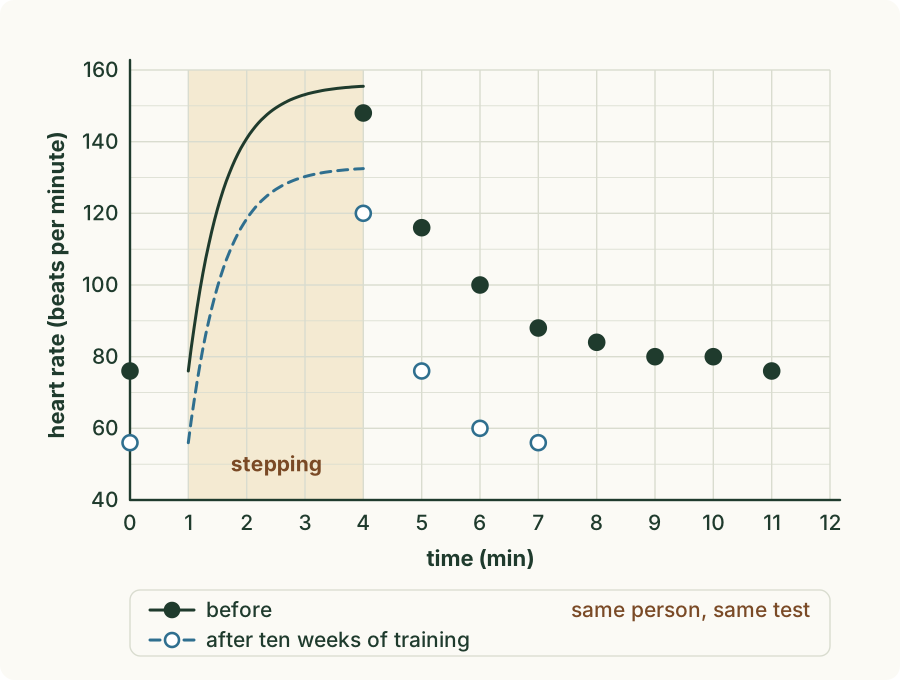
(a) Two differences
(b) Two things kept the same
4. explain
Supplement. A rower's heart rate rises from 60 to 170 beats per minute during a hard race. Five minutes after the race it is still 110. (a) Explain why the heart rate rises during the race. (b) Explain why it is still raised five minutes later.
(a) Why it rises
(b) Why it stays raised
5. describe / state
(a) Describe coronary heart disease. (b) State four possible risk factors for coronary heart disease.
(a) Coronary heart disease
(b) Four risk factors
6. suggest / identify / explain
Mr Osei is 58. He smokes, adds a lot of salt to his food, eats fatty meat and butter every day and takes no exercise. (a) Suggest two changes to his diet or exercise, and explain how each one lowers his risk of coronary heart disease. (b) Identify one risk factor in his profile that he cannot change. (c) Explain why these changes cannot remove his risk completely.
(a) Two changes and how they help
(b) A risk factor he cannot change
(c) Why the risk is not removed