Pupil sheet · Gas exchange and breathing
Breathing in, breathing out — questions
Name ______________________ Date ____________
Try every question before you use a nudge. Write in full sentences where you are asked to explain.
1. identify
What is meant by the depth of breathing?
Circle one answer.
- the volume of air breathed in or out in one breath
- the time taken for one breath
- how far down the trachea the air goes
- the number of breaths per minute
Nudge (only if you are stuck): Think of a deep breath and a shallow breath: what is different?
2. calculate
A pupil counts 9 breaths in 30 seconds. Calculate the rate of breathing in breaths per minute.
Rate of breathing: ______________ unit ________
Nudge (only if you are stuck): How many lots of 30 s are there in a minute?
3. determine
The trace shows a pupil's breathing for 30 s just after running. Use it to determine (a) the number of breaths in 30 s, (b) the rate of breathing, (c) the depth of each breath and (d) the volume of air breathed per minute.
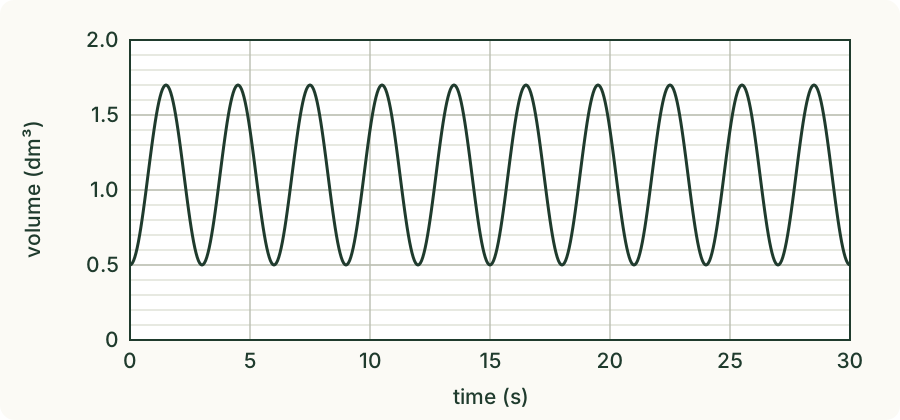
(a) Breaths in 30 s: ______________ unit ________
(b) Rate of breathing: ______________ unit ________
(c) Depth of each breath: ______________ unit ________
(d) Volume per minute: ______________ unit ________
Nudge (only if you are stuck): Count the peaks; depth is from a dip up to the next peak.
4. describe
The table shows a pupil's breathing at rest and just after running. Describe the effect of the running on the rate and the depth of breathing. Use the data.
| Rate (breaths per minute) | Depth (dm³) | |
|---|---|---|
| At rest | 14 | 0.6 |
| Just after running | 30 | 1.8 |
(a) Rate
(b) Depth
Nudge (only if you are stuck): Say the direction of each change and how big it is.
5. identify
Four pupils plan to test the effect of skipping on the rate of breathing. Which plan is a fair test?
Circle one answer.
- Count Sam's breaths for 30 s at rest, then count Ali's for 30 s after 2 minutes of skipping.
- Count Sam's breaths for 30 s at rest, then for 30 s, 10 minutes after 2 minutes of skipping.
- Count Sam's pulse for 30 s at rest, then for 30 s straight after 2 minutes of skipping.
- Count Sam's breaths for 30 s at rest, then for 30 s straight after 2 minutes of skipping.
Nudge (only if you are stuck): Only the exercise should change between the two counts.
6. identify
Supplement. In the bell-jar model, match each part of the model to the part of the body it stands for.
Write the number of the matching option.
- the trachea and bronchi
- the walls of the thorax
- the diaphragm
- the lungs
- bell jar: ______
- rubber sheet: ______
- balloons: ______
- Y-shaped tube: ______
Nudge (only if you are stuck): The rubber sheet is pulled down, like a muscle under the lungs.
7. describe
Supplement. Put these events of breathing in into the right order.
Write the number of each step in order.
- The volume of the thorax increases.
- The pressure inside the thorax falls below atmospheric pressure.
- Air flows into the lungs.
- The diaphragm and the external intercostal muscles contract.
- First: ______
- Second: ______
- Third: ______
- Last: ______
Nudge (only if you are stuck): Muscles first, air last.
8. describe
Supplement. Complete the description of breathing out at rest. The diaphragm (1) and moves up into a dome. The ribs move (2). The volume of the thorax (3), so the pressure inside (4) above atmospheric pressure, and air flows (5).
(1)
(2)
(3)
(4)
(5)
Nudge (only if you are stuck): Everything happens the other way round from breathing in.
9. predict / explain
Supplement. A bell-jar model has a crack in the jar's wall, so air from the room can get into the space around the balloons. (a) Predict what happens to the balloons when the rubber sheet is pulled down. (b) Explain your prediction in terms of pressure.
(a) The balloons
(b) Why, in terms of pressure
Nudge (only if you are stuck): What does the air in the room do when the pressure inside the jar starts to fall?
10. identify
Supplement. When you breathe out hard, for example to blow out a row of candles, which muscles contract to pull the ribs down and in?
Circle one answer.
- the internal intercostal muscles
- the diaphragm alone
- no muscles at all
- the external intercostal muscles
Nudge (only if you are stuck): At rest, breathing out needs no contraction; breathing out hard does.
11. state / predict / explain
Supplement. A pupil makes a better model: a plastic bottle with its bottom cut off, a rubber sheet across the opening and two balloons inside. The sides of the bottle can be pulled outwards. (a) State the part of the chest that the moving sides stand for. (b) Predict how pulling the sides outwards at the same time as pulling the sheet down changes the amount of air that enters the balloons. Explain your prediction.
(a) What the sides stand for
(b) Prediction and explanation
Nudge (only if you are stuck): What happens to the volume inside the bottle when two things move at once?
12. describe
Supplement. Put the steps that make breathing faster during exercise in the right order.
Write the number of each step in order.
- Breathing becomes faster and deeper.
- Nerve impulses go to the diaphragm and intercostal muscles.
- The carbon dioxide concentration in the blood rises.
- Muscles respire faster.
- The brain detects the rise.
- First: ______
- Second: ______
- Third: ______
- Fourth: ______
- Last: ______
Nudge (only if you are stuck): Start in the muscles.
13. identify
Supplement. During exercise, what does the brain detect that makes breathing faster and deeper?
Circle one answer.
- a rise in the temperature of the blood in the lungs
- a rise in the carbon dioxide concentration in the blood
- a fall in the oxygen concentration in the leg muscles
- a fall in the carbon dioxide concentration in the blood
Nudge (only if you are stuck): Which gas do respiring muscles make?
14. explain
Supplement. A pupil says: "When we breathe in, the air rushing into our lungs pushes our ribs outwards." Explain why this statement is incorrect.
Nudge (only if you are stuck): Which comes first: the movement of the ribs or the air?
15. calculate / compare
After the same exercise, pupil A breathes 18 times a minute with a depth of 1.4 dm³, and pupil B 28 times a minute with a depth of 0.9 dm³. (a) Calculate the volume of air each pupil breathes per minute. (b) Pupil C, a trained swimmer, breathes the same volume per minute as A with a depth of 2.1 dm³. Calculate C's rate of breathing. (c) Compare the breathing of A and B.
(a) Pupil A: ______________ unit ________
(a) Pupil B: ______________ unit ________
(b) Pupil C's rate: ______________ unit ________
(c) Compare the breathing of A and B
Nudge (only if you are stuck): Volume per minute = rate × depth.
16. identify / calculate
Straight after a sprint, a pupil counts 7 breaths in 10 seconds and writes: "Rate = 7 × 10 = 70 breaths per minute." Identify the mistake, and calculate the correct rate.
Correct rate: ______________ unit ________
The mistake
Nudge (only if you are stuck): How many lots of 10 s are there in a minute?
17. predict / explain
Supplement. A person sitting still breathes air that has extra carbon dioxide added to it (3% instead of 0.04%). Predict what happens to their breathing, and explain why.
(a) Prediction
(b) Explanation
Nudge (only if you are stuck): Less carbon dioxide can leave the blood. What does the brain detect?