Pupil sheet · Gas exchange and breathing
Air in, air out — questions
Name ______________________ Date ____________
Try every question before you use a nudge. Write in full sentences where you are asked to explain.
1. identify
The diagram shows the two-tube apparatus used to compare inspired and expired air. Match each letter to what happens there.
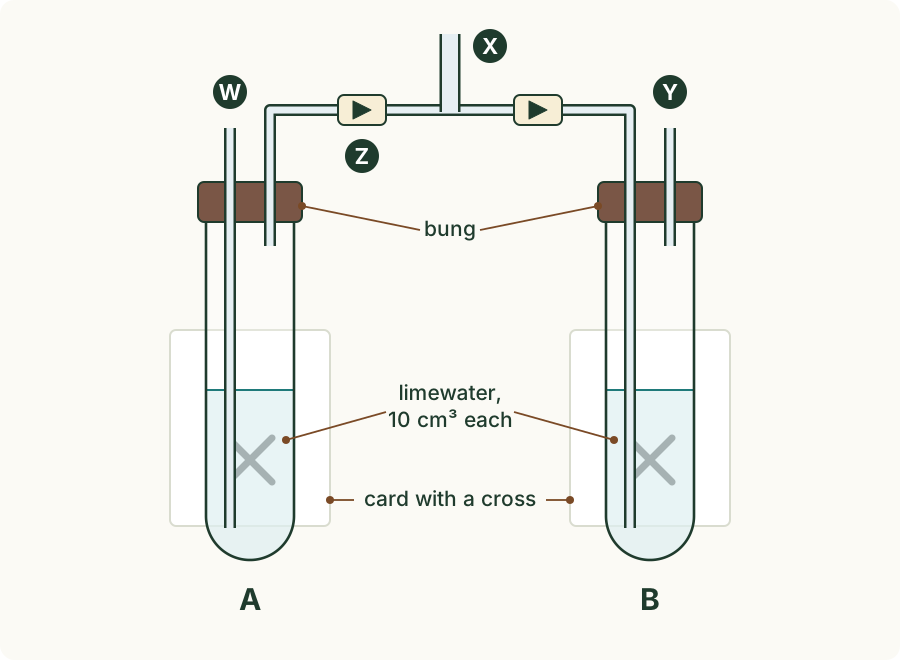
Write the number of the matching option.
- air can pass one way only
- expired air leaves the apparatus
- the person breathes in and out
- room air enters the apparatus
- W: ______
- X: ______
- Y: ______
- Z: ______
Nudge (only if you are stuck): Follow a breath in: where does room air come from, and where does it go?
2. identify
Which result shows that a gas contains carbon dioxide?
Circle one answer.
- Cobalt chloride paper turns from blue to pink.
- Limewater turns from clear to blue.
- Limewater turns from cloudy to clear.
- Limewater turns from clear to cloudy.
Nudge (only if you are stuck): Which test did tubes A and B use?
3. state
State the typical percentages of oxygen and carbon dioxide in inspired air and in expired air.
Oxygen in inspired air: ______________ unit ________
Oxygen in expired air: ______________ unit ________
Carbon dioxide in inspired air: ______________ unit ________
Carbon dioxide in expired air: ______________ unit ________
Nudge (only if you are stuck): Expired air has lost some oxygen and gained carbon dioxide.
4. identify
Which statements about expired air, compared with inspired air, are correct? Choose all that apply.
Tick every correct statement.
- It contains no oxygen.
- It contains less nitrogen.
- It contains less oxygen.
- It contains more water vapour.
- It contains more carbon dioxide.
Nudge (only if you are stuck): Think of the limewater, the mirror and the gas analyser's table.
5. describe
Supplement. Put the journey of oxygen from the air into a muscle cell in order.
Write the number of each step in order.
- The blood carries it to a muscle.
- Oxygen is in the air of an alveolus.
- A muscle cell uses it in aerobic respiration.
- It diffuses through the walls of the alveolus and a capillary into the blood.
- First: ______
- Second: ______
- Third: ______
- Last: ______
Nudge (only if you are stuck): Where does oxygen first cross into the blood?
6. explain / predict
A pupil sets up the two-tube apparatus with 15 cm³ of limewater in each tube. (a) She puts a card with a thick black cross behind tube A and a card with a thin grey cross behind tube B. Explain why her counts of breaths could give a false result. (b) In a second try, the long tube in B has been pushed up so that it ends above the limewater. Predict what she would see in tube B, and explain why.
(a) Why the crosses could give a false result
(b) What you would see in B, and why
Nudge (only if you are stuck): In each case, ask what else, apart from the air, could change the number of breaths counted.
7. identify
A pupil uses the two-tube apparatus with the same limewater in each tube. The cross behind tube B disappears after 7 breaths. She keeps going, and the cross behind tube A disappears after 160 breaths. Which conclusion do these results support?
Circle one answer.
- Inspired air contains more carbon dioxide, as tube A took longer.
- Both airs contain carbon dioxide, but expired air contains much more.
- Inspired air contains no carbon dioxide, so tube A must have leaked.
- Expired air contains less oxygen, as tube B turned cloudy first.
Nudge (only if you are stuck): Both tubes turned cloudy in the end. What does the number of breaths tell you?
8. calculate
A gas analyser takes in 600 cm³ of a person's expired air. It contains 102 cm³ of oxygen. Inspired air is 21% oxygen. (a) Calculate the percentage of oxygen in this expired air. (b) Calculate the volume of oxygen in 600 cm³ of inspired air. (c) Calculate the volume of oxygen the body kept from each 600 cm³ breathed in and out.
(a) Oxygen in this expired air: ______________ unit ________
(b) Oxygen in 600 cm³ of inspired air: ______________ unit ________
(c) Oxygen kept by the body: ______________ unit ________
Nudge (only if you are stuck): Percentage = part ÷ whole × 100.
9. state / explain
A pupil breathes onto strip 1 of blue cobalt chloride paper on a cold mirror, and it turns pink in 15 s. Strip 2, left in the room air, is still blue after 15 s but has turned pink after 30 minutes. (a) State what strip 2 shows about inspired air. (b) Explain why the pupil must compare the two strips after the same 15 s, not after 30 minutes.
(a) What strip 2 shows
(b) Why the same 15 s
Nudge (only if you are stuck): What would the two strips look like if you compared them only after 30 minutes?
10. explain
Supplement. Explain why expired air contains more carbon dioxide than inspired air.
Nudge (only if you are stuck): Where is carbon dioxide made, and where does it leave the blood?
11. identify
Supplement. Which row explains the differences between inspired air and expired air?
| Row | Less oxygen in expired air because … | More carbon dioxide because … | More water vapour because … |
|---|---|---|---|
| A | it diffuses into the blood in the alveoli | it diffuses from the blood into the alveoli | water evaporates from the moist lining of the alveoli |
| B | lung cells use it in respiration | it diffuses from the blood into the alveoli | water evaporates from the moist lining of the alveoli |
| C | it diffuses into the blood in the alveoli | oxygen turns into it inside the alveoli | water evaporates from the moist lining of the alveoli |
| D | it diffuses into the blood in the alveoli | it diffuses from the blood into the alveoli | oxygen and carbon dioxide react in the alveoli to make water |
Circle one answer.
- A
- B
- C
- D
Nudge (only if you are stuck): Check one column at a time: where is each gas made or used?
12. state / explain
A pupil breathes out through a single tube of limewater. It turns cloudy, and the pupil writes: "Expired air contains carbon dioxide, so inspired air does not." (a) State the part of the conclusion that the result supports. (b) Explain why the other part is not supported, and describe the extra test that is needed.
(a) The part that is supported
(b) The part that is not, and the extra test
Nudge (only if you are stuck): What would the pupil need to compare the expired air with?
13. identify / give
A gas analyser tests two samples of air. Sample X: oxygen 16.4%, carbon dioxide 4.1%. Sample Y: oxygen 20.9%, carbon dioxide 0.04%. (a) Identify the sample that is expired air. (b) Give two reasons from the data.
(a) Expired air
(b) Two reasons from the data
Nudge (only if you are stuck): Expired air has lost some oxygen and gained carbon dioxide.
14. explain
On a cold winter morning you can see a white cloud when you breathe out, but not when you breathe in. Explain why.
Nudge (only if you are stuck): What is in expired air that cold air makes visible?
15. explain
Supplement. A swimmer holds her breath for 30 seconds and then breathes out into a gas analyser. Her expired air has less oxygen and more carbon dioxide than her usual expired air. Explain why.
Nudge (only if you are stuck): What goes on in the alveoli while the air stays in the lungs?