Pupil sheet · Gas exchange and breathing
Gas exchange and breathing — final check
Name ______________________ Date ____________
Work alone, with the lesson closed. Answer every question; there are no hints.
1. describe
Describe how the two-tube apparatus is used to compare the carbon dioxide in inspired and expired air, and how the result is judged fairly.
2. identify
A gas analyser tests four samples of air, and a sensor compares their water vapour with room air. Which row could be a sample of expired air?
| Row | Oxygen / % | Carbon dioxide / % | Water vapour compared with room air |
|---|---|---|---|
| A | 3.8 | 16.9 | more |
| B | 20.9 | 0.04 | more |
| C | 16.9 | 3.8 | more |
| D | 16.9 | 3.8 | less |
Circle one answer.
- A
- B
- C
- D
3. explain
Supplement. Explain why expired air contains less oxygen than inspired air.
4. identify
The diagram shows part of the breathing system, seen in a new way. Match each number to the name of the part. Two of the names are not used.
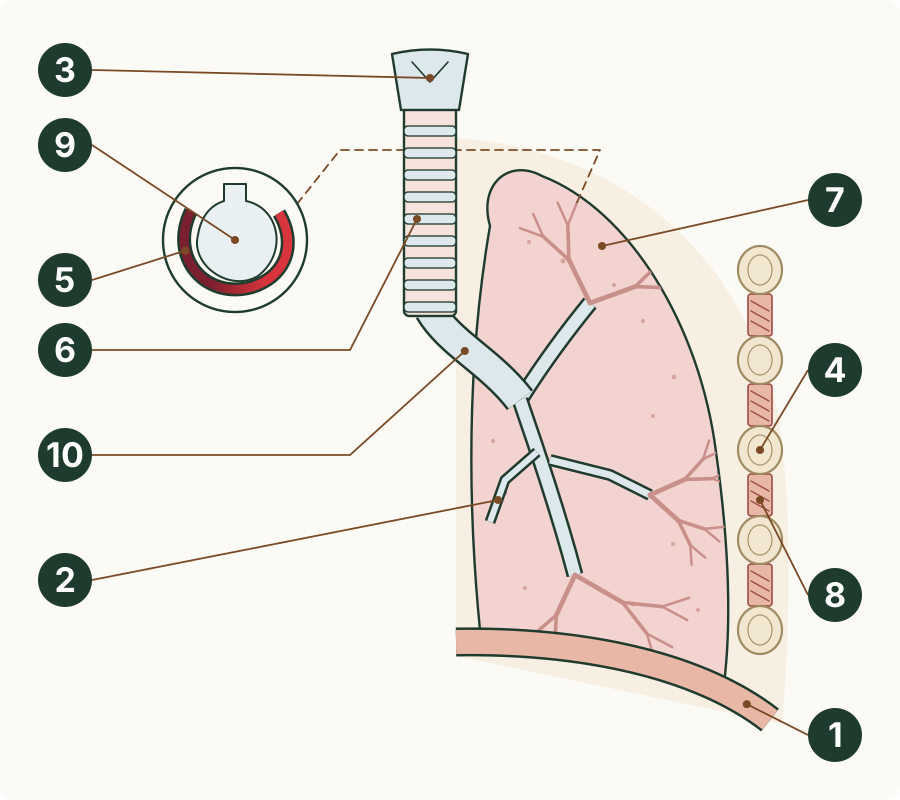
Write the number of the matching option.
- oesophagus
- alveolus
- larynx
- intercostal muscle
- bronchus
- heart
- capillary
- trachea
- rib
- bronchiole
- lung
- diaphragm
- 1: ______
- 2: ______
- 3: ______
- 4: ______
- 5: ______
- 6: ______
- 7: ______
- 8: ______
- 9: ______
- 10: ______
5. explain
Explain how two features of the alveoli make gas exchange fast.
(a) First feature and how it helps
(b) Second feature and how it helps
6. identify / state / explain
Supplement. (a) The diagram shows a section through the chest wall. Identify the letter that shows the muscles that pull the ribs down and in, and state their name. (b) State the function of the cartilage in the trachea. (c) Explain the role of mucus and cilia in protecting the lungs.
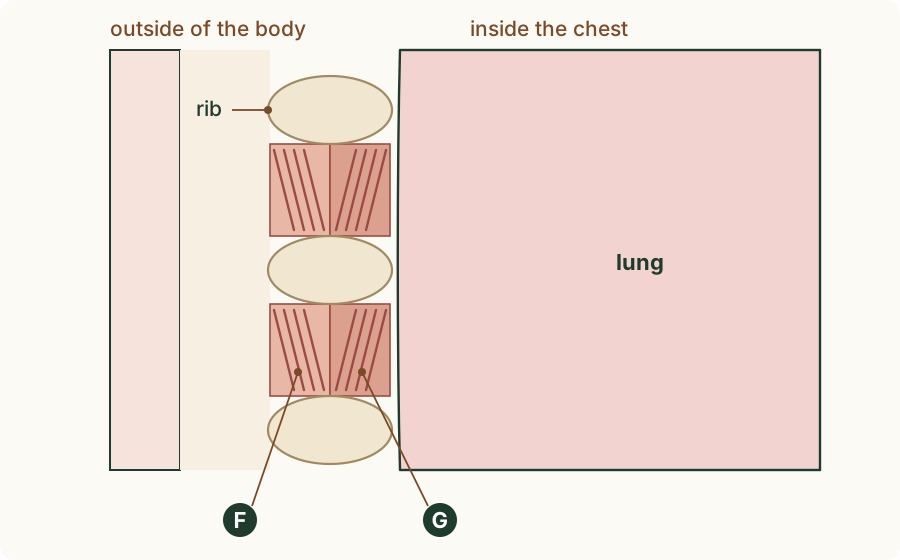
(a) Muscles
(b) Cartilage
(c) Mucus and cilia
7. explain
Supplement. Explain how the ribs, intercostal muscles and diaphragm cause air to enter the lungs.
8. calculate
Straight after exercise, a pupil breathes 28.8 dm³ of air per minute at a rate of 18 breaths per minute. (a) Calculate the depth of each breath. (b) At rest, the depth of her breaths is 0.6 dm³. Calculate how many times deeper her breaths are after exercise. Give your answer to 2 significant figures.
(a) Depth of each breath: ______________ unit ________
(b) How many times deeper: ______________ unit ________
9. describe
Describe how you would investigate the effect of physical activity on the rate of breathing, and the result you would expect.
10. explain
Supplement. A cyclist reaches the top of a steep hill and stops to rest. Over the next few minutes her breathing becomes slower and shallower. Explain why.