Pupil sheet · Energy changes in reactions
Reaction pathway diagrams — questions
Name ______________________ Date ____________
Try every question before you use a nudge. Write in full sentences where you are asked to explain.
1. deduce
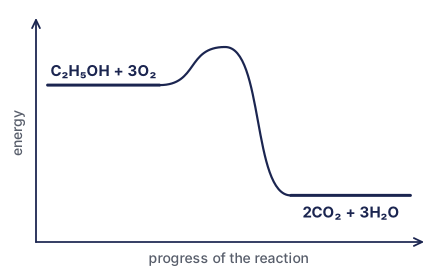
The diagram shows the reaction pathway diagram for burning ethanol. Which statement is correct?
Circle one answer.
- The curve rises in the middle, so the reaction is endothermic
- The products are lower, so the reaction takes in thermal energy
- The products have less energy than the reactants, so it is exothermic
- The products have more energy than the reactants, so it is endothermic
Nudge (only if you are stuck): Compare the level of the products with the level of the reactants.
2. identify
Match each letter on the reaction pathway diagram to what it shows.
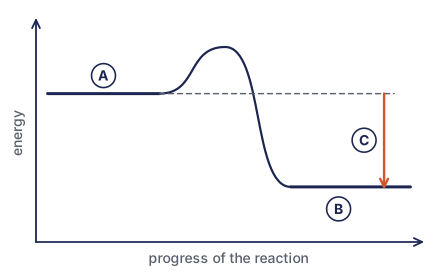
Write the number of the matching option.
- The products
- The energy taken in from the surroundings
- The reactants
- The energy given out to the surroundings
- A: ______
- B: ______
- C: ______
Nudge (only if you are stuck): Which side are the reactants on? Which way does the arrow point?
3. identify / explain / determine
The diagrams show two reactions, P and Q. (a) When one of these reactions is carried out in a beaker, the thermometer in the beaker falls. Identify which reaction it is, and explain how its diagram shows this. (b) Supplement. Two other reactions, R and S, are drawn on one energy scale. For R the reactants are at 180 kJ/mol and the top of the hump is at 210 kJ/mol. For S the reactants are at 30 kJ/mol and the top of the hump is at 190 kJ/mol. Determine which reaction, R or S, needs more energy to start. Explain your answer using activation energy.
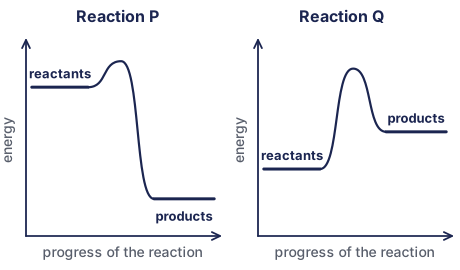
(a) The reaction that makes the thermometer fall
(b) Supplement: R or S, and why
Nudge (only if you are stuck): For (b), where does an activation energy arrow start?
4. deduce
Supplement. Burning propane has ΔH = −2220 kJ/mol. Which statement is correct?
Circle one answer.
- The chemicals lose energy, and the surroundings get colder
- The chemicals gain energy, and the surroundings get warmer
- The chemicals lose energy, and the surroundings get warmer
- The chemicals gain energy, and the surroundings get colder
Nudge (only if you are stuck): From whose point of view is ΔH written: the chemicals' or the surroundings'?
5. deduce
Supplement. Deduce from its enthalpy change whether each reaction is exothermic or endothermic. Match each one.
Write the number of the matching option.
- Endothermic
- Exothermic
- 1. 2Mg + O2 → 2MgO, ΔH = −1203 kJ/mol: ______
- 2. C + H2O → CO + H2, ΔH = +131 kJ/mol: ______
- 3. N2 + 3H2 → 2NH3, ΔH = −92 kJ/mol: ______
- 4. 2HgO → 2Hg + O2, ΔH = +182 kJ/mol: ______
Nudge (only if you are stuck): Which part of each ΔH value tells you which way the energy goes?
6. define
Supplement. Which is the definition of the activation energy, Ea, of a reaction?
Circle one answer.
- The difference in energy between the reactants and the products
- The energy at the top of the hump, read from the bottom of the graph
- The minimum energy that colliding particles must have to react
- The energy that colliding particles give out when they react
Nudge (only if you are stuck): Picture two particles that collide and bounce apart without reacting. What did they lack?
7. identify
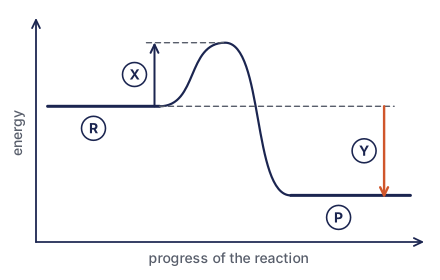
Supplement. Match each arrow on the reaction pathway diagram to what it shows.
Write the number of the matching option.
- The enthalpy change, ΔH
- The energy of the products
- The activation energy, Ea
- Arrow X: ______
- Arrow Y: ______
Nudge (only if you are stuck): Where does each arrow start, and where does it end?
8. determine
Supplement. Use the reaction pathway diagram. (a) Determine the activation energy, Ea. (b) Determine the enthalpy change, ΔH. Include its sign.
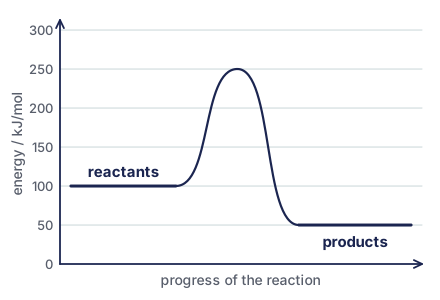
(a) Activation energy: ______________ unit ________
(b) Enthalpy change: ______________ unit ________
Nudge (only if you are stuck): Read the three levels first: reactants, top of the hump, products.
9. describe
Supplement. Hydrogen peroxide decomposes: 2H2O2 → 2H2O + O2. ΔH = −196 kJ/mol and Ea = 75 kJ/mol. Describe its reaction pathway diagram, labelled with reactants, products, ΔH and Ea: (a) where the products' level goes; (b) the ΔH arrow and its label; (c) the Ea arrow and its label; (d) the labels on the two axes. You may draw it on paper first.
(a) The products' level
(b) The ΔH arrow
(c) The Ea arrow
(d) The axes
Nudge (only if you are stuck): Start from the sign of ΔH: is the reaction exothermic or endothermic?
10. deduce
Supplement. A reaction has ΔH = −70 kJ/mol and Ea = 90 kJ/mol. On its reaction pathway diagram, drawn on an energy scale, the reactants' level is at 170 kJ/mol. Which row describes the diagram correctly?
| Row | Products' level | Top of the hump | ΔH arrow |
|---|---|---|---|
| A | 240 kJ/mol | 260 kJ/mol | up, from the reactants' level to the products' level |
| B | 100 kJ/mol | 190 kJ/mol | down, from the reactants' level to the products' level |
| C | 100 kJ/mol | 260 kJ/mol | down, from the reactants' level to the products' level |
| D | 100 kJ/mol | 260 kJ/mol | down, from the top of the hump to the products' level |
Circle one answer.
- A
- B
- C
- D
Nudge (only if you are stuck): Work out the two levels yourself first, then find the row that matches.
11. describe / state / explain
A camping stove burns butane gas. When the tap is opened, the gas comes out but does not catch fire. Pressing the spark button lights it. Then the flame keeps burning on its own and heats a tin of soup. (a) Describe where the products' level is on the reaction pathway diagram for burning butane, compared with the reactants' level, and explain why. (b) Supplement. State whether ΔH for burning butane is positive or negative. (c) Supplement. Explain, using activation energy, why the gas needs the spark. (d) Supplement. Explain why the flame keeps burning after the spark has stopped.
(a) The products' level
(b) Supplement: the sign of ΔH
(c) Supplement: why the spark is needed
(d) Supplement: why the flame keeps burning
Nudge (only if you are stuck): Does the stove give energy to the soup? What does the spark give the particles?