Pupil sheet · Energy changes in reactions
Energy changes in reactions — return questions
Name ______________________ Date ____________
Use one to two weeks after the lessons. Keep the notes and the lesson closed.
1. explain
Each pupil's statement is incorrect. (a) Plaster of Paris mixed with water gets warm as it sets. Pupil 1 writes: "The plaster feels warm because the reaction takes in thermal energy from my hand." Explain why the statement is incorrect. (b) Two solutions are mixed in a polystyrene cup, and the thermometer falls from 23.5 °C to 18.0 °C. Pupil 2 writes: "The reacting chemicals lost thermal energy, so the reaction is endothermic." Explain why the statement is incorrect.
(a) Pupil 1: the plaster
(b) Pupil 2: the cup
2. deduce / explain
In a flash of lightning, nitrogen and oxygen in the air react: N2 + O2 → 2NO. The diagram shows its reaction pathway diagram. (a) Deduce whether the reaction is exothermic or endothermic. Explain using the diagram. (b) Supplement. A pupil says that the activation energy is the height of the hump above the product, 2NO. Explain why the pupil is wrong.
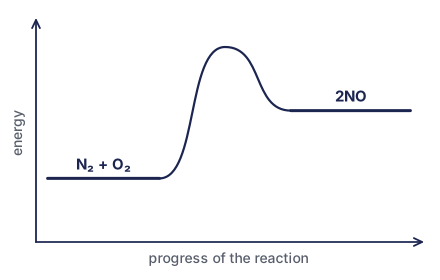
(a) Exothermic or endothermic
(b) Supplement: why the pupil is wrong
3. deduce
Supplement. A reaction has ΔH = +85 kJ/mol and Ea = 210 kJ/mol. On its reaction pathway diagram, drawn on an energy scale, the reactants' level is at 70 kJ/mol. Which row describes the labelled diagram correctly?
| Row | Products' level | ΔH arrow | Ea arrow |
|---|---|---|---|
| A | 155 kJ/mol | up, from the reactants to the products | up, from the reactants to 280 kJ/mol |
| B | 155 kJ/mol | up, from the reactants to the products | up, from the products to 365 kJ/mol |
| C | 155 kJ/mol | down, from the top of the hump to the products | up, from the reactants to 280 kJ/mol |
| D | 85 kJ/mol | up, from the reactants to the products | up, from the reactants to 280 kJ/mol |
Circle one answer.
- A
- B
- C
- D