Pupil sheet · Energy changes in reactions
Energy changes in reactions — final check
Name ______________________ Date ____________
Work alone, with the lesson closed. Answer every question; there are no hints.
1. calculate / predict / explain
Solid hydrated barium hydroxide and solid ammonium chloride are mixed in a beaker. A thermometer pushed into the mixture reads 17.5 °C at the start and −7.0 °C at its lowest. (a) Calculate the fall in temperature. (b) The beaker stands in a small puddle of water on a wooden block. Predict what happens to the puddle. Explain your prediction using the words thermal energy and surroundings.
(a) Fall in temperature: ______________ unit ________
(b) What happens to the puddle, and why
2. calculate / deduce
Dilute sulfuric acid and ammonia solution, both at 21.5 °C, are mixed in a polystyrene cup to make ammonium sulfate. The highest temperature is 27.0 °C. (a) Calculate the temperature rise. (b) Deduce whether the reaction is exothermic or endothermic, and explain how you know.
(a) Temperature rise: ______________ unit ________
(b) Exothermic or endothermic, and how you know.
3. explain / deduce
The diagram shows the reaction pathway diagram for heating copper(II) carbonate: CuCO3 → CuO + CO2. (a) A pupil says: "The reaction is exothermic, because the curve comes down at the end." Explain why the pupil is incorrect, using the diagram. (b) Supplement. Deduce which is bigger for this reaction, Ea or the size of ΔH. Explain how the diagram shows it.
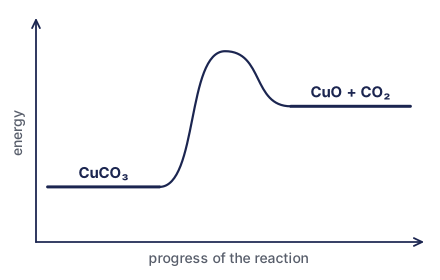
(a) Why the pupil is incorrect
(b) Supplement: Ea or ΔH
4. determine / define
Supplement. The table gives three energies read from the reaction pathway diagram of a reaction. (a) Determine the activation energy, Ea, of the reaction. (b) Determine the enthalpy change, ΔH, of the reaction. Include its sign. (c) Define activation energy.
| Point on the diagram | Energy in kJ/mol |
|---|---|
| Top of the hump | 330 |
| Products | 215 |
| Reactants | 90 |
(a) Activation energy: ______________ unit ________
(b) Enthalpy change: ______________ unit ________
(c) The definition of activation energy.
5. determine / describe
Supplement. Zinc carbonate breaks down when it is heated: ZnCO3 → ZnO + CO2. ΔH = +69 kJ/mol and Ea = 140 kJ/mol. On its reaction pathway diagram, drawn on an energy scale, the products, ZnO + CO2, are at 194 kJ/mol. (a) Determine the energy of the reactant's level. (b) Determine the energy at the top of the hump. (c) Describe the ΔH arrow and the Ea arrow on the labelled diagram: where each one starts and ends, and its label.
(a) Reactant's level: ______________ unit ________
(b) Top of the hump: ______________ unit ________
(c) The ΔH arrow and the Ea arrow