Pupil sheet · Bond energies
Calculating ΔH from bond energies — questions
Name ______________________ Date ____________
Try every question before you use a nudge. Write in full sentences where you are asked to explain.
1. identify
Supplement. Which expression gives the enthalpy change, ΔH, of a reaction?
Circle one answer.
- Energy given out making bonds − energy taken in breaking bonds
- Energy taken in breaking bonds + energy given out making bonds
- Energy taken in breaking bonds − energy given out, made positive
- Energy taken in breaking bonds − energy given out making bonds
Nudge (only if you are stuck): An exothermic reaction gives out more than it takes in, and its ΔH is negative.
2. calculate
Supplement. Hydrogen reacts with bromine: H2 + Br2 → 2HBr. Use the bond energies in the table to calculate (a) the energy taken in breaking bonds; (b) the energy given out making bonds; (c) ΔH.
| Bond | Bond energy / kJ/mol |
|---|---|
| H–H | 436 |
| Br–Br | 193 |
| H–Br | 366 |
(a) Energy in: ______________ unit ________
(b) Energy out: ______________ unit ________
(c) ΔH: ______________ unit ________
Nudge (only if you are stuck): 2HBr is two molecules, each with one H–Br bond.
3. deduce
Supplement. Hydrogen burns in oxygen: 2H2 + O2 → 2H2O. A water molecule is H–O–H. Deduce the number of (a) H–H bonds broken; (b) O=O bonds broken; (c) O–H bonds made.
(a) H–H bonds broken: ______________ unit ________
(b) O=O bonds broken: ______________ unit ________
(c) O–H bonds made: ______________ unit ________
Nudge (only if you are stuck): Count the bonds in one molecule, then multiply by the number in front of the formula.
4. calculate
Supplement. Use the bond energies in the table to calculate ΔH for burning hydrogen: 2H2 + O2 → 2H2O.
| Bond | Bond energy / kJ/mol |
|---|---|
| H–H | 436 |
| O=O | 498 |
| O–H | 463 |
ΔH: ______________ unit ________
Nudge (only if you are stuck): A water molecule is H–O–H, and the 2 in 2H2O counts molecules.
5. calculate
Supplement. Ammonia is made from nitrogen and hydrogen: N2 + 3H2 → 2NH3. Nitrogen has a triple bond, N≡N, and each ammonia molecule has three N–H bonds. (a) Use the bond energies in the table to calculate ΔH for the equation as written. (b) The equation makes two moles of ammonia. Calculate ΔH for making one mole of ammonia. Give your answer to 3 significant figures.
| Bond | Bond energy / kJ/mol |
|---|---|
| N≡N | 945 |
| H–H | 436 |
| N–H | 391 |
(a) ΔH for N2 + 3H2 → 2NH3: ______________ unit ________
(b) ΔH for making 1 mol of NH3: ______________ unit ________
Nudge (only if you are stuck): ΔH belongs to the amounts written in the equation.
6. calculate
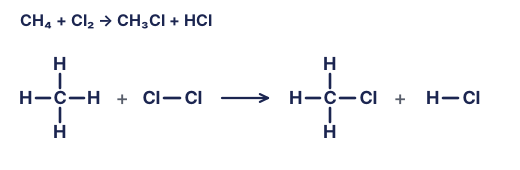
Supplement. Methane reacts with chlorine in sunlight: CH4 + Cl2 → CH3Cl + HCl. Count every bond and use the bond energies in the table to calculate (a) the energy taken in breaking all the bonds in the reactants; (b) the energy given out making all the bonds in the products; (c) ΔH.
| Bond | Bond energy / kJ/mol |
|---|---|
| C–H | 412 |
| Cl–Cl | 242 |
| C–Cl | 338 |
| H–Cl | 431 |
(a) Energy in, every bond in CH4 and Cl2: ______________ unit ________
(b) Energy out, every bond in CH3Cl and HCl: ______________ unit ________
(c) ΔH: ______________ unit ________
Nudge (only if you are stuck): Chloromethane keeps three of methane's C–H bonds.
7. calculate / explain
Supplement. Hydrogen is made from methane and steam: CH4 + H2O → CO + 3H2. Carbon monoxide has a triple bond, C≡O. (a) Use the bond energies in the table to calculate ΔH. (b) The reaction is carried out at about 900 °C. Use your answer to (a) to explain why the reaction must be heated all the time.
| Bond | Bond energy / kJ/mol |
|---|---|
| C–H | 412 |
| O–H | 463 |
| C≡O | 1077 |
| H–H | 436 |
(a) ΔH: ______________ unit ________
(b) Why the reaction must be heated all the time.
Nudge (only if you are stuck): Count the bonds in one molecule, then multiply by the number in front of the formula.
8. calculate
Supplement. Hydrogen reacts with iodine: H2 + I2 → 2HI. ΔH = −9 kJ/mol. Use the bond energies in the table to calculate the bond energy of the H–I bond.
| Bond | Bond energy / kJ/mol |
|---|---|
| H–H | 436 |
| I–I | 151 |
H–I bond energy: ______________ unit ________
Nudge (only if you are stuck): Which side of the equation holds the unknown bond, and how many of it are there?
9. identify / calculate
Supplement. A pupil calculates ΔH for burning ethene, C2H4 + 3O2 → 2CO2 + 2H2O. Ethene has a C=C double bond and four C–H bonds. Their working: energy in = 348 + 4 × 412 + 498 = 2494 kJ/mol; energy out = 4 × 805 + 4 × 463 = 5072 kJ/mol; ΔH = 5072 − 2494 = +2578 kJ/mol. (a) Identify three mistakes. (b) Calculate the correct ΔH.
| Bond | Bond energy / kJ/mol |
|---|---|
| C–C | 348 |
| C=C | 612 |
| C–H | 412 |
| O=O | 498 |
| C=O | 805 |
| O–H | 463 |
(b) The correct ΔH: ______________ unit ________
(a) The three mistakes.
Nudge (only if you are stuck): Check the bond energy used for each bond, the number of each bond, and the subtraction.
10. calculate / suggest
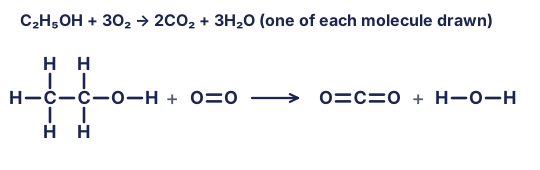
Supplement. Ethanol is used as a fuel: C2H5OH + 3O2 → 2CO2 + 3H2O. (a) Use the displayed formula of ethanol and the bond energies in the table to calculate ΔH. (b) A data book gives ΔH = −1367 kJ/mol for burning ethanol. Suggest one reason why your answer is different.
| Bond | Bond energy / kJ/mol |
|---|---|
| C–C | 348 |
| C–H | 412 |
| C–O | 358 |
| O–H | 463 |
| O=O | 498 |
| C=O | 805 |
(a) ΔH: ______________ unit ________
(b) One reason why your answer differs from the data-book value.
Nudge (only if you are stuck): Tick off each bond in the displayed formula of ethanol as you count it.