Pupil sheet · Bond energies
Bond energies — return questions
Name ______________________ Date ____________
Use one to two weeks after the lessons. Keep the notes and the lesson closed.
1. deduce
Supplement. For the reaction X2 + Y2 → 2XY, breaking the bonds in the reactants takes in 600 kJ/mol, and making the bonds in the product gives out 720 kJ/mol. The activation energy is 170 kJ/mol. Which row describes the reaction pathway diagram correctly?
| Row | Products' level | Top of the hump | ΔH arrow |
|---|---|---|---|
| A | 120 kJ/mol below the reactants | 600 kJ/mol above the reactants | down, from the reactants' level to the products' level |
| B | 120 kJ/mol below the reactants | 170 kJ/mol above the reactants | down, from the reactants' level to the products' level |
| C | 120 kJ/mol above the reactants | 170 kJ/mol above the reactants | up, from the reactants' level to the products' level |
| D | 120 kJ/mol below the reactants | 170 kJ/mol above the reactants | down, from the top of the hump to the products' level |
Circle one answer.
- A
- B
- C
- D
2. identify
Supplement. When limestone is heated strongly it breaks down: CaCO3 → CaO + CO2. The reaction is endothermic. The figure is its reaction pathway diagram. Match each lettered feature, W, X, Y and Z, to what it shows.
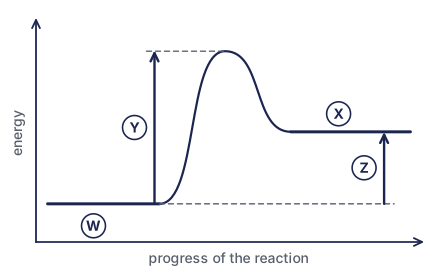
Write the number of the matching option.
- The separate atoms
- Enthalpy change, ΔH
- Products
- Reactants
- Activation energy, Ea
- W: ______
- X: ______
- Y: ______
- Z: ______
3. calculate / deduce / explain
Supplement. Chloroethane breaks down when it is heated strongly: C2H5Cl → C2H4 + HCl. Chloroethane has one C–C bond, five C–H bonds and one C–Cl bond; ethene has a C=C double bond and four C–H bonds. (a) Use the bond energies in the table to calculate ΔH. (b) Deduce ΔH for the reverse reaction, C2H4 + HCl → C2H5Cl. (c) Explain your answer to (b) in terms of bond breaking and bond making.
| Bond | Bond energy / kJ/mol |
|---|---|
| C–C | 348 |
| C–H | 412 |
| C–Cl | 338 |
| C=C | 612 |
| H–Cl | 431 |
(a) ΔH: ______________ unit ________
(b) ΔH for the reverse reaction: ______________ unit ________
(c) Why the reverse reaction has this ΔH, in terms of bond breaking and bond making.