Pupil sheet · Bond energies
Breaking and making bonds — questions
Name ______________________ Date ____________
Try every question before you use a nudge. Write in full sentences where you are asked to explain.
1. state
Supplement. Which statement about bonds is correct?
Circle one answer.
- Breaking a bond gives energy out; making a bond takes energy in
- Breaking a bond and making a bond both take energy in
- Breaking a bond takes energy in; making a bond gives energy out
- Breaking a bond and making a bond both give energy out
Nudge (only if you are stuck): Picture pulling two atoms apart against the attraction of the shared pair of electrons.
2. explain / state
Supplement. An iodine molecule, I2, has one covalent bond. (a) Explain why energy must be taken in to break this bond. (b) State whether breaking the bond is endothermic or exothermic.
(a) Why breaking the bond takes energy in
(b) Endothermic or exothermic
Nudge (only if you are stuck): What holds the two atoms together in a covalent bond?
3. state / calculate
Supplement. The bond energy of the C–Cl bond is 338 kJ/mol. (a) State the energy taken in to break one mole of C–Cl bonds. (b) State the energy given out when one mole of C–Cl bonds forms. (c) A tetrachloromethane molecule, CCl4, has four C–Cl bonds. In an equation, 2CCl4 means two moles of these molecules. Calculate the energy taken in to break all the bonds in 2CCl4.
(a) To break 1 mol of C–Cl bonds: ______________ unit ________
(b) Given out as 1 mol of C–Cl bonds forms: ______________ unit ________
(c) To break all the bonds in 2CCl4: ______________ unit ________
Nudge (only if you are stuck): For (c), count the C–Cl bonds in one molecule first.
4. identify
Supplement. Each change below happens during a reaction. Match each one to energy taken in or energy given out.
Write the number of the matching option.
- Energy given out (exothermic)
- Energy taken in (endothermic)
- 1. The C–Cl bond in a chloromethane molecule breaks: ______
- 2. Two bromine atoms join to make a Br2 molecule: ______
- 3. An N–H bond forms as an ammonia molecule is made: ______
- 4. A C–H bond in a propane molecule breaks: ______
Nudge (only if you are stuck): Picture the two atoms: are they moving apart or coming together?
5. calculate / deduce / explain
Supplement. Propane burns in camping stoves: C3H8 + 5O2 → 3CO2 + 4H2O. Breaking all the bonds in the reactants takes in 6482 kJ/mol. Making all the bonds in the products gives out 8534 kJ/mol. (a) Calculate ΔH. (b) Deduce whether the reaction is exothermic or endothermic. Explain your answer in terms of bond breaking and bond making.
(a) ΔH: ______________ unit ________
(b) Exothermic or endothermic, explained in terms of bond breaking and bond making.
Nudge (only if you are stuck): ΔH = energy taken in − energy given out.
6. explain
Supplement. In photosynthesis, plants make glucose and oxygen from carbon dioxide and water: 6CO2 + 6H2O → C6H12O6 + 6O2. The reaction is endothermic: the energy comes from light. Explain, in terms of bond breaking and bond making, why the reaction is endothermic.
Nudge (only if you are stuck): Compare the energy taken in with the energy given out.
7. deduce
Supplement. The energy staircase, drawn to scale, adds up the energy for the reaction A2 + B2 → 2AB. In steps P and Q the bonds in the reactants break; in steps R and S the bonds in the product form. The table gives the size of each step. The activation energy of the reaction is 130 kJ/mol. A pupil now draws the reaction pathway diagram for the same reaction. Which statement about the pathway diagram is correct?
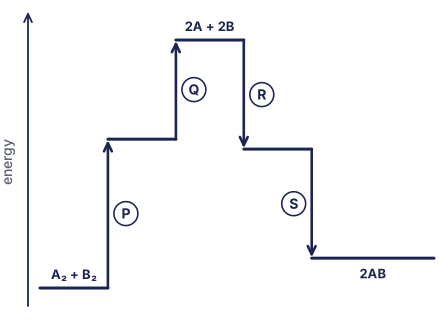
| Step | Size of the step / kJ/mol |
|---|---|
| P | 300 |
| Q | 200 |
| R | 220 |
| S | 220 |
Circle one answer.
- Its ΔH arrow goes from the top of the hump down to the products' level, 2AB
- Its products are drawn below the reactants, because the staircase ends with two steps down
- It starts and ends at the same levels as the staircase; its hump reaches up to 2A + 2B
- It starts and ends at the same levels as the staircase; its hump is far below 2A + 2B
Nudge (only if you are stuck): Add up the steps up and the steps down, and compare.
8. explain
Supplement. A balloon filled with hydrogen does not react with the oxygen in the air until a lit splint touches it. Then all the hydrogen burns in one flash: 2H2 + O2 → 2H2O. Use ideas about bond breaking and bond making to explain (a) why the hydrogen needs the flame of the splint to start reacting; (b) why, once the first molecules react, the rest of the hydrogen burns without the splint.
(a) Why the flame is needed
(b) Why the rest burns without the splint
Nudge (only if you are stuck): Think about the first molecules to react, then about the molecules next to them.