Pupil sheet · Bond energies
Bond energies — final check
Name ______________________ Date ____________
Work alone, with the lesson closed. Answer every question; there are no hints.
1. calculate / determine
Supplement. Ammonia can be burned as a fuel in ships: 4NH3 + 3O2 → 2N2 + 6H2O. Breaking all the bonds in the reactants takes in 6186 kJ/mol. Making all the bonds in the products gives out 7446 kJ/mol. (a) Calculate ΔH. (b) On the reaction pathway diagram, drawn to scale, the top of the hump is 1600 kJ/mol above the products' line. Determine the activation energy, Ea.
(a) ΔH: ______________ unit ________
(b) Ea: ______________ unit ________
2. calculate / deduce / explain
Supplement. On a hot catalyst, methanol vapour breaks down into carbon monoxide and hydrogen: CH3OH → CO + 2H2. Breaking all the bonds in methanol takes in 2057 kJ/mol. Making all the bonds in carbon monoxide and hydrogen gives out 1949 kJ/mol. (a) Calculate ΔH. (b) Deduce whether the reaction is exothermic or endothermic, and explain your answer in terms of bond breaking and bond making.
(a) ΔH: ______________ unit ________
(b) Exothermic or endothermic, explained in terms of bond breaking and bond making.
3. calculate
Supplement. Hydrazine, N2H4, is a rocket fuel: N2H4 + O2 → N2 + 2H2O. Use the displayed formulae and the bond energies in the table to calculate (a) the energy taken in breaking bonds; (b) the energy given out making bonds; (c) ΔH.
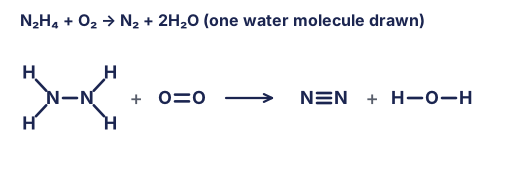
| Bond | Bond energy / kJ/mol |
|---|---|
| N–N | 158 |
| N–H | 391 |
| O=O | 498 |
| N≡N | 945 |
| O–H | 463 |
(a) Energy in: ______________ unit ________
(b) Energy out: ______________ unit ________
(c) ΔH: ______________ unit ________
4. calculate / deduce
Supplement. Ethene reacts with chlorine to make 1,2-dichloroethane, used to make PVC: C2H4 + Cl2 → C2H4Cl2. (a) Use the displayed formulae and the bond energies in the table to calculate ΔH. (b) Deduce whether the reaction is exothermic or endothermic. Use your answer to (a).
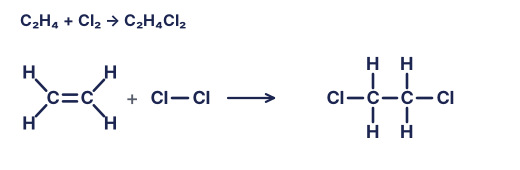
| Bond | Bond energy / kJ/mol |
|---|---|
| C=C | 612 |
| C–H | 412 |
| Cl–Cl | 242 |
| C–C | 348 |
| C–Cl | 338 |
(a) ΔH: ______________ unit ________
(b) Exothermic or endothermic, from your answer to (a).
5. calculate
Supplement. Hydrogen peroxide, H–O–O–H, breaks down into water and oxygen: 2H2O2 → 2H2O + O2. ΔH = −206 kJ/mol. Use the bond energies in the table to calculate the bond energy of the O–O single bond.
| Bond | Bond energy / kJ/mol |
|---|---|
| O–H | 463 |
| O=O | 498 |
O–O bond energy: ______________ unit ________