Pupil sheet · The eye
Focusing and the retina — questions
Name ______________________ Date ____________
Try every question before you use a nudge. Write in full sentences where you are asked to explain.
1. describe
Supplement: you lift your wrist close to your face to read the time on a small watch. Match each part of the eye to what happens to it.
Write the number of the matching option.
- increases
- slacken
- relax
- decreases
- becomes thinner
- contract
- becomes fatter
- are pulled tight
- the ciliary muscles: ______
- the suspensory ligaments: ______
- the lens: ______
- the refraction of light: ______
Nudge (only if you are stuck): Is the watch near or far? Does the light from it need more bending or less to meet on the retina?
2. sequence
Supplement: a goalkeeper watches the ball from the moment it is kicked, far up the pitch, until it is close to her. Put the changes in her eyes in order as the ball comes close.
Write the number of each step in order.
- The lens refracts the light more.
- The rays from the ball meet on the retina.
- The suspensory ligaments slacken.
- The lens springs into a fatter shape.
- The ciliary muscles contract.
- Step 1: ______
- Step 2: ______
- Step 3: ______
- Step 4: ______
- Step 5: ______
Nudge (only if you are stuck): Start with the muscles; end with where the rays meet.
3. identify
Supplement: the graph shows the numbers of rods and cones across a human retina. Which row identifies the fovea, the blind spot and the lettered place with the most rods?
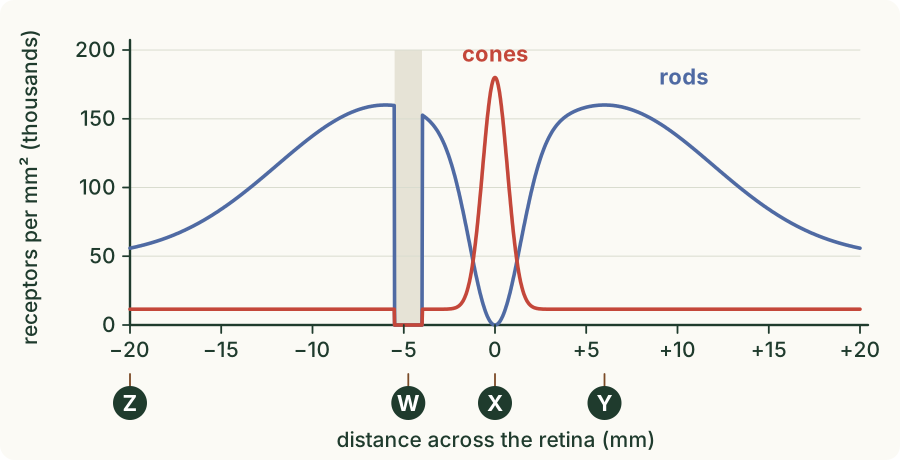
| Row | Fovea | Blind spot | Most rods |
|---|---|---|---|
| A | Y | W | X |
| B | X | W | Y |
| C | X | Z | Y |
| D | W | X | Y |
Circle one answer.
- A
- B
- C
- D
Nudge (only if you are stuck): Read both lines at each letter. Where are there no receptors at all, and where are there cones but no rods?
4. state
Supplement: which receptors give colour vision?
Circle one answer.
- The rods.
- Rods and cones.
- Optic nerve cells.
- The cones.
Nudge (only if you are stuck): Which receptors need bright light, and come in more than one kind?
5. state
Supplement: what is the function of the fovea?
Circle one answer.
- It controls how much light enters the eye.
- It changes the shape of the lens.
- It gives the most detailed vision.
- It is where the optic nerve leaves the eye.
Nudge (only if you are stuck): What kind of vision do you get when you look straight at something?
6. identify
Supplement: which statement about rods is correct?
Circle one answer.
- They are less sensitive to light than cones, and give colour vision.
- They are packed most tightly in the fovea, and give detailed vision.
- They are more sensitive to light than cones, and give night vision.
- They come in three kinds, each absorbing light of a different colour.
Nudge (only if you are stuck): Think of which receptors still work when the light is dim.
7. predict / explain
Supplement: a walker's eye is focused on a map held close in her hands. She looks up at a distant mountain, and for a moment, before her eye changes, the mountain is blurred. (a) Predict where the rays from the mountain meet in that moment: in front of the retina, on it or behind it. (b) Explain how the shape of her lens must change to see the mountain clearly.
(a) Where the rays meet
(b) How the lens must change
Nudge (only if you are stuck): Rays from a distant object are nearly parallel. What does a fat lens do to parallel rays?
8. explain
Supplement: a student writes: "To focus on a distant object, the ciliary muscles contract and pull the suspensory ligaments tight." Explain what is wrong with this statement.
Nudge (only if you are stuck): Do the ciliary muscles contract or relax when the ligaments are pulled tight?
9. identify
Supplement: a small patch of a human retina has more rods than anywhere else, and very few cones. Where on the retina could it be?
Circle one answer.
- Exactly at the blind spot.
- A little way out from the fovea.
- In the middle of the fovea.
- At the very edge of the retina.
Nudge (only if you are stuck): Where are the rods most numerous?
10. explain
Supplement: at dusk, as the light fades, it becomes hard to tell the colour of a flower, although you can still see its shape. Explain why.
Nudge (only if you are stuck): Which receptors still work in dim light, and what can they not do?
11. identify
Supplement: the diagram shows a cross-section of an eye with four places lettered. Identify the places labelled J to M.
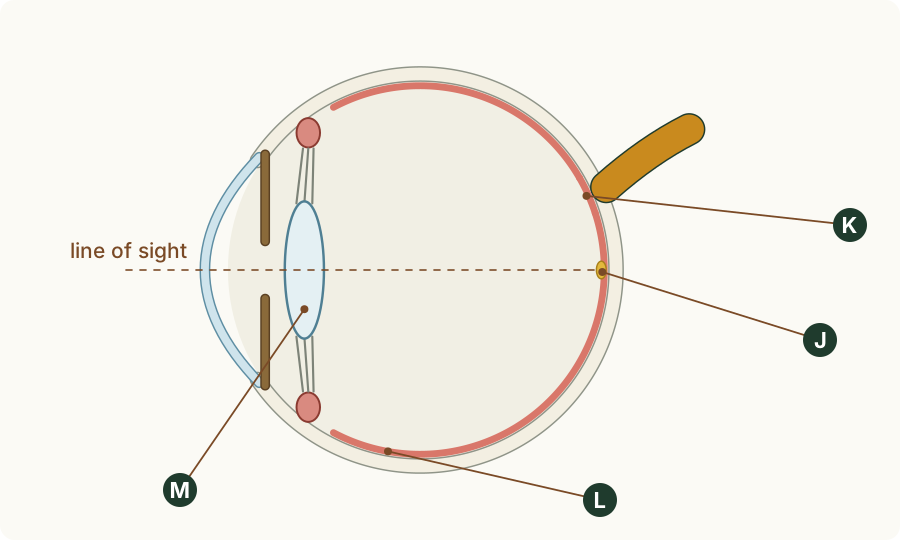
Write the number of the matching option.
- blind spot
- cornea
- fovea
- optic nerve
- lens
- retina
- J: ______
- K: ______
- L: ______
- M: ______
Nudge (only if you are stuck): Follow the line of sight through the eye to the back. Then find where the thick cord leaves.
12. suggest
Supplement: an astronomer finds that a very faint star is easier to see if she looks slightly to one side of it rather than straight at it. Suggest why.
Nudge (only if you are stuck): Where does the star's image fall when she looks to one side, and which receptors are there?
13. compare
Supplement: a camera focuses on near and distant objects by moving its glass lens closer to or further from the sensor; the lens never changes shape. Compare this with how the human eye focuses on near and distant objects.
Nudge (only if you are stuck): What changes in the eye: the lens's position or its shape?
14. suggest
Supplement: owls hunt at night. Their retinas have many more rods than human retinas, and few cones. Suggest (a) one advantage and (b) one disadvantage of this for an owl.
(a) Advantage
(b) Disadvantage
Nudge (only if you are stuck): What does each kind of receptor do best?
15. explain
Supplement: an eagle can spot a mouse from high in the sky. The fovea of an eagle's eye has even more cones packed into it than a human fovea. Explain how this helps the eagle.
Nudge (only if you are stuck): What does the fovea give, and what do more cones there do?