Pupil sheet · The eye
Your eye and its parts — questions
Name ______________________ Date ____________
Try every question before you use a nudge. Write in full sentences where you are asked to explain.
1. identify
Match each sense organ to the stimulus its receptors respond to.
Write the number of the matching option.
- chemicals
- light
- sound
- touch and temperature
- eye: ______
- ear: ______
- skin: ______
- tongue: ______
- nose: ______
Nudge (only if you are stuck): Think of what each organ lets you sense: seeing, hearing, feeling, tasting, smelling.
2. define
Which of these describes a sense organ?
Circle one answer.
- A group of nerve cells that carry the impulses to the brain.
- A group of receptor cells that respond to one kind of stimulus.
- A single receptor cell that responds to one kind of stimulus.
- A group of receptor cells that respond to every kind of stimulus.
Nudge (only if you are stuck): How many cells, and how many kinds of stimulus?
3. identify
Two friends have different eye colours: one has brown eyes and the other blue. Which part of the eye is a different colour in the two friends?
Circle one answer.
- The lens.
- The iris.
- The cornea.
- The pupil.
Nudge (only if you are stuck): Which of these parts are clear, and which one is a hole?
4. state
Match each part of the eye to its function.
Write the number of the matching option.
- controls how much light enters the pupil
- refracts light as it enters the eye
- carries impulses to the brain
- focuses light on to the retina
- contains light receptors, some sensitive to different colours
- cornea: ______
- iris: ______
- lens: ______
- retina: ______
- optic nerve: ______
Nudge (only if you are stuck): Follow the light: in at the front, through, focused, detected, then sent on as impulses.
5. identify
In one of a patient's eyes, light passes normally through the cornea, the pupil and the lens, and forms a sharp image on a healthy retina. Yet no impulses from that eye reach the brain. Which part of that eye is most likely damaged?
Circle one answer.
- The blind spot.
- The optic nerve.
- The iris.
- The pupil.
Nudge (only if you are stuck): The image forms and the retina works. Which job comes after that?
6. identify
Which statement about the pupil is correct?
Circle one answer.
- It is the clear layer that bends light as it enters.
- It is a hole in the iris that lets light into the eye.
- It is a black layer at the back that detects light.
- It is the coloured ring of muscle in front of the lens.
Nudge (only if you are stuck): Picture an eye from the front. What is the black circle in the middle?
7. explain / state
A student writes: "The image of what you see is formed on the lens." Explain what is wrong with this statement, and state what the lens does.
Nudge (only if you are stuck): Think of what the lens does to the rays, and where they go next.
8. identify / explain
A doctor photographs the inside of the back of a patient's eye. The photograph shows a small pale round patch, where nerve fibres from the whole retina meet and leave the eye. (a) Identify this patch. (b) Explain why light that falls on this patch is not seen.
(a) The patch
(b) Why light there is not seen
Nudge (only if you are stuck): Where do the nerve fibres leave the eye, and what is missing there?
9. explain
The ear contains many receptor cells, but you cannot see with your ears. Explain why.
Nudge (only if you are stuck): Think of what makes the receptors in the ear respond.
10. identify
The diagram shows a cross-section of an eye, with the light arriving from the left. Identify the parts numbered 1 to 6.
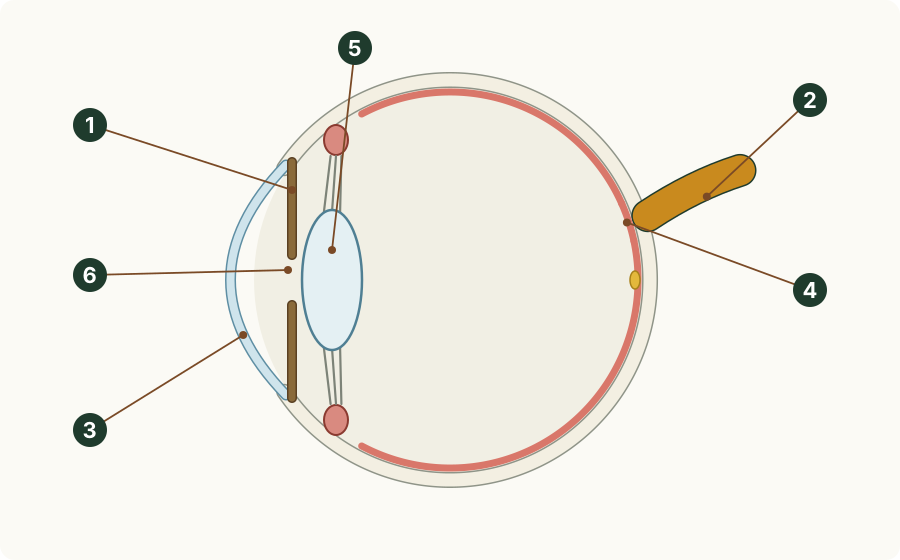
Write the number of the matching option.
- blind spot
- lens
- cornea
- pupil
- iris
- retina
- optic nerve
- 1: ______
- 2: ______
- 3: ______
- 4: ______
- 5: ______
- 6: ______
Nudge (only if you are stuck): Start where the light enters, on the left, and work towards the back of the eye.
11. state / identify
A cat has receptors at the roots of its whiskers. They respond when a whisker is bent by touching something. State the stimulus these receptors respond to, and identify the human sense organ whose receptors respond to the same kind of stimulus.
Nudge (only if you are stuck): What has to happen to a whisker before its receptors respond?
12. identify
A camera has a ring that can change the size of a hole in front of its lens, a light sensor at the back, and a cable that carries signals to a computer. Match each camera part to the part of the eye that does the same job.
Write the number of the matching option.
- cornea
- optic nerve
- iris
- retina
- lens
- pupil
- the ring that changes the size of the hole: ______
- the hole the light goes through: ______
- the light sensor at the back, with cells for red, green or blue light: ______
- the cable to the computer: ______
Nudge (only if you are stuck): Which part of the eye changes the size of a hole, and which part is the hole?
13. identify
A photograph shows a person's eye from the front. Which pair of parts can you see in it?
Circle one answer.
- The iris and the pupil.
- The iris and the lens.
- The retina and the optic nerve.
- The pupil and the retina.
Nudge (only if you are stuck): Which parts are at the front, and which lie at the back of the eye?