Pupil sheet · Homeostasis
Blood glucose — questions
Name ______________________ Date ____________
Try every question before you use a nudge. Write in full sentences where you are asked to explain.
1. state
What does insulin do to the blood glucose concentration?
Circle one answer.
- It decreases it.
- It turns it into protein.
- It has no effect on it.
- It increases it.
Nudge (only if you are stuck): In the experiment, what happened to the glucose trace after the pancreas released insulin?
2. state
Which organ secretes insulin when the blood glucose concentration rises?
Circle one answer.
- The stomach.
- The liver.
- The adrenal glands.
- The pancreas.
Nudge (only if you are stuck): The same gland you met in the module on hormones.
3. interpret
The graph shows a student's blood glucose concentration after a sweet drink. Read (a) the highest concentration and (b) the time at which it was reached.
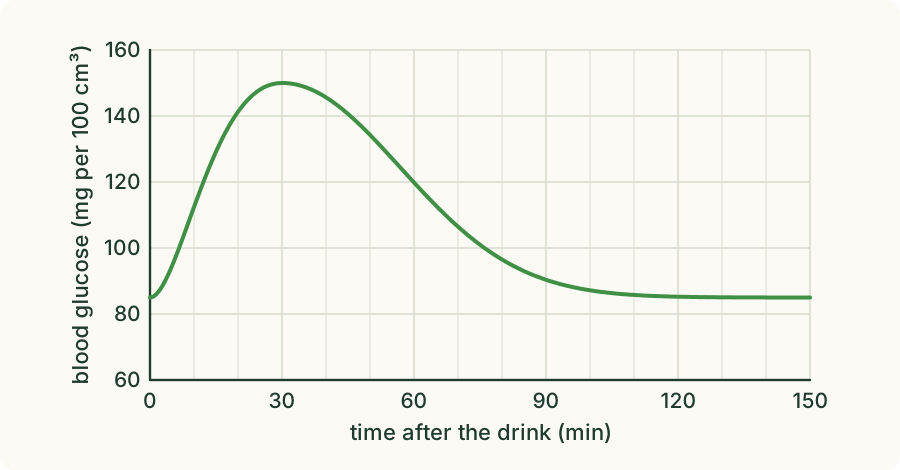
(a) Highest concentration (mg per 100 cm³): ______________ unit ________
(b) Time of the peak: ______________ unit ________
Nudge (only if you are stuck): Find the top of the trace, then go across to the vertical axis and down to the time axis.
4. identify
Supplement: match each hormone with when it is secreted and what it causes the liver to do.
Write the number of the matching option.
- secreted when blood glucose falls; the liver breaks down glycogen and releases glucose
- secreted when blood glucose rises; the liver takes up glucose and stores it as glycogen
- insulin: ______
- glucagon: ______
Nudge (only if you are stuck): One hormone stores glucose away; the other releases it.
5. define
Supplement: what is glycogen?
Circle one answer.
- A storage carbohydrate made of many glucose molecules.
- A hormone secreted by the pancreas.
- A protein that digests glucose.
- Another name for glucagon.
Nudge (only if you are stuck): The liver turns glucose into it after a meal.
6. state
Supplement: in Type 1 diabetes, what is wrong?
Circle one answer.
- The pancreas makes too much insulin.
- The blood cannot carry glucose.
- The liver cannot store glycogen.
- The pancreas makes little or no insulin.
Nudge (only if you are stuck): Which hormone is missing, and which organ makes it?
7. calculate
From the graph, calculate how much the student's blood glucose concentration rose from the start to the peak.
Rise in blood glucose (mg per 100 cm³): ______________ unit ________
Nudge (only if you are stuck): Read the start at 0 minutes and the peak, then subtract.
8. explain
After the peak, the student's blood glucose concentration fell back to 85 mg per 100 cm³ by about 120 minutes. Explain why it fell.
Nudge (only if you are stuck): Which hormone was secreted when the glucose rose, and what does it do?
9. describe
Supplement: describe what the liver does (a) after a meal and (b) during an hour's brisk walk without food, and name the hormone that causes each.
(a) After a meal
(b) During the walk
Nudge (only if you are stuck): One stores glucose; the other releases it.
10. compare
Supplement: a student writes "glucagon is stored in the liver". Explain the mistake, using the words glucagon and glycogen.
Nudge (only if you are stuck): One is a hormone and one is a carbohydrate. Which is stored?
11. outline
Supplement: outline how Type 1 diabetes is treated.
Measure
Inject
Plan
Nudge (only if you are stuck): Three parts: measure, inject, plan.
12. explain
Supplement: explain why a person with Type 1 diabetes needs to inject insulin, and why the blood glucose concentration would otherwise stay high after a meal.
Nudge (only if you are stuck): Which organ cannot make enough insulin, and what does insulin do?
13. explain
Supplement: two hours after a large lunch, a student's liver contains more glycogen than before the lunch. Explain why.
Nudge (only if you are stuck): What happened to the blood glucose after the lunch, and which hormone did the pancreas secrete?
14. explain
Supplement: a cyclist rides for two hours without eating, but the blood glucose concentration stays above 70 mg per 100 cm³ for most of the ride. Explain how.
Nudge (only if you are stuck): Where is glucose stored, and which hormone releases it?
15. explain
Supplement: a person with Type 1 diabetes plans a football match for the afternoon. Explain why exercise has to be planned around the insulin.
Nudge (only if you are stuck): What does exercise do to the blood glucose concentration, and what does insulin do?